At my TGN proposal here https://tangerinefocus.com I’ve said for years, that drawing is a form of engagement with models, and the form is due for an upgrade to match the upgrade over the last 30 years in modeling from mental modeling to digital modeling.
I realize that many people have no any idea what I’m talking about.
I mean, hundreds of people know very well and want this upgrade in their modeling software. But those hundreds make no difference.
Far more people don’t recognize that drawing is a form of (visual) engagement with models, a necessary technique used for understanding models. It’s the activation of visual attentive focus.
When I say that, many people hear random word salad that I like to repeat over and over again for no reason. That could be because everyone knows very well already what drawings are, they’re “dumb lines and arcs”. While models are “smart stuff, hot stuff”.
They are. But see, it makes the conversation broken at the start. And saying anything else just doesn’t mean anything. Preconceived notions are hard to break through.
Another example of preconceived thought, a common metaphor:
People like to drop drawing into the buggy whips category
It’s the category of obsolete tech stubbornly clung onto long after obsolescence, perfectly illustrated by buggy whips and buggy whip canisters still attached coach-side by automobile manufacturers, long after motor-driven automobiles replaced horse-drawn buggies.
But with analogy based on functional equivalency, notice that whips prodded horses into motion, and the gas pedal in the car became the functional equivalent of the whip.
So let’s get to analogical breakdown
People make this analogy between drawing and buggy whips, as if digital models are analogous to automobiles, with drawings in the role of obsolete horse-drawn carriages prodded by whips. Like this:
Digital models are to drawings …as… automobiles are to horse-drawn carriages.
It’s a bit of a confused analogy on its own terms. But the problem is real category error, not loose logic shifting. So let’s do it better:
Digital models are analogous, actually, to mental models (not to drawings, and, yes, an upgrade in power)
While drawings are analogous to, yes, buggy whips that make the mental model move (bring it to life… drawings stimulate, spur in the mind, the growth of adequate understanding of the mental model). Drawings are activated visual attentive focus.
With the model upgraded now (for the last 30 years) from mental model to digital model, we have people calling out for everyone to ditch the obsolete buggy whip, drawing, WITHOUT replacing it with the gas pedal.
So now we have a very powerful new engine (the digital model, overpowering the mental model), but no gas pedal to give it gas, if we abandon drawing.
Others say, OK, no, we need drawing too. So keep it.
That’s better but what’s left unsaid is that what’s to be kept is drawing in its conventional form that had developed in the centuries pre-dating digital modeling.
So, turning the tables on the buggy whip analogy, THAT is equivalent to keeping the buggy whip canister attached coach side on a motor-driven automobile.
Not so smart.
TGN is the proposed gas pedal to digital modeling.
TGN is the functional upgrade of conventional drawing, the gas pedal prod that puts the digital model in motion, that brings it to life, …that spurs in the mind, the growth of adequate understanding of the digital model, through activated visual attentive focus.
TGN actually whips, or gas pedals both models, mental and digital.
OK, So, analogies can be productive or counterproductive, useful or off target
Off target analogies can derail industries for decades.
THIS ONE’S WRONG:
— Digital modeling is to drawing
as
— automobile is to horse drawn carriage
ON TARGET:
— Digital modeling is to mental modeling
as
— TGN is to conventional drawing
ALSO ON TARGET
— Conventional drawing is to buggy whip on horse carriage
as
— TGN is to gas pedal in car
The 8 features of TGN
are described in outline format here, near the top of the one pager (embedded below the screenshot):
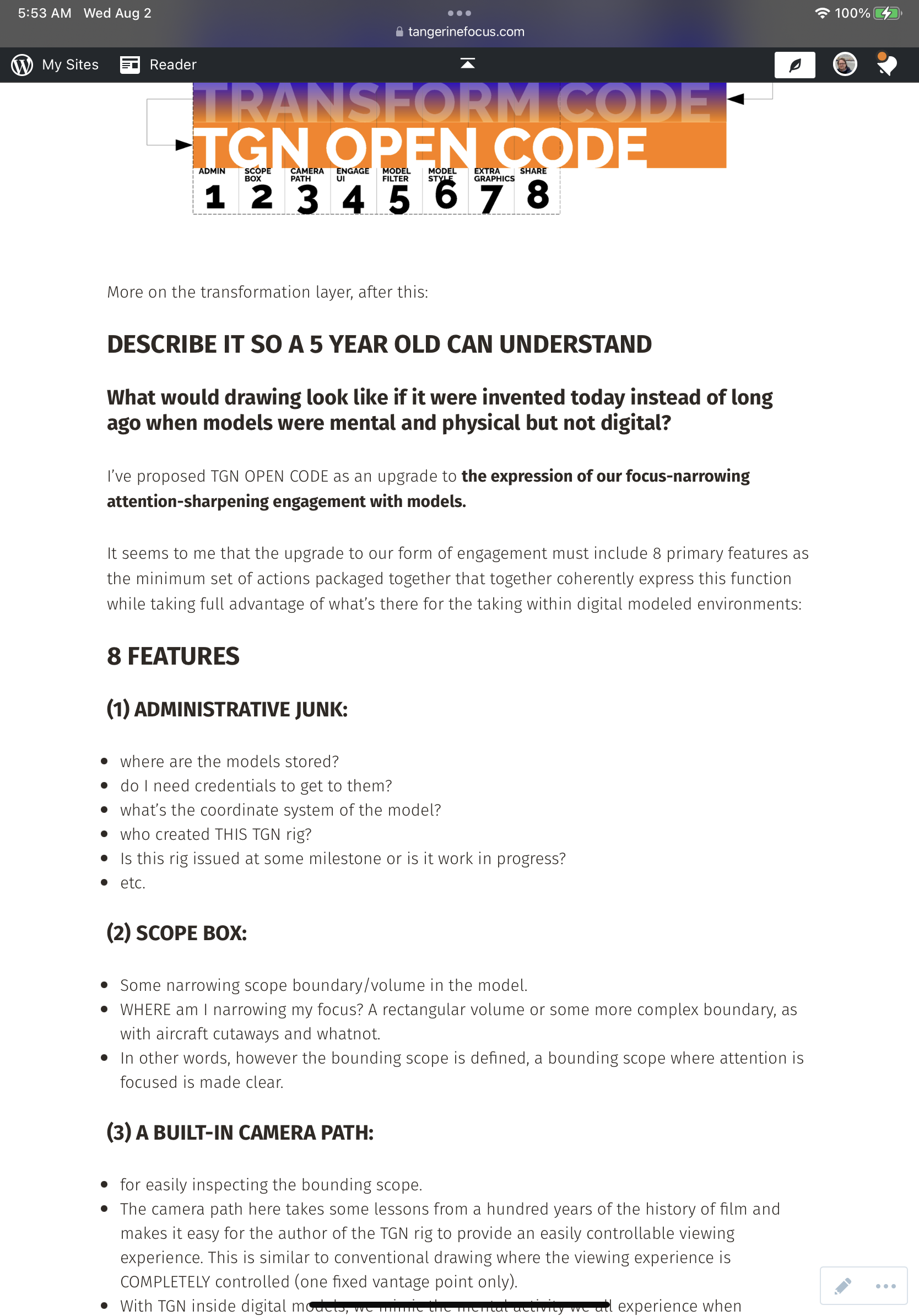
There’s a mockup demo video embedded on the same page.


 OPEN VCS, a lens for looking at models