I’m on the side of the people who have to use these tools.
We have to hear a lot about tools. There’s something to say about hearing about tools, in return. I mean, we have to listen, to all kinds of people telling us about tools …all the time.
The first thing to say is that there’s a difference between hearing about tools and using tools.
A lot of us, when we’re young, haven’t learned yet that there’s a difference. Or maybe we get that but not how great the difference is. I’m speaking for myself here. I hadn’t learned that. I bought into everything I was told about tools. I walked around saying the same things I was told. Telling others. I became a walking unpaid marketing kiosk for tools, parroting professional advertising copy in my own words.
I was a true believer.
This led to useful outcomes for awhile. I learned a lot, mostly about the tools, from extreme over-use of the tools for which I’d become an advocate. It paved the way for over 20 years of employment using the tools. I certainly can’t complain about that.
My life became, about hearing about the tools, talking about the tools, and using the tools. A sideline was to actually learn what I was educated for, trained for. Architecture. I learned about that too, but the space occupied by the tools was, well, really disproportionate.
Looking back I’d choose to do some things differently.
Clearly I’m not alone in such thoughts. Again, I’m on the side of the people who have to use these tools, to do something, of value beyond the tool.
I’m on the side of people who need to make things clear. People who are working very hard to do that.
I can say it with more intensity
What I advocate is spurred from my own experience building digital models of extreme detail, modeling every molecule and atom (metaphorical exaggeration) of a project, for years. I was a huge evangelist of that, really devoted. But doing it for years left me wanting to bash my head against a wall to make it feel good when I stop.
I knew there was something fundamentally stupid going on that has to be fixed. Something very wrong both with the tools and what we’re told about the tools.
That idiotic pressure to model everything, yagchhh, drove me insane. And I pressured myself to do that. I was the guy in the office telling everybody, you gotta model everything, because… reasons. Efficiency! Blah blah. After many years of extreme modeling, I finally figured out I’d been wrong about total modeling.
Fundamentally wrong.
Fundamental means: wrong all the way down, not wrong just on the surface. I wasn’t wrong just for reasons of technique, or immaturity of the tools, or lack of skill.
I wasn’t wrong either, for other reasons that became popular in the tools discourse: “flaws in contract law”, “the legal system”, “flaws in human psychology”, “flaws in business culture”, “flaws in user education, training”.
Reminiscing…
I did about 10 years of high intensity modeling at design firms starting in 1998. Here are a few of the projects I worked on: https://tangerinefocus.com/projects/
I’ll say the fundamental problem.
The problem is that people need their slice of cherry pie, while the tools have been driven down a different path. They could have given us (and still can) the slice of pie we need, but instead, everything is pushed towards giving everyone all possible cherry pies. Instead of a slice of pie, we’re all to devote ourselves to modeling every cherry, on every cherry tree in the world, because, …reasons. Because when you model every cherry in the world, then everyone can have as many cherry pies as they could ever want, forever. So, isn’t that great?
Here’s a cherry pie I made from cherries I picked (with permission) from the neighbor’s giant cherry tree:


Finally I admitted to myself there’s some sense in having a piece of pie
And not so much in the idea of all possible pies. There’s something about limits. About how much we can take in. How we actually make sense of things. Something about perception. About how the mind works.
And ultimately, something about form.
We can’t just have all the cherries in the world piled up in a rotting glob the size of the ocean.
But we’re pushed in that direction.
By what we hear about the tools.
There have been a lot of changes. A lot of new entries. A lot of real improvements, profound improvements. But that drumbeat is still there, all the way down, fundamentally, we’re still hearing that beat:
“model everything, end of story.”
The problem is it’s not the end of the story. It’s not even a story. A story with no beginning, middle, or end? No human engagement. It’s just nothing. This is the problem.
The drumbeat powers a discourse that’s been broken from the beginning. Broken because it’s premised on an analogy that happens to be distorted and, wrong. Yes a single analogy powered decades of discourse, practice, and development.
It’s been a mistake.
The bad analogy caused a blind omission of a huge chunk of actual reality with regard to how perception works, how people visually engage with spatial environments, worlds real and digital. It’s not by eating the whole pie, or, all possible pies in the world.
This can be fixed, by development that would eliminate huge problems that exist because of the omission of due consideration in a critical area that’s called, I don’t know, I call it VISUAL ENGAGEMENT, the form of visual engagement in worlds real and digital.
Here’s the analogy. And the problem with it:
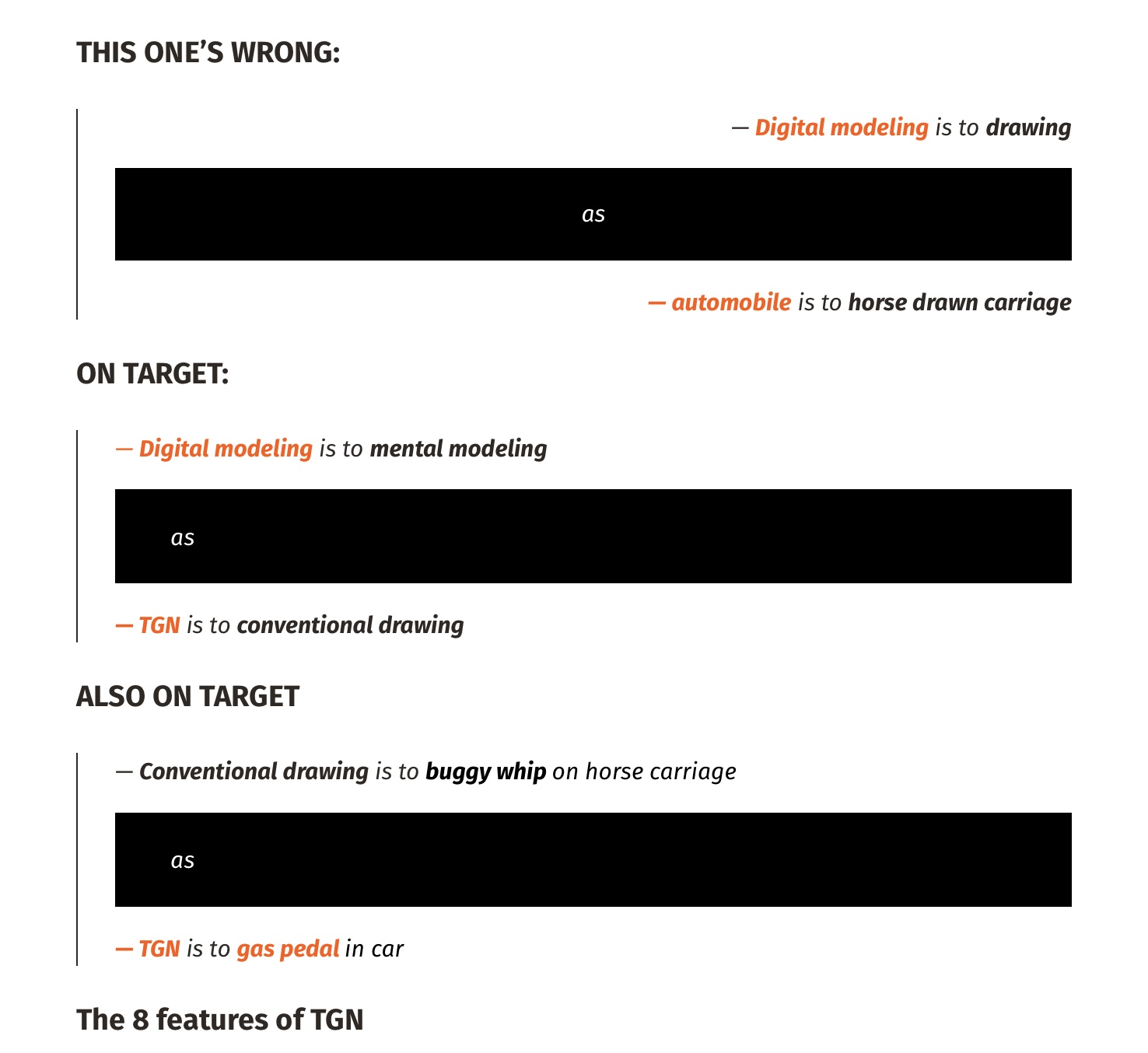
Three analogies. Look at the first one. It’s certainly seductive. It seems right. Above and below the first black bar, both pairs are about an increase in power. So, the first analogy seems to match two pairs, each of the same kind and compare them in terms of:
[increase in power]
The problem though is the first line.
Replace digital modeling with “yellow” and drawing with “7”
Then the analogy is nonsense. You could say, “1000” is to “7” as automobile is to horse-drawn carriage. That would work. That’s an increase in power both above and below the black line, with things of the same type/kind on each line.
“yellow” is to “7” as automobile is to horse-drawn carriage is meaningless because the categories are misaligned. Yellow and 7 aren’t the same type/kind.
A category error
Models and Drawings are not the same kinds of things. They don’t have the same purpose, and not even close (I define the categories below). So comparing them in terms of their relative power makes as much sense (none) as comparing yellow and 7 in terms of power.
It doesn’t. It’s nonsense.
And yet this non-sensical analogy is back there beating the drum behind 3+ decades of software development in the AEC segment of the software industry. You can hear that drum. I challenge anyone to say they can’t hear it.
Check the second analogy. That one works. On each line, things are in the same category. The second analogy makes its comparison on, again, [increase in power]. What’s TGN? I’ll get to that in a second.
The third analogy also works. The categories are aligned on each line, so a comparison above and below the black line works. The third analogy is about comparison in terms of:
[spur, prod] to action.
We need this spur. We’ve been pretty effectively deprived of this for decades because our thinking and our software products, are shaped by a seductive but wrong analogy.
Why don’t people see the problem?
Many don’t recognize the category when I say (as I’ve said like a broken record for years) that
drawing is a form of (visual) engagement with models, a necessary technique used for understanding models. It’s the activation of visual attentive focus
Many people hear random word salad when I say that. I guess they pity me. They let me go on and on repeating it over and over again because I’m brain damaged. Probably they cringe, and maybe hope its not contagious.
But why?
Well, everyone knows already what drawings are:
they’re “dumb lines and arcs”
(feel the drumbeat)
While models are “smart stuff, hot stuff”.
They are. But see, it makes the conversation broken from the start. Anything said after that is like trying to nail jello to a wall. It just falls off.
Preconceived notions are hard to break through.
The metaphor is deeply locked in.
Drawing gets dropped into the buggy whips category
It’s the category of obsolete tech stubbornly clung onto long after obsolescence, perfectly illustrated by buggy whips and buggy whip canisters still attached coach-side by automobile manufacturers, long after motor-driven automobiles replaced horse-drawn buggies.
But with analogy based on functional equivalence, notice that whips prodded horses into motion, and the gas pedal in the car became the functional equivalent of the whip.
So let’s get to analogical breakdown
People make this analogy between drawing and buggy whips, as if digital models are analogous to automobiles, with drawings in the role of obsolete horse-drawn carriages prodded by whips. Like this:
Digital models are to drawings …as… automobiles are to horse-drawn carriages.
As discussed, the problem is category error. So let’s do it better:
Digital models are analogous, actually, to mental models (not to drawings, and, yes, an upgrade in power)
While drawings are analogous to, yes, buggy whips that make the mental model move (bring it to life…):
drawings stimulate, spur in the mind, the growth of adequate understanding of the mental model. Drawings are activated visual attentive focus.
With the model upgraded now (for the last 30 years) from mental model to digital model, we have people calling out for everyone to ditch the obsolete buggy whip, drawing, WITHOUT replacing it with the gas pedal.
So now we have a very powerful new engine (the digital model, overpowering the mental model), but no gas pedal to give it gas, if we abandon drawing.
Others say, OK, no, we need drawing too. So keep it.
That’s better but what’s left unsaid is that what’s to be kept is drawing in its conventional form that had developed in the centuries pre-dating digital modeling.
So, turning the tables on the buggy whip analogy, THAT is equivalent to keeping the buggy whip canister attached coach side on a motor-driven automobile.
Not so smart.
TGN is the proposed gas pedal to digital modeling.
TGN is the functional upgrade of conventional drawing, the gas pedal prod that puts the digital model in motion, that brings it to life, …that spurs in the mind, the growth of adequate understanding of the digital model, through activated visual attentive focus.
TGN actually whips, or gas pedals both models, mental and digital.
It puts the mind in motion. Gets us engaged with spatial environments real and digital. It gives us our slice of cherry pie, the metaphorical slice we can digest. It’s of a size we can engage with.
I’m mixing metaphors, yeah. But the point is about giving us something to engage with. Drawing is the hook. It’s what we use to engage and make sense of things, to make things clear. To make our ideas clear. It’s both for our own interpretation of environments that otherwise are too complex to grasp, adequately. It cuts to the chase. And we can share it with others. In a way they can receive.
Have a slice of cherry pie!
It has a particular FORM. It’s not a phantasm. It’s tangible. Have some respect (yeah?) for the FORM of technical drawing.
I came around a long time ago. I love digital modeling. I love the advances software makes for the last 30 years, in modeling. Many kinds of modeling.
But modeling is not enough.
Once a completely devout modeling evangelist, I am now the most pro-drawing dude anyone’s ever seen
I advocate
- not abandoning it.
- And not leaving it adrift stuck in its current form.
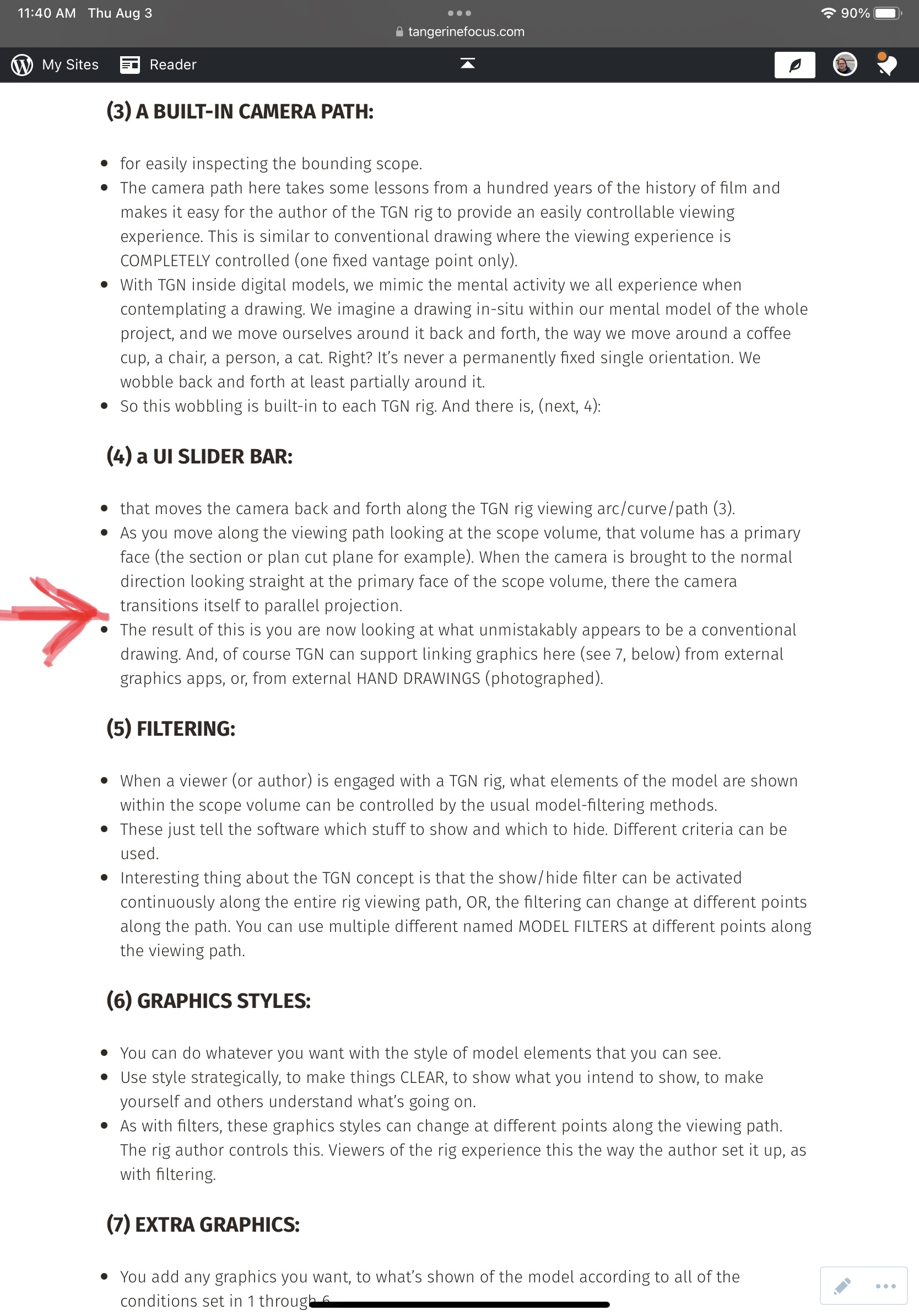
- To evolve its form and do it in a way that honors its centuries old form, leaves the old form intact and accessible, while also upgrading it to a new form at the same time, non-destructively, and letting people access the new form when and if they want it.
- And the reverse, users can engage and express the new form and from that access the old form when and if they wish.
How?
How to do that is very simple, very straightforward. I mean it is simple technically. As a software development project, it is very simple.
As a human project, getting people to listen, be interested, read about it, think about it, that’s not simple at all.
Maybe this post helped. I don’t know. It’s really hard to get people to think about the form of things they’re already very familiar with.
It’s very hard.
Take a look, would you?
I explain it in simple terms at my 2 page website here
Read about Rob Snyder’s proposal for evolution in the form of visual engagement with modeled worlds in AEC: The Form of Engagement
My experience with modeling pushed me into the search for the ways we get engaged visually with models, techniques of engagement that get us elevated beyond superficial haphazard understanding of the model, which are very complex information environments, like the real world. We all need to get more understanding, insight and utility out of our modeling.
The search led to an appreciation for the nature and purpose of technical drawing, an admiration of its form, and some reflection on how it operates. It operates by spurring us to visualize these tangible drawing externalizations in-situ within our mental models, which themselves are put into formation through this tangible medium, drawing.
This led me to previous and current proposals for means of visual engagement with models being developed in software for expression IN THE DIGITAL MODELS so that software can support the mental process already underway, better.
The first proposal did get taken up fairly well, it exists in 9 or more softwares. See here. The second one, TGN, blows the doors off the first
Relief from Total Modeling
With TGN rigs in models from day 1 of a project, people can make clear what they want to make clear, and have to make clear. The TGN rigs directly assist that effort. It’s their entire purpose. By making things that matter clear, at those rigs, in the models (and they can be externalized from the model too), people are relieved from the burden of TOTAL modeling, and ideologies of total modeling.
But TGN doesn’t prohibit it either. People can do as much modeling as they want. And as much “making themselves (and things) clear” at TGN rigs as they wish. No one, I imagine, will force anyone into more, or less, of either modeling, or TGN rigging in the models, than they want, or need.
Everyone is free, to make themselves clear as they wish.
New forms of engagement, and old
As mentioned above in the “pro-drawing dude” list, about keeping both forms, old (technical drawing), and new (TGN), intact and expressible on demand, one from the other, see the red arrows, from The Form of Engagement page:

For those who read this far, my appreciation. For those who want more commentary on the nature of visual perception, there’s more here:


 OPEN VCS, a lens for looking at models