Take a look at my updated proposal for the future of technical drawing. The proposal website is here: https://tangerinefocus.com
It’s an all new website that’s concise. There are 2 pages, one about the proposal and one about me. There’s also a blog with commentary.

The idea of the development proposal is:
Equipment for visual close study (VCS), in models of all kinds.
It’s a continuation, conceptually, of my earlier work on the automatic FUSION (v1.0) of drawings in-situ within models (which now exists in at least 9 softwares after my team developed and commercialized it first in 2012).
The new proposal is not yet developed by anyone. But it is intended to be OPEN, standardizable to support portability across different modeling apps, and to honor and respect the rich legacy of centuries of technical drawing.
The proposed development UPGRADES technical drawings into a much richer FORM of articulate visual engagement there, in the model, than was the case with the v1.0 fusions. The upgrade empowers everyone to more readily make full use of the purpose of VISUAL CLOSE STUDY: purposeful engagement with complex information environments, the means at hand for making what need be clear, clear to self and others, and through that, improving interpretation and taking onboard adequate understanding supporting meaningful action in all AEC phases: design, construction, operations.
The proposed automated fusion and upgrade in FORM, of articulated visual close study (otherwise/formerly known as ‘technical drawing’) is non-destructive; it’s completely reversible, automatically — the logic is straightforward.
Two forms of expression, new and old, of equipment for VISUAL CLOSE STUDY: technical drawing and its proposed upgrade, TGN.
What’s proposed, really — see the description here of the 8 features of the VCS/TGN proposal: https://tangerinefocus.com/visual-engagement-with-modeled-worlds/ — is evolution spurred by drawing’s existence now in-situ within digital models, inspired, by the way, by the same instantiation, by mental exercise only, of conventional drawing within mental models. It’s what we all do anyway, but now richly assisted by digital media and the software producing it.
I’m available to help any dev team that wants my assistance designing their implementation of equipment for visual close study (VCS) in models of all kinds. My opinion is that implementations will be better if you bring me in to participate. But, yeah, just my opinion.
My earlier work, now leapfrogged by the VCS/TGN proposal, is here: https://tangerinefocus.com/tgn/earlier-media-innovations/
It exists in 9 softwares now since I did it first in 2012.
So, I’ve done this before and I believe I can do it again.
Because better equipment for visual close study within models is so very much needed, by everyone, and so under-addressed by software development to date.
I’ll keep trying until this happens.
WHAT ABOUT AI?
You say,
What about AI, and AI-generated models?
They’re still models, aren’t they?
We still have to perceive, see, engage, think about, develop, interpret, understand, evaluate, improve, use, and exist in the models.
‘TGN’ equipment within digital models — the expression of what ‘technical drawing’ would look like if it were invented today instead of long ago when models were mental and physical but not digital — are an optimal host for ‘control rods’.
CONTROL RODS
“Control Rods” for human-in-the-loop input, back into AI and other ‘generative’ model creation systems, for human guidance, for the laying down of control parameters, control markers, control drivers, within models, for feedback back into model-generating systems — you understand the idea? — these controls are optimally hosted within TGN rigs, within models.
You can see why, right? It’s not hard to imagine the development of a variety of controls, putting the ‘human in the loop’ ‘in ways made easily visible, accessible, close at hand and intelligible, within TGN visual close study (VCS) equipment in AI-generated models, and models generated by any other means (computational algorithmic and stick-built by humans tediously).
Let your imagination loose. What control rods would you embed, to guide (AI or NI) generative development of complex models?
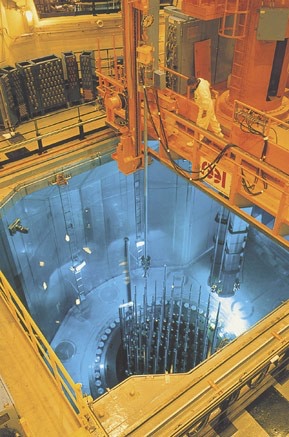
Control rods, as with nuclear power, …the power generation can run out of control in the plant, with negative consequences, hence the control rods:
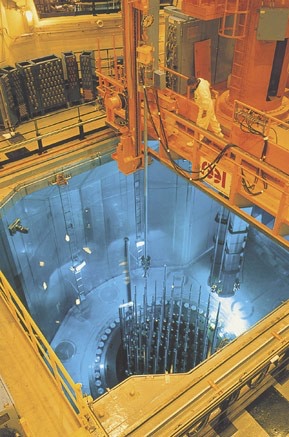
AI-generated architectural and engineering models likewise have to be kept under control.
- Yes, there are directed graph controls possible, connectable.
- And there is prompt engineering.
But more work is needed here, and control through equipment for visual close study (VCS) can only be useful.
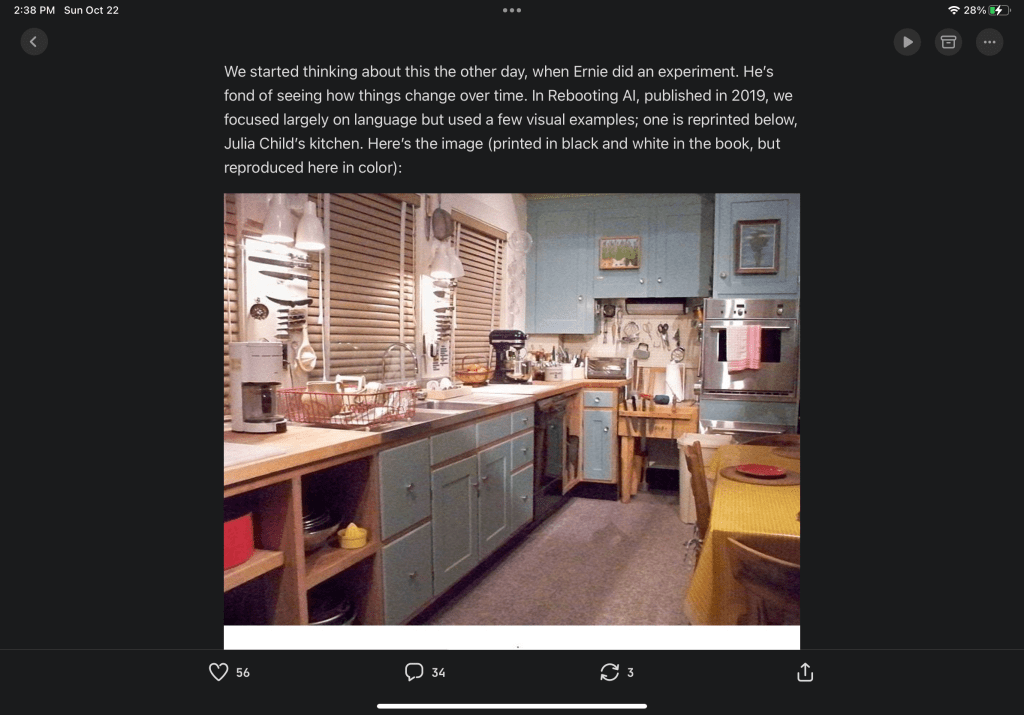
Here’s Julia Child’s kitchen, by the way. The article by Gary Marcus and Ernest Davis is only about failed Q and A with an LLM against an image, but you can extrapolate the general conditions of these things, to their use in generating AEC models of physical infrastructure. They tend to run out of control; we need reliable mechanisms for keeping them under control; not too controlled; they can run wild, serendipitous accidents are welcome, but reigned in as required:
I’ll help you build VCS equipment in YOUR modeling apps.
My “knock on doors, at software companies, with a development proposal” strategy worked before: https://tangerinefocus.com/tgn/earlier-media-innovations/. I think it can work again. I’m knocking right now; do you hear me knockin?
I can help you build VCS equipment in YOUR modeler, call me.
I’ve been knocking a long time though. Remember this?:
Likewise, does anyone but me want the future of technical drawing developed as an open standard form of engagement with digital models? Some thoughts on that here:
What about starting a new company?
The market is huge. AutoCAD for example, a technical drawing software, remains ±60% of Autodesk corporate revenue in AEC, still today after 30+ years of modeling apps.

There is enormous terrain out there ahead for the future of technical drawing. Plenty of room for many companies, existing and new starts.
I can build this. No doubt about it. Just need a funder.
Here’s another song. Put some energy into it (whatever it is). That’s my advice:

 OPEN VCS, a lens for looking at models