I extended the recent mockup of ‘TGN’ equipment for looking to include critical information for getting the tiles up in the right place on the wall behind my stove:
Shown is a simulation of ‘TGN’ equipment for looking, for visual close study (VCS) of models via (proposed) open source ‘TGN Code’ features built into any digital modeling app.
Proposed user interface, and automated TGN rig placement, and rig setup presets in menus for selection — via ‘AI’, otherwise known as ‘SALAMI’ (Systematic Approaches to Learning Algorithms and Machine Inferences1), OR by manual selection and modification by human user — are not yet shown because of limited mockup skills (mine) and limited budget to ask others to mock it up for me.
But here is a little story that includes the critical matter with regard to these tiles.
Due to new regulation, getting the annual certificate from the local authority to operate the wood stove at home required installing a new 5cm thick calcium silica fire board protecting the wall from the stove heat. We decided to install the fireboard and cover it with mosaic tiles. Then came the decision, which tiles?
We chose these, rendered in a model I made of the situation:


The stove is not shown but the chimney is the grey rectangular volume. If you want the tiles laid out with consideration for aesthetics, then you’ll have to decide what to do about the tile grid (they’re square, so they make a grid). You need to choose where the grid starts and ends, if it’s regular or broken, if it’s consistent through wall and floor. And this determines how many tiles are cut (with a wet saw) and where they’re cut and not cut. And, what the whole thing looks like.
These tiles are 45cm square tiles 1cm thick, surface-scored down the middle both directions so they look like 22.5cm squares. But really, they’re 45cm 4-squares.
After thinking about different grid options and rendering two, it turned out to look as bad as I predicted if starting the grid from the right corner of the room and moving left. Rejecting that, it works much better with the grid aligned on the left side of the chimney and keeping it regular to the left and right from there, and down the whole wall and through the floor.
That gives whole squares starting from the top left of the wall, across and down consistently, through the white tiles on the floor. Looking at that, we know where the tiles are cut and not. If you zoom in on the renderings you can see the tiles are cut ONLY at the far right edge of both the wall and floor, plus one horizontal cut across the bottom of the wall.
Here’s the critical thing about this. If you want the tiles to actually adhere to this concept (cut only at the bottom and the right), then you’d really better cut the bottom tile at the correct dimension. It matters because you have to place the tiles at the bottom of the wall first, then lay the 4-squares up the wall. It goes from the bottom, up, because of gravity, and sliding, and the ability to support from below as you go, with nibs inserted in the joints. The goal is, with sensible (practical) joint spacing between the tiles, you go all the way up, and reach placement of the last whole 4-square tile at the top, uncut and actually fitting.
With those constraints, you’d better think and think again.
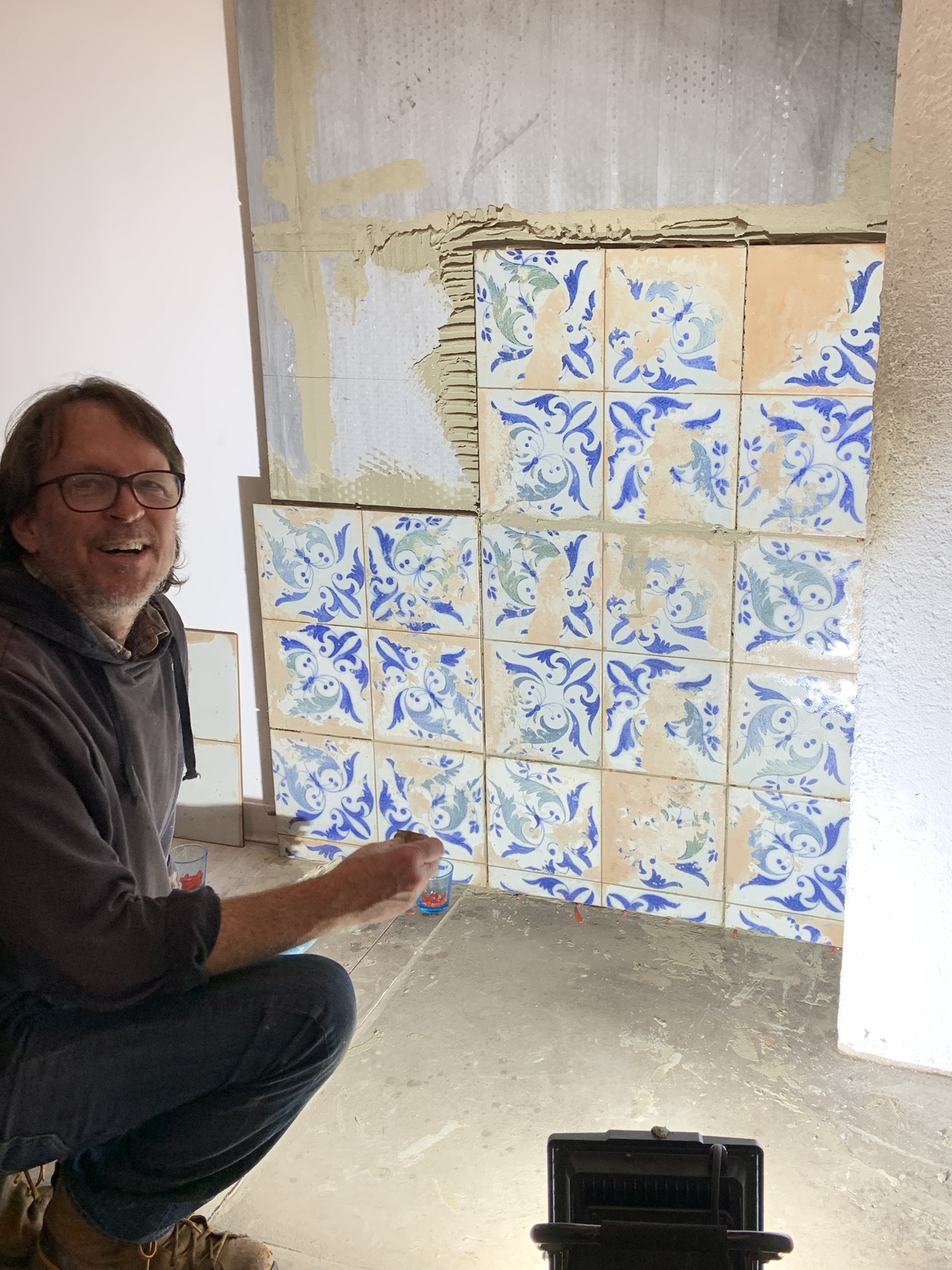
OK, so with the tiles in hand, and the tile mud in the bucket ready for troweling, the grid layout drawing I’d made with 2mm joints between the squares seemed silly, impractical, so I redrew it quickly (mud in the bucket drying) with 3mm joints and extra space at the top for play. That layout gave a 27.5cm cut line in the 4-squares at the bottom of the wall. I cut those, and up we go hoping for the best. See the infinite optimism:
With a lot of luck, it worked:
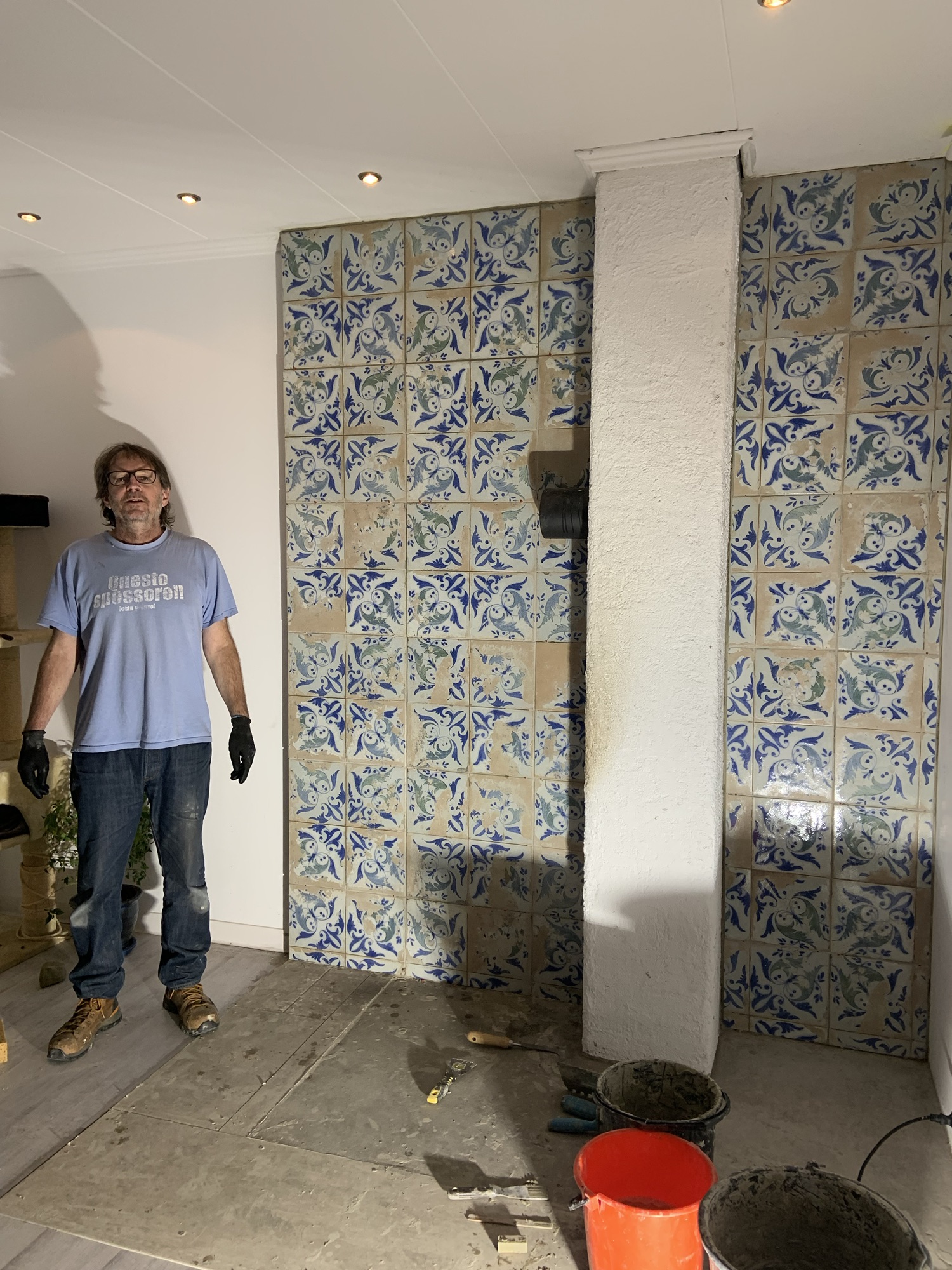
The thing is, having a model, even a good quality model, isn’t enough. Drawing’s narrowed attentive focus, visual close study, are critical.
Here’s the grid drawing:
Download that little PDF (17 kb) and you see the 3mm joints and the critical cut dimension at the bottom left of the drawing, 0.275m. That one dimension, nearly alone, is the key to getting this whole thing to work. Cut that tile to any other dimension instead and the whole concept falls apart. So you’d better cut it right, and you’d better be right, in thinking what that dimension ought to be.
So, yeah, some pressure was felt. I mean, it’s enough work to exhaust a person (I was), and the tiles aren’t cheap, and wasting a whole wall of them is out of the question. If I got it wrong I’d have to think about taking them off, and the silica board, which was the purpose of the project, would be damaged too, no doubt, and that cost more than the tiles.
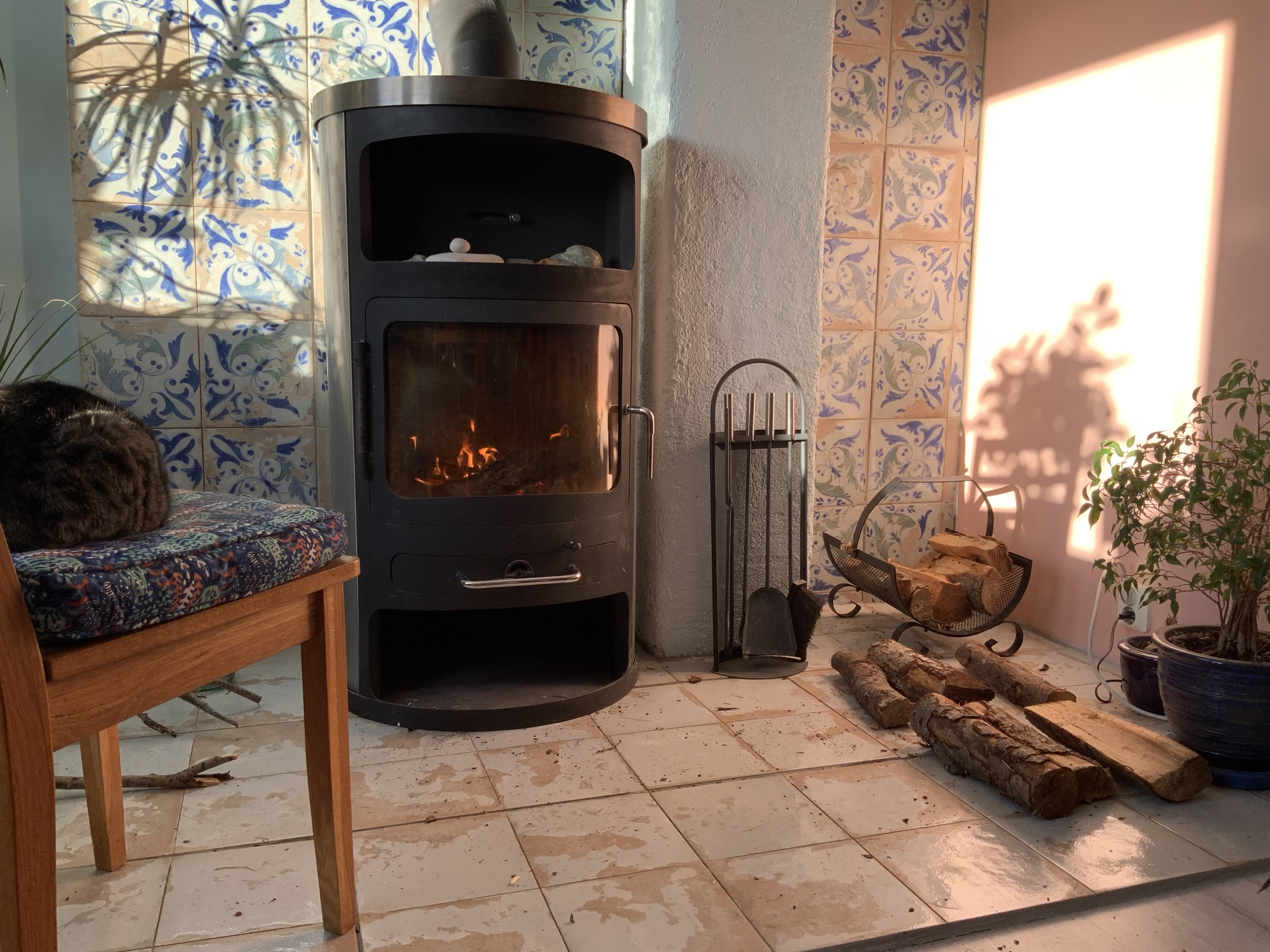
So I put some thought into it, by drawing. Attention is drawn, by drawing. And it’s an instrument of/for thinking. But still, I got lucky. Many things had to go right and few wrong for my calculation to actually work. I’m grateful to some kind of force, in the universe. And the fire feels good in the cold winter now:
All of that is a long way of saying,
I updated the TGN demo:
to include the tile layout grid drawing IN THE MODEL, integrating it in a way that, well… why should expressions of visual close study (VCS) of models mental and digital, be ONLY externalized from the digital model? That’s counterproductive. We do internalize the VCS, in-situ in our mental model of the situation anyway, to make it (the VCS) mean something. And that internalization of visual close study is a mental exercise only, unassisted by digital media.
The non-assist from the digital model leaves the digital model underutilized, under-useful, sub-coherent, sub-participatory in making intelligible what must be understood when doing complex tasks in complex environments.
Why leave digital models in such a sub-performant dingy state? Particularly after 3+ decades of marketing hype touting their revolutionary utility?
I think it’s self-defeating and counterproductive to leave digital media so ill-equipped for making things clear.
Which is why I propose doing something about it. See the software development proposal here:
To better see the potential of the TGN proposal on the page above:
- read the outline description of the proposed 8 FEATURES of TGN OPEN CODE, near the top of that page, and
- look at both the demo videos, on that page
Then, I think you can see how the mockups partially show some of the ways the 8 features of TGN can be expressed, among many other possible ways of making use of the same features. It’s easy to imagine TGN expressions. Try it yourself!
By the way, an excerpt from Peirce on making things clear:
Charles Sanders Peirce https://en.wikipedia.org/wiki/Charles_Sanders_Peirce
How to Make Our Ideas Clear (1878)
The principles set forth in the first part of this essay lead, at once, to a method of reaching a clearness of thought of higher grade than the “distinctness” of the logicians. It was there noticed that the action of thought is excited by the irritation of doubt, and ceases when belief is attained; so that the production of belief is the sole function of thought. All these words, however, are too strong for my purpose. It is as if I had described the phenomena as they appear under a mental microscope. Doubt and Belief, as the words are commonly employed, relate to religious or other grave discussions. But here I use them to designate the starting of any question, no matter how small or how great, and the resolution of it. If, for instance, in a horse-car, I pull out my purse and find a five-cent nickel and five coppers, I decide, while my hand is going to the purse, in which way I will pay my fare. To call such a question Doubt, and my decision Belief, is certainly to use words very disproportionate to the occasion. To speak of such a doubt as causing an irritation which needs to be appeased, suggests a temper which is uncomfortable to the verge of insanity. Yet, looking at the matter minutely, it must be admitted that, if there is the least hesitation as to whether I shall pay the five coppers or the nickel (as there will be sure to be, unless I act from some previously contracted habit in the matter), though irritation is too strong a word, yet I am excited to such small mental activity as may be necessary to deciding how I shall act. Most frequently doubts arise from some indecision, however momentary, in our action. Sometimes it is not so. I have, for example, to wait in a railway-station, and to pass the time I read the advertisements on the walls. I compare the advantages of different trains and different routes which I never expect to take, merely fancying myself to be in a state of hesitancy, because I am bored with having nothing to trouble me. Feigned hesitancy, whether feigned for mere amusement or with a lofty purpose, plays a great part in the production of scientific inquiry. However the doubt may originate, it stimulates the mind to an activity which may be slight or energetic, calm or turbulent. Images pass rapidly through consciousness, one incessantly melting into another, until at last, when all is over — it may be in a fraction of a second, in an hour, or after long years — we find ourselves decided as to how we should act under such circumstances as those which occasioned our hesitation. In other words, we have attained belief.
In this process we observe two sorts of elements of consciousness, the distinction between which may best be made clear by means of an illustration. In a piece of music there are the separate notes, and there is the air. A single tone may be prolonged for an hour or a day, and it exists as perfectly in each second of that time as in the whole taken together; so that, as long as it is sounding, it might be present to a sense from which everything in the past was as completely absent as the future itself. But it is different with the air, the performance of which occupies a certain time, during the portions of which only portions of it are played. It consists in an orderliness in the succession of sounds which strike the ear at different times; and to perceive it there must be some continuity of consciousness which makes the events of a lapse of time present to us. We certainly only perceive the air by hearing the separate notes; yet we cannot be said to directly hear it, for we hear only what is present at the instant, and an orderliness of succession cannot exist in an instant. These two sorts of objects, what we are immediately conscious of and what we are mediately conscious of, are found in all consciousness. Some elements (the sensations) are completely present at every instant so long as they last, while others (like thought) are actions having beginning, middle, and end, and consist in a congruence in the succession of sensations which flow through the mind. They cannot be immediately present to us, but must cover some portion of the past or future. Thought is a thread of melody running through the succession of our sensations.
We may add that just as a piece of music may be written in parts, each part having its own air, so various systems of relationship of succession subsist together between the same sensations. These different systems are distinguished by having different motives, ideas, or functions. Thought is only one such system, for its sole motive, idea, and function is to produce belief, and whatever does not concern that purpose belongs to some other system of relations. The action of thinking may incidentally have other results; it may serve to amuse us, for example, and among dilettanti it is not rare to find those who have so perverted thought to the purposes of pleasure that it seems to vex them to think that the questions upon which they delight to exercise it may ever get finally settled; and a positive discovery which takes a favorite subject out of the arena of literary debate is met with ill-concealed dislike. This disposition is the very debauchery of thought. But the soul and meaning of thought, abstracted from the other elements which accompany it, though it may be voluntarily thwarted, can never be made to direct itself toward anything but the production of belief. Thought in action has for its only possible motive the attainment of thought at rest; and whatever does not refer to belief is no part of the thought itself.
And what, then, is belief? It is the demi-cadence which closes a musical phrase in the symphony of our intellectual life. We have seen that it has just three properties: First, it is something that we are aware of; second, it appeases the irritation of doubt; and, third, it involves the establishment in our nature of a rule of action, or, say for short, a habit. As it appeases the irritation of doubt, which is the motive for thinking, thought relaxes, and comes to rest for a moment when belief is reached. But, since belief is a rule for action, the application of which involves further doubt and further thought, at the same time that it is a stopping-place, it is also a new starting-place for thought. That is why I have permitted myself to call it thought at rest, although thought is essentially an action. The final upshot of thinking is the exercise of volition, and of this thought no longer forms a part; but belief is only a stadium of mental action, an effect upon our nature due to thought, which will influence future thinking.
https://courses.media.mit.edu/2004spring/mas966/Peirce%201878%20Make%20Ideas%20Clear.pdf
- https://doctorow.medium.com/the-ai-hype-bubble-is-the-new-crypto-hype-bubble-74e53028631e “As (Emily M) Bender says, we’ve made “machines that can mindlessly generate text, but we haven’t learned how to stop imagining the mind behind it.” One potential tonic against this fallacy is to follow an Italian MP’s suggestion and replace “AI” with “SALAMI” (“Systematic Approaches to Learning Algorithms and Machine Inferences”). It’s a lot easier to keep a clear head when someone asks you, “Is this SALAMI intelligent? Can this SALAMI write a novel? Does this SALAMI deserve human rights?”: ↩︎


 OPEN VCS, a lens for looking at models