That’s design of course.
Imagining things that don’t exist.
Starting with a conception (in fog) of things that should be, then developing them into what they become. Thinking things through all the way through along the way to get there.
That’s not easy. And you need some equipment to help you.
Years ago I tried to describe it by unwinding a completed digital model of a building, turning things off, then isolating a corner of the model, then deleting pieces one at a time.
Here’s a video showing that. It’s model creation in reverse, sort of. It’s not reverse order precisely but it’s going from done to undone, backward toward the beginning when there was nothing, or close to nothing:
If this isn’t your field of work (architecture, engineering, construction) maybe you’ve never thought of it much. The video might give you some skimming-level sense of the complexity. You might get a glimpse of that.
The point of the video is to start more people thinking about complexity, to counter tendencies toward magical thinking.
There is no magic bullet. There is no magical solution that makes very complex work easy and fast. There is no substitute for hard work, and concentration sustained over many months.
Several types of media are involved supporting that work.
Each medium helps keep the mind engaged in the work. Media are in play such that they sustain ongoing thinking about the project. They encourage, enable, and document the intellectual work involved either in designing the project, or in interpreting what’s documented in support of constructing it in the real world, or both at the same time, usually.
Media hold things active in the memory and keep our minds active in their development. That’s why they’re called media. They mediate between our minds, and some future something in the world that doesn’t exist yet.
Media show the state of things. They make things clear. They show what’s in development, what’s being worked on, what’s good enough and what’s not good enough, yet. They keep us working on moving everything that needs to become good enough, developing in that direction. Toward good enough. And they make clear the difference. When specific locations in a model are known to be good enough, because they are shown to be so, and someone qualified to do so evaluates that this is so, then the necessary affirmations can be made and made clear.
We don’t have to waste our time forming and launching a new search party every 5 minutes for 6 months of 14 hour work days to go on a hunt in the project model, for what is and what is not good enough yet, either for delivering to the construction phase if we’re designing, or good enough to rely on to a reasonable extent if we’re doing construction and trying to interpret what’s been given to us.
A stable vehicle
We need a stable vehicle for that. That’s the main role of a set of technical drawings. Play again the video above but picture playing it in reverse. From a start at the end of video where there is nothing, or close to nothing, backward until the whole model is completed.
If you are building such a model, how can you build it without a stable vehicle for evaluating its quality/completion? Without a stable lens for looking at the model at key locations, how can you evaluate QA/QC status as you develop the model and prepare to sign off on it for delivery?
It’s a rhetorical question.
Rub the magical thinking out of your eyes if necessary.
There is no substitute for stable memory, and sustained visual recall articulating visual attentive focus at key locations over the long duration of design development work. No substitute for clarity. No substitute for location-specific affirmation of QA/QC.
I put down on paper, so to speak, some of the most important functions of the lens for looking at models (technical drawings are that lens) on this page, V1.0.
In my experience there are 5 primary functions of the lens for looking at models. i.e., ‘drawings’. If I don’t say so myself, I think those 5 functions are worth reviewing. So please have a look:
We need a stable vehicle for that, one that powers the 5 functions. There is some story telling in the V1.0 page above about the functions. The stories fill out the picture but here’s the list:
- Expression of visual close study (V.C.S.), sustained articulate expression of the act of narrowed attentive focus within the wider expansive environment of a project’s model (mental, physical, and digital models)
- Physical Evaluation, of the model at V.C.S. locations, primarily a check against omission of physical items, and development of good fit among the physical items present.
- Affirmation of (2. Physical Evaluation)
- Building The Engine of Thought, an interplay between two poles: wide and narrow, environment and focused close study. In the interplay, thought happens and understanding grows. With either of the two poles absent or diminished, the engine shuts down, or evaporates along with thinking itself and understanding, which fails to develop.
- The courtesy of drawing attention to things not to be missed, in the model.
This is the function of technical drawing.
5 functions that is, all at once.
I built well detailed digital models of building designs, for construction (BIMs), since 1998 and automated every drawing in the construction documents sets, from the models. The models supplied 99.9% of the geometric and stylization graphics on whole architecture projects, purely as model views (adding only text and dimensions on the drawings).
Having done that I still advise strongly against doing what I did because it is an extreme waste of time and energy. You can model much less and add necessary graphics against the models, in drawings, as needed. It’s more efficient and effective that way. And you can maintain your physical and mental health by working like a sane person.
Here’s an example I retained of doing it the crazy way:
It may be of some interest to see the full set of construction drawings the way I did them back then (1998 – 2008) with essentially all of the graphics that represent the physical construction automated from the digital model, along with all the stylization, and most of the labels and symbols likewise automated from the model. Notations were added manually. You can see the model here (with the drawing fusion tech we added later at Bentley in 2012, retrofit back into the old project model from 2008):
Here are the automated drawings, from 2008. Click the links to view full size PDFs of each sheet:
Exterior Shell work, drawings:
https://drive.google.com/drive/folders/1BZckPOyYCyGFgoVIDUEO69_zEjBqVxdI?usp=sharing McKay Snyder Architects, Jim McKay, Architect
Interior Renovation work, drawings:
https://drive.google.com/drive/folders/1564qx1FAvD5mCFucBGtB5O_0IKQ5LJCw?usp=sharing McKay Snyder Architects, Jim McKay, Architect
The important thing is the drawings. See the two links above and click on them to browse and download the original automated drawings architected in PDF format. You can download and zoom in full size.
It’s worth taking a look at some of those to get an idea what I used them, and what the builders we delivered them to used them for. Take a look at them, and think about the 5 functions above.
I’ll repeat here the list:
- Expression of visual close study (V.C.S.), sustained articulate expression of the act of narrowed attentive focus within the wider expansive environment of a project’s model (mental, physical, and digital models)
- Physical Evaluation, of the model at V.C.S. locations, primarily a check against omission of physical items, and development of good fit among the physical items present.
- Affirmation of (2. Physical Evaluation)
- Building The Engine of Thought, an interplay between two poles: wide and narrow, environment and focused close study. In the interplay, thought happens and understanding grows. With either of the two poles absent or diminished, the engine shuts down, or evaporates along with thinking itself, and understanding which fails to develop.
- The courtesy of drawing attention to things not to be missed, in the model.
Look at the drawings, and think about these functions while looking at them.
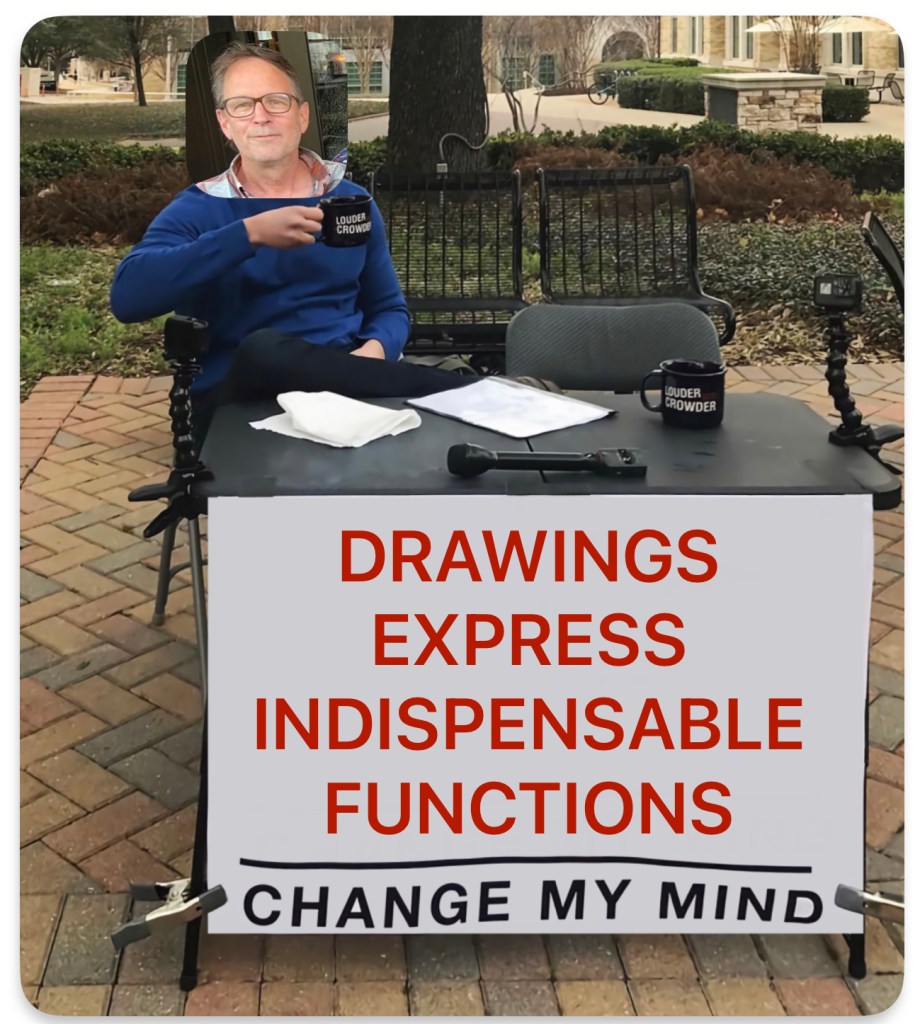
Think about this and think again when people advocate getting rid of drawings. What are they advocating substituting in their place? Nothing? If they’re not accounting for the utility of these functions, and the need for some kind of device either internal to digital models or externalized, that can do what needs to be done indispensably, they may be making an unserious argument. They may be adhering to a slogan without loading-bearing thought backing it up.
So check that and think for yourself.
What I did is propose that technical drawings as we know them should be automatically internalized in-situ at true orientation where they really are within models mental and digital.
That was my V2.0 work that was commercialized first in 2012 and since then is developed in 9 different softwares:
V3.0 (2024)
Those envisioning the future of software/tech in the AEC industry must account for the clear necessity of these functions (the 5 functions above) within each AEC discipline as they develop their discipline models, and the use of drawings, and things that are functionally like drawings, throughout the design > fabricate > supply > construct > and use and maintain chain.
There is no future in which the essential functions of drawing are not expressed either in traditional form, or in new forms of expression of the same functions within digital models.
There is no future in which the functions are abandoned.
TGN (V3.0) is an evolution in FORM.
The form of expression, of technical drawing, now that it resides in digital models (V2.0), should evolve. Because it can. And must.
TGN stitches together technical drawing and digital modeling. Not only a fusion, but also an evolution in form that surfaces the best of both media, in a new form of expression greater than the sum of its parts.
It is proposed to enter the market through an open source set of core features to be developed, shared, and promoted to existing and new software companies and relevant standards organizations, with commercial opportunities for software companies for extending beyond the open core.
The V3.0 page includes a summary outline explanatory text describing the 8 core features of ‘TGN’ VCS equipment in digital models., a more comprehensive TGN VCS specification for software developers, and demonstration videos simulating TGN functionality in a visual mockup.
Development has started
We have now 3 developers volunteering on the TGN open source project so far and 2 more just now joining. We’re getting our codebase house in order, to make it easier to open the doors and invite everyone who’s interested, into the project.
We’ll announce our GitHub and Discord server later this summer (2024).


 OPEN VCS, a lens for looking at models