The error started decades ago with everyone confusing the basic categories. We saw drawings and then we saw digital models and we thought,
ah… that’s the progression, drawings are the past and models are the future.
The fact is there are two progressions, not one.
- The first is from mental models to digital models.
- The second is from conventional drawings to OPEN VCS (or something like it)
Simon’s point 3 is right (see screenshot below). I just add to it. Keeping drawing in its centuries old form of expression only, or dreaming of getting rid of drawings, are missing the point and all of the opportunity. See the FACTS, and 5 FUNCTIONS, sections in this intro:
It’s about our mechanism for LOOKING, for physical evaluation, checking for ommission and good fit, for affirmation, and this mechanism is the interplay between the whole and these looks/evaluations/affirmations… It’s the way we think, how our mind works to get beyond superficial understanding, and beyond the illusion of model adequacy to proof of adequacy.
This thing we call drawing can evolve though. It can be authored in a different way, in the models, and the way we engage with it visually can be very much elevated. That’s what OPEN VCS intends to do, in every modeler, or starting with a standalone browser tab or app that does it in a speckled or other pipelined expression of your models.

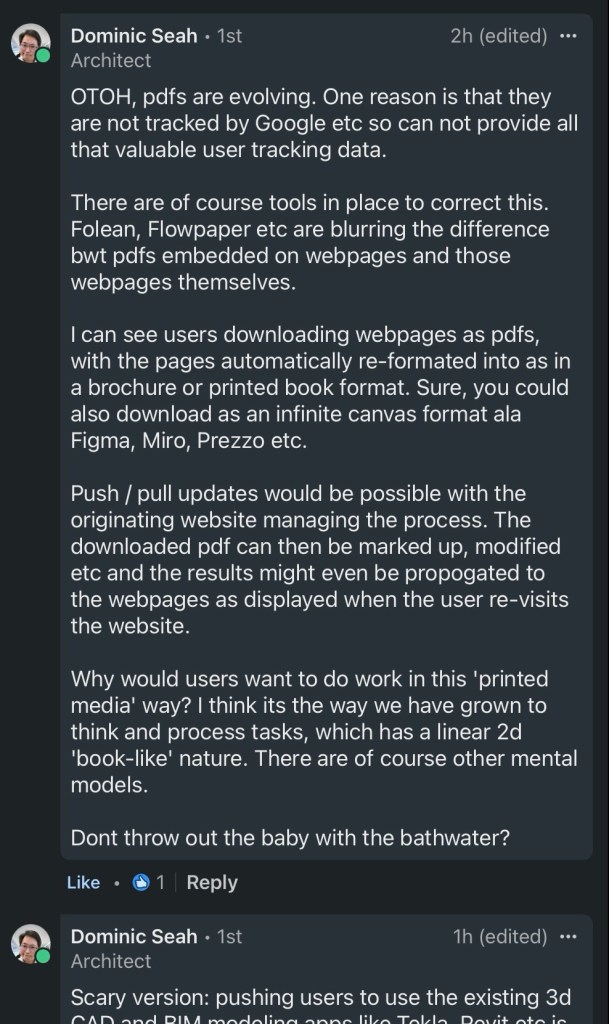
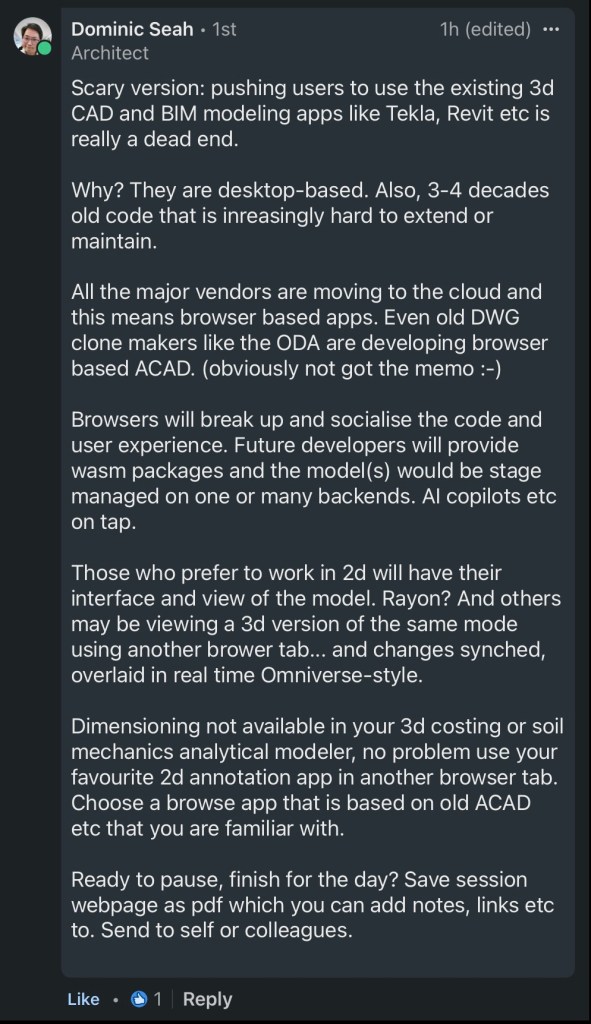
Also see the comments by Dominic Seah under this post https://www.linkedin.com/posts/oystein-ulvestad-b1602a79_bim-gps-constructiontech-activity-7267103560499175424-h8mr:



 OPEN VCS, a lens for looking at models