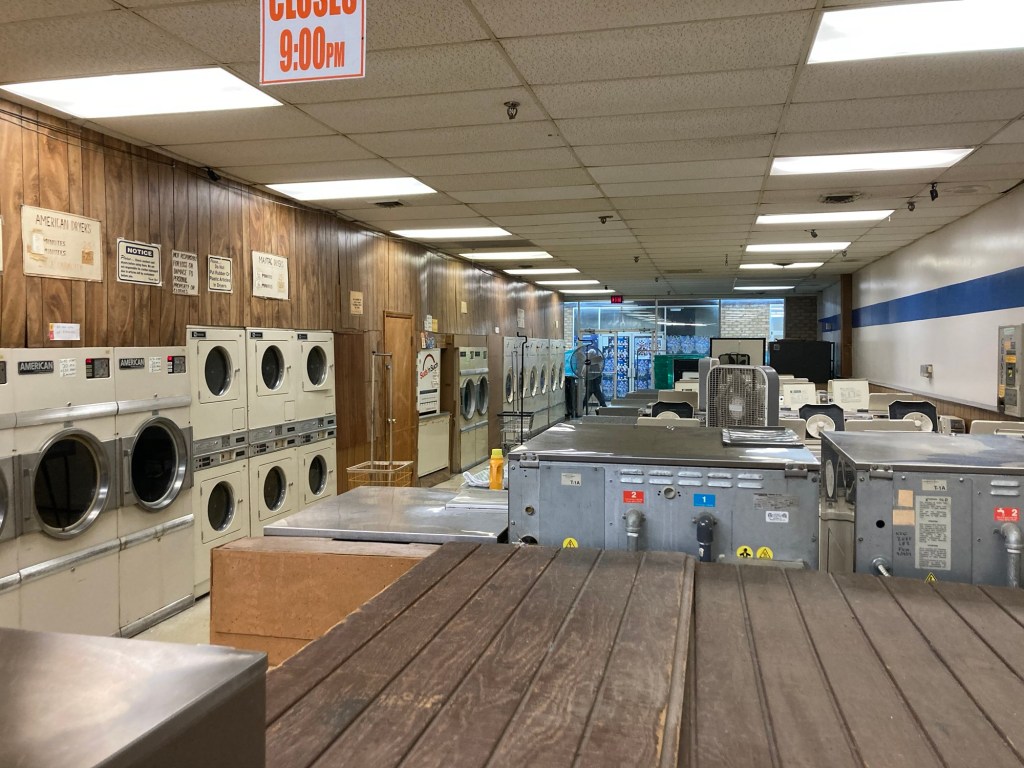
Circumstances have me doing laundry at a laundromat in the neighborhood where I was a kid in the 70s in Lexington, Kentucky.
The place hasn’t changed. The machines were installed probably around 1973 I’ll guess (I called to ask and will update here if answered).
It puts a few things in perspective today.
Kubrick’s 2001: A Space Odyssey came out in 1968 and laundry machine manufacturers got busy immediately. So by 1973 at the latest, washing a load of whites was pretty much the same as dueling it out with HAL9000 on Discovery 1, or using a zero gravity toilet..
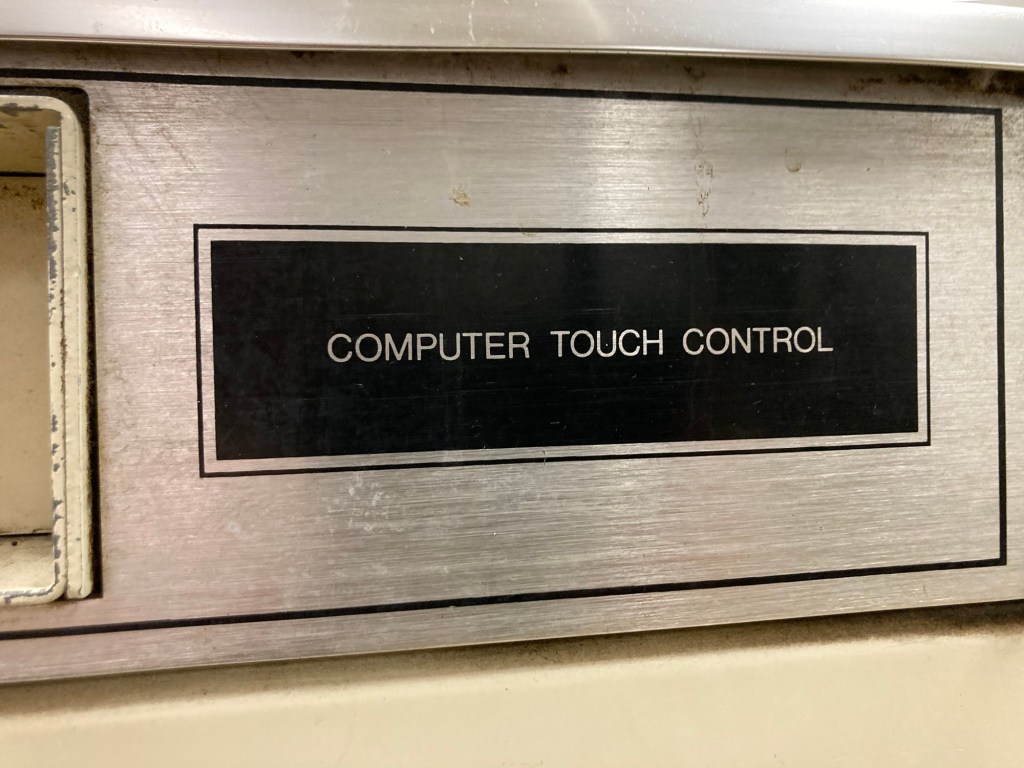
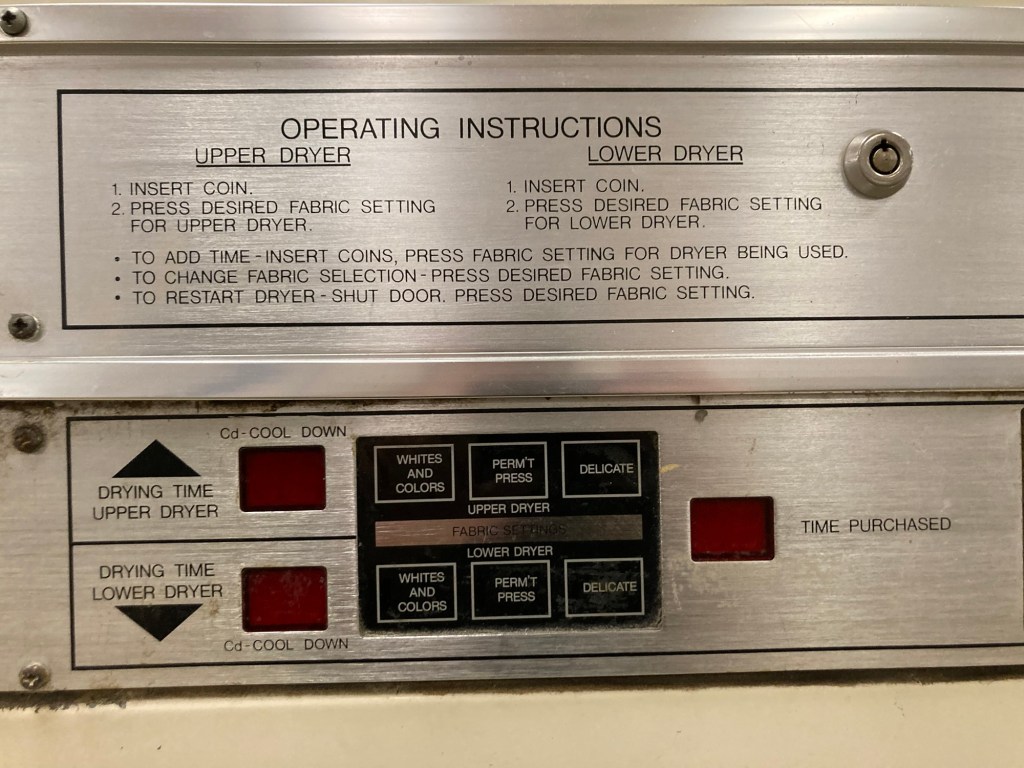
Here’s the Computer Touch Control:
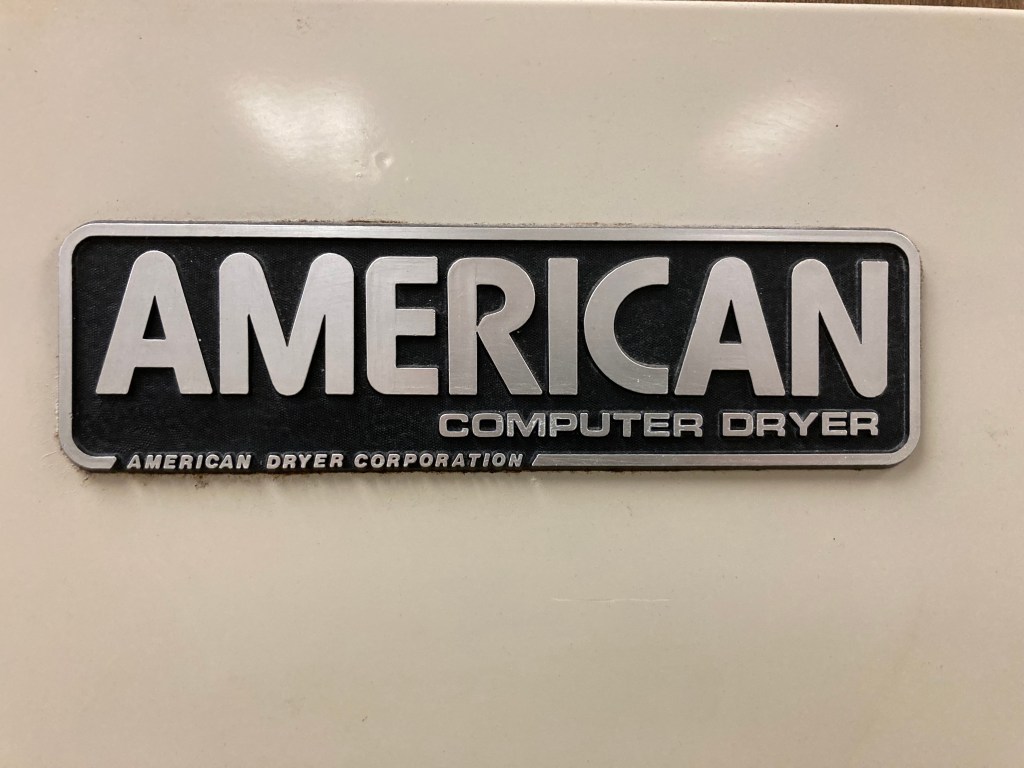
American Computer Dryer with Computer Touch Control..
These are fond memories to be honest, and the optimism of the time was qualitative. Mainly it was coherent. The way artificial intelligence was portrayed… watch the movie again today and see the expectations (mainly competence) set in ways that well and truly inspired, and that in no way were Enshittified (don’t get stuck only on the plot outcome)
The laundromat is a legitimate homage to the optimism of the time, which probably did reach its apex in ‘68. And probably nowhere was more fully expressed than in the movie.
I went to architecture school in the 90s (91-96) at a school founded in 1958 by Corb devotees. There was a Mies guy too though who’d worked in his office. And others.
I miss those times. I didn’t always agree or pick sides. Sometimes I did. That’s what I miss. You could agree or disagree, speak or keep quiet, but at least the arguments were coherent.
They were more or less based on things real and recognizable. Also you knew something, that it’s about the less than 1% of built structure designed by who’s who. And then there was everything else, a lot of which is junk. But some isn’t. And it’s a big world and you could orient your way through that and try to do good work, or at least recognize it when you see it.
Today I don’t know. Maybe it’s the company I keep. So much emphasis on meta-work, on software, and dreams of utopian software, and worse: belief that everything will be integrated into software, that we’ll live through goggles or otherwise through indefatigable screen addiction.
Demoralizing resignation now is casually vocalized (if there’s any speech left at all) that we’re all simulations of physical/digital worlds anyway, that everything, will be integrated into ‘this’, which is never defined. It’s not even attempted.
AEC will eventually be integrated into the game industry. We are all simulations of the physical/virtual worlds.
– someone said, about Architecture, Engineering, and Construction (AEC)
I prefer making as clear as needed (there is need) the differences between those industries although they have interesting things in common worth seeing too.
They’re both about making environments for human (something; fill in any word here). But is the rhetoric of digital/physical unification over extended by now? Or is it too late already? As I type, the real evaporates, all mystified into nothing? It’s vanishing.
Many believe, anyway, that the (real) world and virtual worlds are the same thing. People who believe that, probably will always believe it. Others don’t. Many are finally getting less interested.
The quality of 1968 is gone along with the optimism. And the innocence of paying homage to it through washing machines in 1973.
And we’ve noticed. What’s left is a void.
Thanks for sharing. I’m a generation younger, but feel similarly. From the prevailing western commitment to self interest and exploitation has emerged a growing cohort entirely disinterested in humanity. Ideologies of automation, technologism, exploitation, centered on personal financial enrichment.
There are viable alternatives, the vc-fueled tech bro future is not inevitable, but requires resistance and the design of better possible futures.
Until then, many seem content to build their own coffins.
The void is everywhere now. Dr. Jeffrey Funk writes:
What is Science? People coming out of a university with a Master’s degree or a PhD and you take them into a field and they literally don’t believe anything unless it’s a peer reviewed paper. It’s the only thing they accept. And you say to them.. let’s observe, let’s think, let’s discuss.
They don’t do it. It’s just, is it in a peer-reviewed paper or not? That’s their view of science. I think it’s pathetic.
Gone into #universities as bright young people, They come out of it brain dead! Not even knowing what science means. They think it means peer-reviewed papers, etc. No that’s #academia.
And if a paper is peer-reviewed, it means…..everybody thought the same, therefore they approved it. An unintended consequence is: When new knowledge emerges, new scientific insights…. They can never ever be peer-reviewed. So we’re blocking all new advances in science – that are big advances.
If you look at the breakthroughs in science. Almost always they don’t come from the center of that profession. They come from the fringe. The finest candlemakers in the world couldn’t even think of electric lights. They don’t come from within they often come from outside
We’re going to kill ourselves because of stupidity.
WORDs of wisdom from a famous scientist, Allen Savory.
His words have important implications for how scientists, #funding agencies, and even entrepreneurs and #VCs think about #science and #technology. #Scientists are too focused on how many papers they or someone else publishes, and not enough on ideas expressed in papers. Do the ideas explain something, enable something, or suggest a new line of inquiry? If they don’t, we shouldn’t be impressed.
Stop counting papers and using h-indices and start focusing on ideas! What are the ideas that really explain or point to something important?
Universities must think about ideas when they measure themselves and their professors. It’s not how many papers are published but whether they have created ideas that lead to new products, services, or practices.
Funding agencies must think about ideas when they fund #research projects, or else they will merely fund the same old ideas and the same people. How can we expect something useful, whether it is new products, services, or practices, to emerge from research unless we think about ideas, and not just how many papers a research project has produced or might produce in the future?
Richard Feynman always emphasized simple explanations (If you can’t explain something to a child, there’s a chance you don’t understand it well) and questioning of ideas. “I would rather have questions that can’t be answered than answers that can’t be questioned.”
Similar logic applies to #startups. How can we identify potentially profitable startups when emphasis is more on opinions of “serial” entrepreneurs (Masayoshi Son) and fund managers (Cathy Wood) than ideas? Focus on evidence and logic of ideas. see my book, Unicorns, Hype and Bubbles.
There are many young starting endeavors aiming to build the optimal modeling platform for AEC. This is good and gives reason for optimism again. But only if major errors are not repeated.
Sure. Get all of that in place, build the ideal modeling platform, and that also won’t make the industry a nirvana.
It’s like saying google docs makes collaborative writing a nirvana.
The work, the core work of AEC professions is very hard, complex. Nothing can change that.
There is however a good argument, increasingly so, seeing the last 30 years in hindsight, for going back to mental models and pencils.
I continue to say what I’ve said since 2007. Models are half the problem. The other half is “looking at models”.
AEC software has left that half of the problem stuck in a 500+ year old form of expression (format) unaltered by digital modeling for over 30 years: technical drawing.
Leaving it stuck there undermines, among other things, the modeling endeavor itself, more than anything else.
Developers should not feel proud of this and should start to recognize some embarrassment
I recently answered a survey:
What project/software do you want to develop:
OPEN VCS equipment for visual close study in (all) digital models.
What do you want to achieve with the development of that software? What is the company’s objective for developing that software?
We want to increase the utility and utilization of digital models for all users in all project phases in all modelers and model-handling apps, environments, platforms, and formats. AEC models are very complex things. Close study is required for model development and interpretation in all project phases. Development of such equipment has remained largely ignored for over 30 years. It is time to change that. We can no longer tolerate abandoning this critical essential function to a 500 year old format for VCS externalized from digital models, i.e.: technical drawing in its traditional format.
Leaving VCS stuck there is illogical, counterproductive and self-defeating. It undermines the modeling endeavor itself.
What functionalities should the software have?
There are very many possible features of VCS equipment for visual close study within digital models. I describe many of them in an OPEN VCS specification here:
We think it is important to narrow down from all possible VCS features to a small set of minimum open source core features, enough to make a real difference in defining the future of VCS equipment for visual close study in models, and small and clear enough to be shaped into a standard for VCS that can become acceptable to the industry as an industry standard codebase for implementation (and continued managed evolution) in all modelers.
In the specification linked above I designate the 8 core features of OPEN VCS to distinguish them from many other related VCS features that are possible. Among the latter, beyond the open source 8 core features, the spec also describes those too, all the ones I thought of myself while writing the spec. Anyone can think of many more, l’m certain.
In addition to the specification document, there is also a brief outline of the 8 OPEN VCS features here:
We plan to use (your platform) as the core platform for OPEN VCS development in the context of (your) data pipelines for model environment supply (we develop VCS equipment for use within the context of models under development and in use). Successful development of OPEN VCS will attract the interest of users and developers who want OPEN VCS core features implemented elsewhere too, in other modelers (e.g., Rhino, Grasshopper, Blender, standard BIM apps, Cesium, and many more), and also connecting with various kinds of graphics editors like CAD apps, illustration apps, etc)
How many people are working or will work on the project? Please detail the number of people per role. E.g. 5 developers, 1 project manager, etc.
I’m getting close to retirement myself and at this point I act as a development coach or guide, or PM. Our OPEN VCS team has so far attracted 6 volunteer part time developers in 5 countries, as well as the interest of two very interesting professional software development organizations who have stated their intention to collaborate with us in OPEN VCS development. We have the attention of other companies too.
How long would you like to have the project ready?
One year (taking our time, not rushing) I think is a reasonable estimate for serious effort accomplishing worthy outcomes in each of the 8 feature areas of OPEN VCS
What would it mean for the company to have the project ready in that time?
It would mean that (your platform) would succeed even more than it otherwise does, and all users would see and recognize what IS, what will become, the primary means of visual engagement with digital models of all kinds, for ALL users who require more than superficial visual engagement with models and the superficial understanding (at best) that such engagement enables. The very long history of VCS has been stuck for centuries in technical drawing as we all know it. Leaving VCS stuck there is not the way forward, not 3 (or 6) decades into the movement from models mental only (and physical) to models mental AND DIGITAL. THIS compels a corresponding evolution in VCS. It also enables it.
What development phases have you planned?
We plan the core features (8) development in a standalone environment (on your platform) that shows and proves the utility and correctness of vision of OPEN VCS. In addition to the specification document, there is also a brief outline of the 8 OPEN VCS features here: https://tangerinefocus.com/visual-engagement-with-modeled-worlds/
What milestones have you planned?
We plan separate milestones for each of the core features, and their coherent function together in unison. While also developing with implementation in mind, of OPEN VCS in diverse modeling apps, platforms, environments, and formats.
We intend (feature 8) to support portability of VCS rigs. VCS rigs authored in any modeler should be shareable to users in other modelers, as long as OPEN VCS is implemented in each modeler.
What costs have you estimated for the project?
We have recently started evaluating OPEN VCS development and resource scope with an outside development organization. That work remains at its beginning and we have no conclusions yet. We’d like to plan scope and resources together WITH YOU (your company).
What is your budget for the project?
We are volunteers so far, and unfunded so far. But we have great interest among users at a number of large A, E, and C firms, and at some of the software organizations serving AEC, and we intend to establish an OPEN VCS COLLABORATIVE (consortium, or foundation) that can manage OPEN VCS development, maturation, and proliferation through the industry, and that can win resource support from user and developer organizations alike.
What are the next steps you plan to do when the project is ready? For example, a marketing or sales campaign to offer it to customers, etc.
We’re going to prove it works, and then make it available to all AEC software user and developer organizations so everyone can benefit from what will become THE primary means of visual engagement with digital models, elevating model utility and utilization in all AEC project phases and nearly all model usage scenarios.
Feedback from the participating companies will be very useful for us to be able to really adapt the technology to their needs. Is your company willing to actively provide such feedback during the technology development period?
Absolutely. Yes.
Since this is the last question, please feel free to tell us anything else you would like us to know about you or your company.
The greatest single obstacle in AEC to digital model usefulness that has kept model utilization stuck at a rate under a rather low ceiling is the lack of developer organization awareness of the essential purpose and function of VCS equipment (I list those functions here: https://tangerinefocus.com/2024/12/08/in-aec-close-study-of-models-matters-for-these-reasons/ ), and the lack of recognition that such equipment must no longer be confined only to an ancient VCS format externalized from digital models but rather must be embedded within the model, and must evolve in its form of expression and power to engage the mind in the complexity of a project in a way that renders insight and clear understanding far more effecively.
Hi! My name is Rob Snyder, I’m on a mission to elevate digital models in AEC (architecture, engineering, and construction) by developing equipment for visual close study (VCS) within them, so that they supply an adequate assist to the engine of thought we all have running as we develop models during design and as we interpret them so they can be put to use in support of necessary action, during construction for example.


 OPEN VCS, a lens for looking at models