Someone kindly had an offline discussion with me which brought out something worth clarifying.
Meanwhile someone else messaged me today:
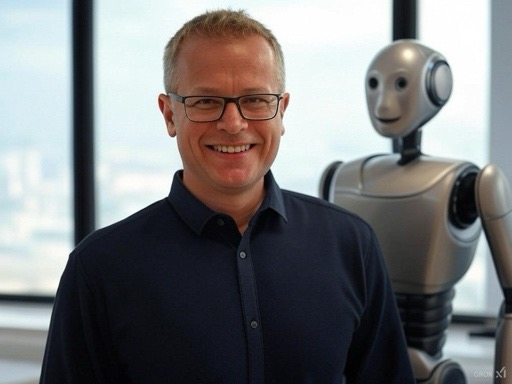
“Grok: Show Robert Snyder of OPEN VCS smiling with a humanoid robot servant.”
To clarify, I am not saying that all sets of drawings achieve these functions (see facts and 5 functions at the link below). I am saying that an adequately skilled person or group of people CAN reasonably aspire to carry out these functions through a set of drawings.
I also say that an adequately skilled person or persons CANNOT do so with digital models in their current form in general (with some very rare and few very specialized exceptions). It is a matter of the medium itself.
A model does not and cannot express these functions.
A set of drawings on the other hand can. Doing so in fact is their purpose.
The technical drawing medium handles these functions (see functions listed at the link below) in a manner suggesting the medium itself is designed as it were, specifically for expressing these functions.
The model medium not so much. Not at all in fact. Quite the opposite. Models are environments. Completely different things than drawings.
However this can be resolved, for models, through fusion (which I invented and commercialized in 2012).
And it can be further addressed through evolution in the form of expression of drawing itself, now that “drawing’s” residence in digital models is already established.
The evolution in form is specified in my OPEN VCS specification linked here.
Facts related to, and 5 Functions of technical drawing:
Drawings are a vehicle for Close Study.
Visual Close Study, or ‘VCS’.
Close Study, whatever its vehicle, matters for these reasons in AEC. Consider the 5 Functions of Technical Drawing listed here, and the Facts:
FACTS:
A. The digital model means next to nothing, to anyone, without formation of an adequate mental model of the same ‘FIELD’. “Proofs” of this are unnecessary. Experience and logic suffice to say that if you’re looking around in a digital model, and not learning as you go by building a progressively less-fogged mental model of the same, then what you’re understanding from the digital model is superficial at best and likely less.
Mental model formation is not optional.
B. Within a short time after project start, an AEC digital model quickly already exceeds our cognitive grasp. This is demonstrated by our declining ability to answer even basic questions about it, like:
- is it done yet?
- is it good enough yet?
- is the model forming a coherent functionally successful whole?
- is there good fit among the physical items modeled?
- are any physical items that matter, missing? Where? Where not?
- is the model good enough in some regions and not others?
- where are the regions that are good enough?
- does anything signify to anyone the useful distinction between regions that are good enough and all other regions that may not be?
C. We rely on the drawings as a lens for looking at the models in a sustained and articulate manner as the model develops, during design. And again later during construction we rely in the same manner on technical drawing for interpreting the model in very specific ways such as to assist in answering the questions above, and also for other reasons described next.
D. A systematic framework for visual engagement with models is necessary.
5 PRIMARY FUNCTIONS OF TECHNICAL DRAWING
- At significantly informative locations within models mental, physical, and digital, we conduct sustained articulate expression of the act of VISUAL CLOSE STUDY (V.C.S.).
- We conduct PHYSICAL EVALUATION of models at V.C.S. locations, mainly A CHECK AGAINST OMISSION of physical items in the model, and A CHECK FOR GOOD FIT among the physical items present. It takes thoughtful effort, through the lens of visual Close Study (V.C.S.), and time, to develop and complete these checks, particularly during model development during the design phase of a project, but also during construction and during the handoff from design to construction. Models start from nothing and grow into what they become. The checks are done all along the way in a process of effort-full thinking, using the engine of thought, *see (4).
- Physical evaluation at V.C.S. locations concludes in a state of AFFIRMATION of model QA/QC (quality assurance and control). Who affirms what, where, is made clear. This supports ACCOUNTABILITY.
- Successful expression of Visual Close Study (V.C.S.) sets out the necessary array that is what we can call: the 2-pole *ENGINE OF THOUGHT* itself, an engine formed as an INTERPLAY between the wide expanse of a modeled environment (the FIELD), and the narrowing act of our attentive focus within it, at V.C.S. locations.
- In this INTERPLAY between environment and focus, world and attention, field and close study, model and vehicle of visual close study (‘drawing’), thought happens and understanding grows.
- The two poles, (wide/narrow) (FIELD/Focus) (model/V.C.S.), are as distinct from each other as the cosmos is from a lens for looking at it, as distinct as the universe from a telescope, They’re not in any way the same kinds of things and of course are mutually irreplaceable.
- Finally, VISUAL CLOSE STUDY supplies THE COURTESY OF DRAWING ATTENTION TO THINGS NOT TO BE MISSED IN THE MODEL
Imagine this: Equipment for visual close study (VCS, a.k.a.: technical drawing) can evolve.
EVOLUTION OF VCS EQUIPMENT
Just as technical drawing is for visual close study, of mental models, OPEN VCS is for close study of digital models.
So I repeat as I always do:
We thought wrong. The error started decades ago with everyone confusing the basic categories. We saw drawings and then we saw digital models and we thought:
ah… that’s the progression, drawings are the past and models are the future.
The fact is there are two progressions, not one.
- The first is from mental models to digital models.
- The second is from conventional drawings to OPEN VCS (or something like it)
OPEN VCS developer specification
This is the third version of the OPEN VCS Specification. Please read it at this link:
OPEN VCS equipment for Visual Close Study in all digital models 26NOV2024x
The spec includes detailed description of the 8 core features of OPEN VCS, plus a dozen or so related features, among many other possible features beyond the proposed, shared, standardizable OPEN VCS feature set.
This is a living document. If you would like to comment or be invited to help edit the OPEN VCS specification, send me a message on LinkedIn: linkedin.com/in/robsnyder3333/

 OPEN VCS, a lens for looking at models