If you ask the wrong questions and answer them correctly, where does that get you?
You can think of this at the scale of life in general, or narrow it down to some specialized area of interest, any area you like, including my particular interest: the last 4+ decades of software development for (AEC) Architecture, Engineering, and Construction.
I’ll jump into the subject again of course, with some points in no particular order.
Ask what provokes thought, what calls us to think. What are we called on to think about?
I’ve answered that many times in this blog, in relation to the core work of AEC professions and it’s, yeah, worth repeating:
Two lists, of what’s going on with attentive visual focus and model formation, during the design and construction of complex things:
Technical drawing is an instrument for helping you pay attention, and, for showing that you did.
If you’re designing a building, a ship, a machine, or an aircraft, designing any complex thing for construction or manufacturing, what’s really happening is that:
you’re formulating a mental and digital model of the thing,
that model is fuzzy, and full of gaps and inaccuracies, and
you’re shepherding the model from its inadequate state to something functionally adequate.
Basic Questions
Very soon after project start, an AEC digital model quickly exceeds our cognitive grasp. It’s just too much to hold in mind. We experience a declining ability to answer even basic questions about it, like:
is it done yet?
is it good enough yet?
is the model forming a coherent functionally successful whole?
is there good fit among the physical items modeled?
are any physical items that matter, missing? Where? Where not?
is the model good enough in some regions and not others?
where are the regions that are good enough?
does anything signify to anyone the useful distinction between regions that are good enough and all other regions that may not be?
Focus is needed.
First of all, recognize the difference:
The broader field
The narrowing focus
The interplay between those sets the mind in motion.
As it is for all fields, so it is in AEC design and construction.
Drawing is the expression of, and vehicle for, a number of primary behaviors or functions of AEC professionals revolving around model review:
Model Review: technical drawings are checks, against omission, and for good fit. And, they’re one stroke in a 2-stroke engine of thought, or one pole in a two-pole INTERPLAY that IS thinking.
(1) Attentive Focus or Visual Close Study (VCS)
At informativelocations within modeled environments (within models mental, physical, and digital) we develop and express our act of attentive clarifying focus. We could call these, locations of visual close study (V.C.S. locations).
(2) Checks against Omission and for Good Fit
At V.C.S. locations we conduct physical evaluation of the model. This involves mainly two checks:
A check against OMISSION of physical items in the model (checking that everything that should be shown, at this V.C.S. location, is shown; nothing that matters, here, is missing), and
Checks for omission and good fit are the QA/QC and interpretive work carried on through project design and development, and continuing during construction.
(3) Affirmation (of checks against omission and for “good fit”)
Omission and good fit evaluations conclude with AFFIRMATION of model QA/QC. Who affirms what, where, within models mental, physical, and digital, about omission and good fit, is made clear. This supports accountability.
But preceding accountability, these checks and affirmations are supporting something more fundamental and more generative: coherent thought itself, thought applied to the process of making our models clear, building up our own understanding of and confidence in our own models, and then conveying that to others in a way that’s receivable. Clear thinking clearly conveyed… One can affirm, or assert, that at these locations, the primary checks have been made, that professional standard of care, is met.
(4) Drawings in models (mental and digital) set the mind in motion
Checks and affirmations are made at an already, first of all, narrowed set of locations within a model, not ALL locations, but representative ones. Everyone is free to take whatever they can, and want, from all other locations within the FIELD of a model, but at these locations affirmation is made. The narrowing comes first. Otherwise one creates an engagement with infinity problem that makes fools of us all.
The narrowing sets out the necessary peaks and valleys of attention. The difference, like a voltage drop, sets the mind in motion, gets the perception engaged, makes meaning, delivers coherence, makes sense of things.
Visual close study within models, our narrowing focus within a FIELD, is our deployment of a context / focus interplay that is the engine of thought itself. Thought is an interplay between our expansive perception of a modeled environment (the FIELD), and our narrowing act of attentive focus within it, at V.C.S. locations.
From this engine comes adequate project understanding and functional competence. In the interplay, thought happens and understanding grows.
There are two poles in dynamic interplay (which is thought):
(WIDE ←→ narrow) or (FIELD ←→ focus) or (MODEL ←→ VCS)
The two poles are as different from each other as the COSMOS and a ←→ lens for looking at it, as mutually distinct as the UNIVERSE and a ←→ telescope. These things are not in any way the same kinds of things, and are mutually irreplaceable.
It should occur to no one, that one obviates the other.
(5) The Courtesy of Drawing Attention to what is not to be missed
Finally, expressions of attentive focus through visual close study supply the courtesy of drawing attention to things not to be missed in the model.
What’s drawn by any drawing?
Your attention.
The applied thought functions, the 5 described above, fairly well represent the core cognitive workload of AEC professions.
These are lists of what provoke thought in AEC. They are what call us to think in AEC. They are lists of what we are called on to think about.
That should put some emphasis and should provoke you to think, about the nature of technical drawing, about drawing’s function.
And to put this in another context, think of Astronomers. They, like all of us, have the whole cosmos. I mean, we’re in it. We can look around. Does the existence of the cosmos prompt astronomers to disparage their telescopes, to promote the abandonment of telescopes, to advocate a future astronomy beyond telescopes?
No.
That’s self-defeating maximally.
But we have this in AEC, 20+ years of (software) tech enthusiasts promoting the abandonment of drawing, a future of digital models sans drawings.
Really,
…technical drawing, a device/lens, an instrument, for helping you pay attention, and, for showing that you did, this is to be abandoned because, *…checks notes*, reasons, i.e., “IFC”, “Open BIM workflows”, etc.
In other words: abandon drawings (telescopes, the lens for looking) because of digital models (the cosmos).
A concept embodying maximum counterproductive self-defeat. If your motivation is advancement, this is not what you do. Not if your thoughts are coherent.
Sure, look up into the night sky with the naked eye, but don’t glamorize a future defined by pitching telescopes into junkyard car crushers.
Really, this isn’t rocket science. It’s simple. If your motivation is industry advancement, then promote the continued development/evolution of telescopes (instruments that help you pay attention, and show that you did).
Let me drag out another analogy.
Don’t forecast the demise of recorded sound because of the arrival of motion picture (silent film). Some actually did forecast that, a hundred years ago, as idiotic as that sounds now.
Those who figured out that recorded sound should and could be synchronized into silent film, producing a fusion of sound and motion picture greater than the sum of its two parts, persisted +/-30 years with steps forward and back in the face of, yes, technical challenges, but also in the face of people, actually, opposing it along the way, particularly, people directly affected or in positions of great influence, like the Warner Brother, Jack Warner:
In September 1926, Jack L. Warner, head of Warner Bros., was quoted to the effect that talking pictures would never be viable: “They fail to take into account the international language of the silent pictures, and the unconscious share of each onlooker in creating the play, the action, the plot, and the imagined dialogue for himself.”[146]https://en.wikipedia.org/wiki/Sound_film#Commerce
Presumably, audiences would prefer creating the play, the action, the plot, and the imagined dialog for themselves, and, leaving it as such would also well and truly represent the preference of those creating, directing and producing films. Just leave the interpretation more fully poetic, or something, in the enforced absence of a primary form of communication: speech.
AEC software development answers correctly, the wrong questions for 30 years
This gets us precisely:
the wrong software
ROI underperformance where it hurst most, its near absence (or failure to move the needle) in support of the core tasks of AEC professions (see the lists above)
a double whammy: wasted resources poured into problems created by software itself (in exchange for minimal return on investment)
There is a way out. Software development in AEC could be reoriented. I’ll get to that.
It’s worth tracing our steps how we got here first.
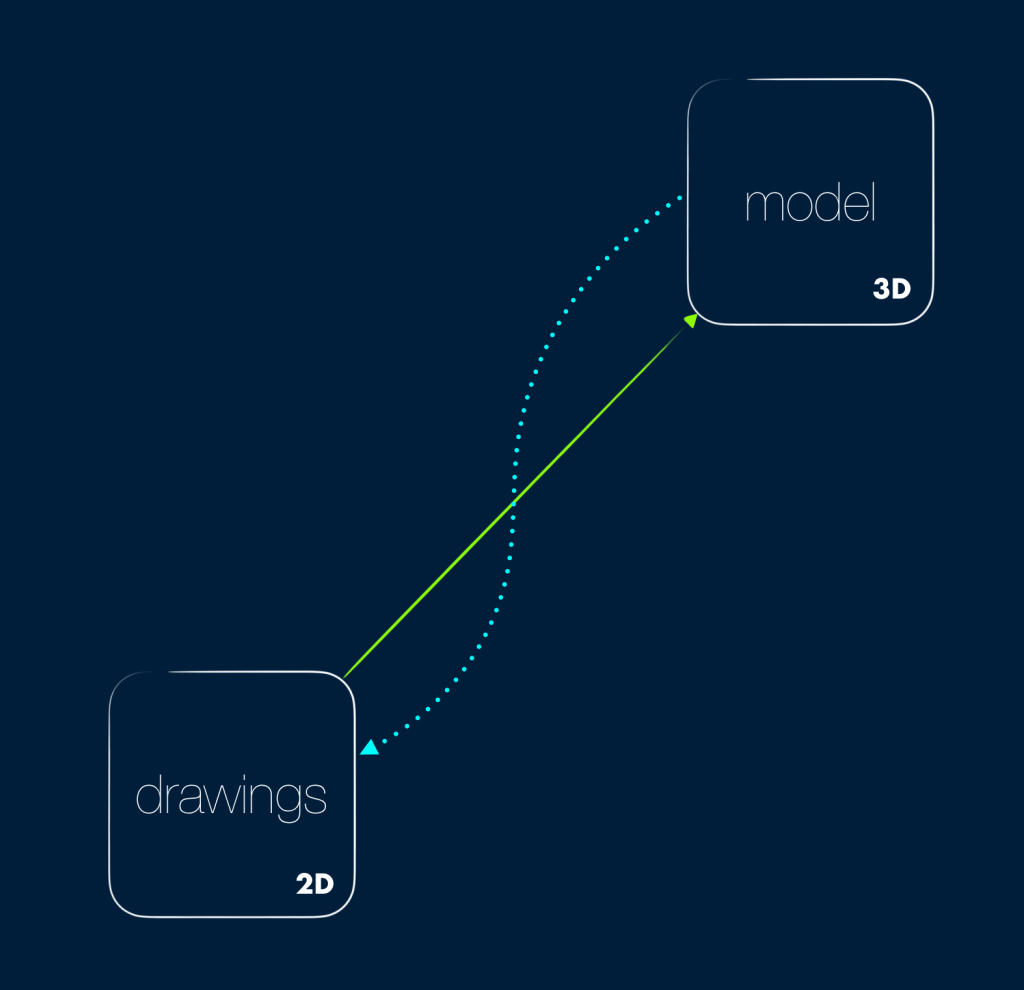
The cartoon below illustrates the concept that drove already 30 years of AEC software development since about 1995.
The green arrow is the conceptual progression from drawings to models. The idea is that models will replace drawings, eventually, and that in the meantime in a transitional period, drawings will be automated from models (the blue dashed arrow):
fig. 1
Drawing automation, from models was well underway in the mid 1990s in some software, even all the way back to 1987 in its first iteration (ArchiCAD). The market leader (Revit) came later, in the late 90s.
To be clear, the outcome of the progression, is the digital model walking away untethered from an obsolete past, the past severed, and forgotten:
fig. 2
The idea was popularized at the large firm level in AEC around 25 years ago (I first heard it in 2003).
Since then some of the early proponents retracted their position, but nevertheless software development continues today along the same trajectory fired from an origin traceable back to this underlying, demonstrably thoughtless, premise: “Models are the future; drawing is archaic, obsolete.”
Meanwhile a whole new generation of evangelists floods the internet with rhetoric flowing from the same font/source in the same words verbatim that flowed 25 years ago.
None of that matters. I mention it only to show its age.
It’s aging, and not well.
What matters is what follows from the premise, and the outcomes.
What followed from the premise — models will replace drawings, eventually, and in the meantime in a transitional period, drawings will be automated from models — is that people decided to compare models to drawings as if they’re likethings that are comparable. This was category error but it set the framing for thought, discussion and development for 30 years already, anyway.
From the framing come the questions.
From the questions, the answers.
From the answers, the conclusions.
From the conclusions, the expectations, the scope and the limit of thought, the horizon.
From the limit of thought, the software development.
So that’s what we get.
The software we have, derives directly from the initial framing.
So I refer to the title of this blog piece:
What happens if you ask the wrong questions and answer them correctly, where does that get you?
It leads you astray.
That “models are better than drawings” is coherent productive thought, no more than:
“let’s crush our telescopes because we have the cosmos” and
“silent film is better than recorded sound, so let’s keep motion picture silent forever.”
I propose reorienting based on better premise.
I’ll get to that, but again, tracing our steps, how did we get here?
We were told that models replace drawings, because they’re better. And this provoked some less than adequate thought. We would say things like:
The world is 3D. Drawings are 2D. Therefore drawings are dumb.
Drawings are just dumb lines and arcs.
…and things of this nature. I could list more but the quality of the argument never got any better. It was and remains superficial pseudo-argument. Real argument has thought behind it. There is no substantive thought behind this “idea” whatsoever.
There is no awareness, let alone consideration or understanding, of the function and purpose of technical drawing. Nor its relationship to modeling, a relation very much like the relation connecting telescope and cosmos (and sound and film). Nor for that matter how the function and purpose are served by drawing, their role in human perception of things very complex.
All of this, the whole story, the state of the core software of AEC as it is, and how it got that way, is a genuine oddity.
But there is also a compounding oddity. Truly puzzling.
I mean, I get it; if you start with a premise 30 years ago that somehow mesmerizes (as slogans do), a slogan that fit very well with the needs of corporate software marketing, and from that starting point you necessarily end up with a set of observations, questions, and answers that are completely off target, that miss the point of where software could have gone in its development, you end up then with software that stunts addressing the core work of AEC professions, that fails in assisting those tasks in a compelling effective way that rises to the occasion presented to us all by digital modeling itself.
Because the relevant potentials in software are underutilized, and because the core work of AEC professions is not addressed at all, even, because it’s overlooked, entirely unrecognized, then this is what you get.
That’s clear. I can follow that, logically, from starting point, to where we are. It’s faulty logic, but it’s logic nonetheless.
But to keep things in stasis for so long (remember, we were told that models are better than drawings and will replace them)… to do this in the dominant software product, the one that (this is the puzzling part) is the claimant, to the embodiment of the arc of this idea, to pull this off in that product, in a manner that rigidly enforces, during the course of a model’s development, user engagement with the model through a viewing lens of planar views of the model that look and feel exactly like, and unalterably like, conventional 2D technical drawing.
Make it make sense:
Models are better than drawings and will replace them, but
In the flagship software product embodying this premise, model engagement is enforced as flat 2D views of the model during model development.
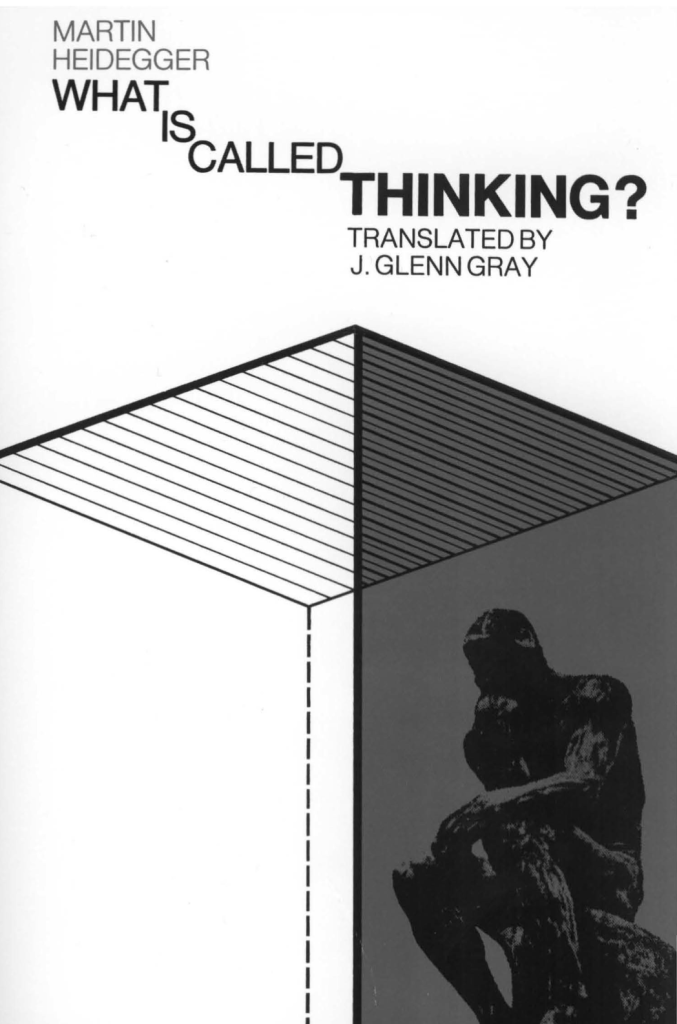
This makes you want to go back and read Heidegger again (thank you Pia Lauritzen, PhD), because none of us, including Heidegger himself, has yet begun to think, he says:
Thinking, about software in AEC, starts with recognizing correctly what calls out to us to be compared
We were off target comparing models to drawings, just as we would be off target in comparing telescopes to the cosmos, and just as we were wrong comparing sound to film. They don’t go in the same box. They’re not likethings. They’re not comparable. And as non-like things, one is not better than the other. Chocolate Ice Cream is not better than a Tractor.
So we need to find what we should be comparing instead.
We need to find the relevant likethings and compare those.
Then we need to find relevant questions, about their similarities and differences.
This will be food for thought.
We’ll need to think about implications of these similarities and differences among like things. And also think about interrelationships between different un-like things (different boxes) that are categorically interrelated necessarily.
So let’s attempt to do that.
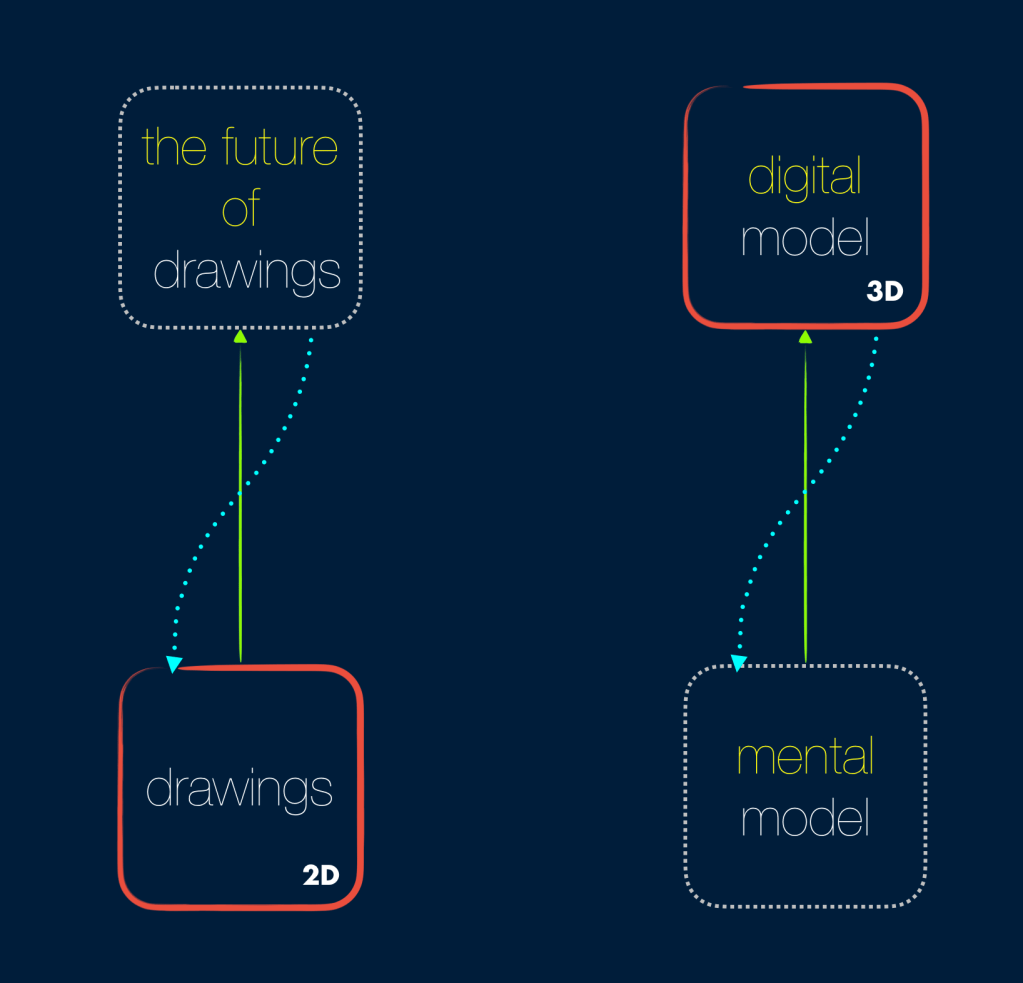
See the alteration in the previous cartoons below in figure 3.
There are big differences.
fig. 3
mental models and digital models (and their necessary interaction)
We no longer observe a progression from drawing to model.
Instead, see the right side of fig. 3, we see a progression (if that’s what it is) from mental model to digital model.
This is food for thought, thought-provoking. We should compare digital models to mental models.
Are we going to say that one is better than the other? Or are we going to realize that such thoughts are absurd?
The latter.
We’re not going to say that digital models are better than mental models, because saying that just plainly means nothing. You can see for yourself and prove in your own experiment, that no digital model means anything to anyone without adequate mental model formation underway, and in some state or another of readiness and adequacy:
Contemplate the mental model of your bicycle, or car, for example.
Seriously, how adequate is that? Would you say that:
it is highly accurate and fairly free from gaps and errors?
Or is it rather fuzzy, incomplete, full of gaps, inaccuracies and errors, and yet acting in some fundamental way in support of thought and perception?
Here you’ve proven to yourself already that the latter is not only nearer the truth of what’s going on in human perception of things very complex, but that the former is so far off target it can be dismissed and retired from consideration. The former has no overlap at all with the actual cognitive apparatus of perception. Perception just doesn’t work that way. We do not absorb complexity whole. The mind just doesn’t work that way.
There are indeed very productive (useful) things that we can observe, think and say about the differences and similarities between mental models and digital models.
Let’s (all of us) do that.
Doing that is part of what needs to be done (what needs to be thought) in order to, get the underlying thought premises that drive AEC software development, on target, i.e., addressing and assisting the core work of AEC professions.
Now see the left column of figure 3.
drawings as we’ve known them, and their future form of expression
What do we compare technical drawings to, if not to digital models?
Well, we compare technical drawing as we’ve known it for centuries, to drawing’s future form of expression, a form that yet doesn’t exist, but that necessarily will exist because it must, and because now, it can.
So likewise, that’s thought-provoking, food for thought.
There are productive things (useful) that we can observe, think and say about the differences and similarities between drawings as we’ve known them for centuries, and drawings in a future form of expression that doesn’t yet exist.
Let’s (all of us) proceed to do that too.
That’s also part, of what needs to be done (what needs to be thought) to get the premise that drives AEC software development, on target, i.e., addressing and assisting the core work of AEC professions.
A Unified Fusion
Lastly, we need to put the two things together, just as telescopes and the cosmos are brought together in human perception in inseparable interaction, and just as recorded sound and motion picture were put together in unifying fusion since 1927 commercially (and since 1898 experimentally).
There are twin tandems:
the tandem of models mental and digital, and
the tandem of drawing in both its current and future forms of expression
The two tandems need to be brought together into a unified fusion.
Thinking about this need not start from scratch. Because I already thought about it, a lot. And wrote it down, here:
The way forward with the outcome Mike Paraska asks for precisely, is specified at the link above, Drawings in Models V3.0 (2024).
“Ultimately, we want a system where the gap between “wtf am i looking at?” and “relevance realization” is mininized. What is the best way forward?”
– Mike Paraska
I also did commercial work (software development) on a precursor to the future unification yet to be developed. You can see that prior work described (and shown) below, and in action in the numerous softwares in which it now exists. Those are mentioned here:
The proposed unification and evolution (V3.0) shoots far past the earlier V2.0 (2012) work.
There is a lot yet to do.
The potential remains almost entirely untapped.
Looking – Showing
Technical drawing is an instrument for helping you pay attention1,
and,
for showing that you did.
Notes:
“Paying attention”: The industry will have to take into account what “paying attention” means in this context (in AEC). It’s not arbitrary. It has a specific meaning. I gathered that, and wrote it above on this page, here at this header: Two lists, of what’s going on with attentive visual focus and model formation↩︎
Hi! My name is Rob Snyder, I’m on a mission to elevate digital models in AEC (architecture, engineering, and construction) by developing equipment for visual close study (VCS) within them, so that they supply an adequate assist to the engine of thought we all have running as we develop models during design and as we interpret them so they can be put to use in support of necessary action, during construction for example.




 OPEN VCS, a lens for looking at models