Give or take a few years:
1983: software apps, for drawing lines, arcs, shapes, text…
1998: new features include the 4th iteration of a line trimming tool
2002: “drawings are just dumb lines and arcs“; it’s Building Information Modeling (BIM) now!
2010: It’s time for “Moving Beyond Geometry”; It’s the “I” in BIM (data, “information”)
2026: It’s the AI show now. Not the I, the AI.
These are pretty big leaps.
When I was a kid, parents would say Go jump in a lake.
Or, Take a leap, synonymous with Get lost.
It looks like it’s human nature to obey that imperative.
okey doke!
We had centuries of technical drawing, descriptive geometry and its application in many domains, a purposeful endeavor understood by its practitioners who busied themselves doing it.
In the 1980s personal computers arrived along with software companies and their drafting wares.. Some of this came after earlier versions of the software on pre-PC hardware. But the total time in sum of these gizmos is short.
15 years down the PC software road — not that they weren’t doing a whole catalog of software development work on these products — they were still introducing as a new feature for the yearly roll out, their fourth iteration of a line trimming tool.
And yet, just 4 years later they leapt all the way to “drawings are just dumb lines and arcs“; it’s Building Information Modeling (BIM) now!
Without hesitation.
But these things have a very short lifespan.
Just 8 years later (2010) they were “Moving Beyond Geometry” altogether. It’s the “I” in BIM now (data, “information”). So much for drawing and who cares about modeling either?
Now in 2026 we arrive at the state of the art of software company marketing. I paraphrase from a recent post:
.
Drawings have always been a means to an end – not the end itself.
.
But with projects now more complex and connected, static files alone are not enough to carry that value forward.
.
With Data Models and AI, information becomes more connected and more usable, enabling decision making without losing perspective.
.
Ensure your expertise shapes outcomes not just deliverables.
.
Will you simply hand off plans, or will you lead with insight, stronger partnerships and new ways to create value?
.
Discover how AI is helping design firms extend their impact across the project lifecycle.
.
.
I’m not criticizing this on its own terms. I just wish the terms were grounded.
Look again at the timeline at the top. That’s 43 years now. There is a constant theme. You can see the pattern for yourself:
- Drawing is the perennial whipping boy. Shame is targeted there.
- No thought is given to what drawings are.
- An undefined superior future is promised.
I don’t know about you but I am less able than I used to be to assume that things like — enabling decision-making, ensuring your expertise shapes outcomes, leading with insight, stronger partnerships and new ways to create value, and extending impact across the lifecycle — mean what I used to believe they meant. Don’t get me wrong; I hope they do. I’m wary though that I’m susceptible to wishful thinking and that what’s presented is appeal to emotion (to the human desire for a better world) and other well known tools for steering behavior like fear of missing out together with other similar heartstrings played. Again I don’t criticize this. Please do continue imagining the future. I only wish if you point to the future, please make yourself a little clearer.
This is the minor point though.
The major point is that no thought has been applied to what drawings are, for 43 years. You:
- point at them and denounce them as archaic,
- hold them up as the clearly absurd option on the one hand, the superior but undefined future on the other, while
- you never say what drawings are, their origin, purpose, function, what people are actually doing as they develop and interpret them. It never occurs to you to ask, or think about that.
You can diminish them as “deliverables” or, “firms produce them because that’s what they get paid for.” But you never ask why they get paid to develop and deliver them. What on earth for?
The outcome, 43 years of running in place, is no surprise at all.
The function of drawing:
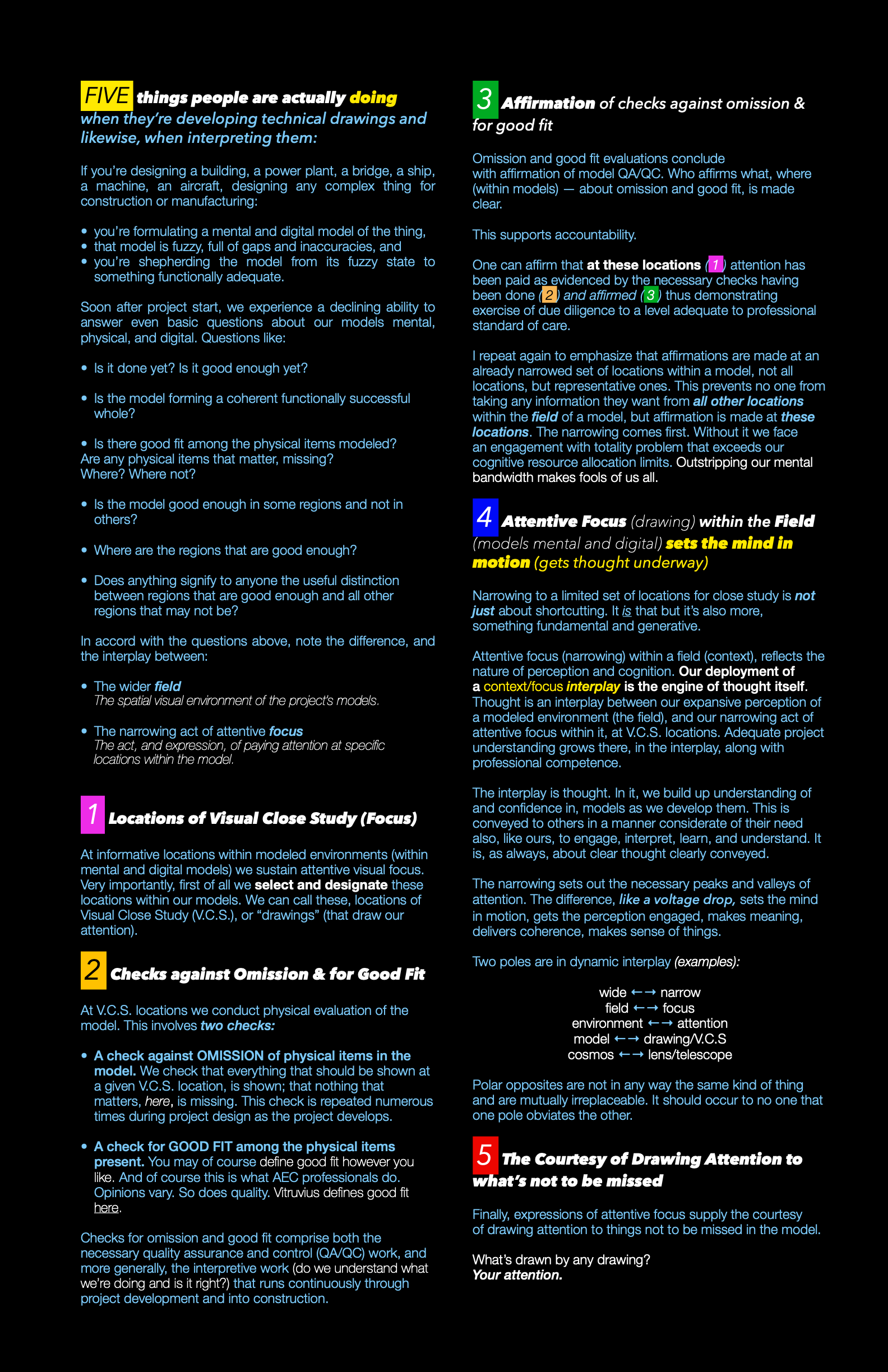
Any discussion on this topic that doesn’t include the functions listed above, is meaningless. It’s not even a topic, only sympathies and antipathies floating in the aether.
All of this has been exceedingly counterproductive.
Abandoning drawing is abandonment of these functions. And these functions are at the foundation of perception and thought itself.
But of course drawing wasn’t actually abandoned. Despite the software rhetoric, firms still devote most of their resources to producing drawings. It’s most of their cost and most of their revenue.
Meanwhile drawing’s form of expression gained absolutely nothing from model’s progression from mental modeling to (mental and) digital. This is software development’s failure and an essential one. Drawing’s failure to evolve in ways that make use of modeling’s transformation from mental to digital, is the cause of modeling’s failure to thrive. This is counterintuitive for some. But if you recognize the functions of drawing, the 5 listed above, you no longer see it the same way. Instead you see It turns out that none of this was ever abandonment of drawing; it was abandonment OF DIGITAL MODELING. You left it out in the cold.
By calling for the end of drawing, by shunting drawing — the lens for looking at models with specific intent, and showing that you did — into a 5 decades long unchangeable state, unaffected in its form of expression by digital modeling, you stunted the utility, usefulness, and utilization of models.
Congratulations!
You win the Trophy of Self Defeat.
You’re the Champion of Counterproductive.
How are Models, or “the I in BIM” or “AI” going to do any part of the 5 functions listed above — which are non-optional foundational functions necessary for getting any kind of work done, in any field — other than niche things on the margins?
Or to tune that a bit, if you truly do want models, and the “I” in BIM, and AI, to invigorate/elevate the core work of AEC professions, why would you not start by building the equipment necessary for addressing these core functions, the 5 listed above, in-situ, within digital models, and then add your your “I in BIM” and A.I. to that in order to address the core work and activity, and amplify it? Would that not logically be maybe infinitely better (more effective) than pointing at the core work with disdain and claiming in a fog of obfuscatory empty words that you’re going to replace it with something grandly superior, that you can’t yet put your finger on and describe with any clarity?
I mean, that is, if you wanted to stop stealing defeat from the jaws of victory and actually be productive?

And here is some random stuff about Charles Sanders Peirce relevant because as in points 1, 2, 3, 4, and 5 above, thought and perception are an interplay between narrowed attentive focus within the wider expanse of a visual spatial environment. So there is a triad:
- The wider environment of a project’s models (mental, physical, and digital).
- the act and expression of narrowed attentive focus within that environment.
- the mental model put into formation through the dynamic interplay between 1 and 2
- and the prerequisite for 3, a sentient being, having a mind capable of model formation.


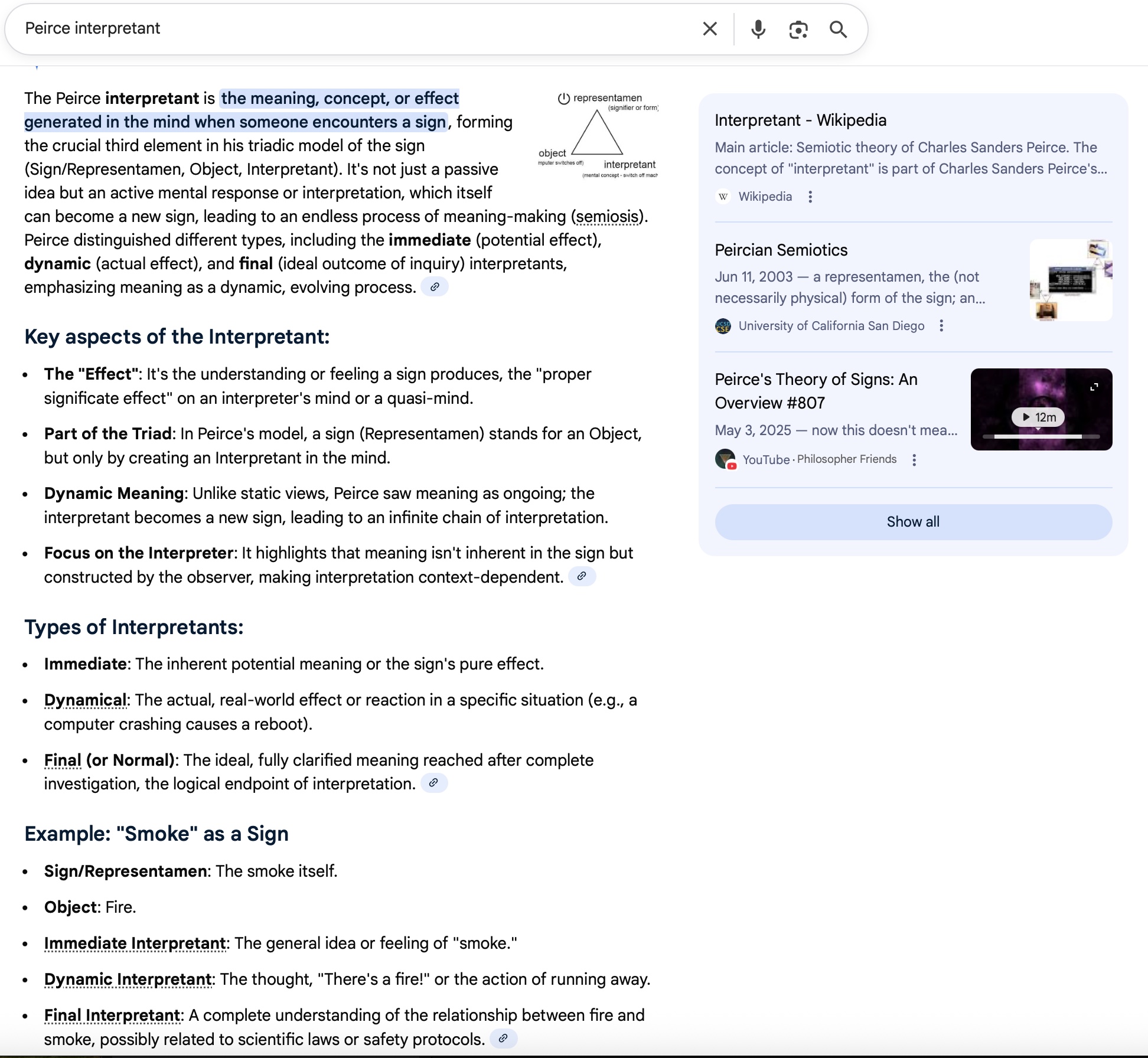
Interpretant is a subject / sign that refers to the same object as another sign, transitively.[1]
History
Main article: Semiotic theory of Charles Sanders Peirce
The concept of “interpretant” is part of Charles Sanders Peirce‘s “triadic” theory of the sign. For Peirce, the interpretant is an element that allows taking a representamen for the sign of an object, and is also the “effect” of the process of semeiosis or signification.
Peirce delineates three types of interpretants: the immediate, the dynamical, and the final or normal.
Immediate, Dynamical and Final
The first of his trichotomies is of the Immediate, Dynamical, and Final interpretant.
The first was defined by Peirce as “the Quality of the Impression that a sign is fit to produce, not to any actual reaction”[2] and elsewhere as “the total unanalyzed effect that the Sign is calculated to produce, or naturally might be expected to produce; and I have been accustomed to identify this with the effect the sign first produces or may produce upon a mind, without any reflection upon it.”[3] An Immediate interpretant can take a variety of forms “it may be a quality of feeling, more or less vague, or an idea of an effort or experience awaked by the air of previous experience or it may be the idea of a form or anything of a general type”.[4]
The second, the Dynamical interpretant. is the “direct effect actually produced by a Sign upon an Interpreter of it”.[5] The last, the Final, is “the effect the Sign would produce upon any mind upon which circumstances should permit it to work out its full effect” and not “the way in which any mind does act but in the way in which every mind would act” if “the Sign is sufficiently considered”.[6]
Intentional, Effectual, and Communicational
Peirce offers another trichotomy of interpretants which he explains as follows:
https://en.wikipedia.org/wiki/InterpretantThere is the Intentional Interpretant, which is a determination of the mind of the utterer; the Effectual Interpretant, which is a determination of the mind of the interpreter; and the Communicational Interpretant, or say the Cominterpretant, which is a determination of that mind into which the minds of utterer and interpreter have to be fused in order that any communication should take place.[6]


 OPEN VCS, a lens for looking at models