We can get stuck on ideas, good or bad.
It takes giant effort to revise ideas held tightly.
For many it’s impossible.
This is a truism well clarified by Max Planck:
AI Overview
The idea that new concepts triumph only when the old guard dies is known as Planck’s Principle, famously summarized by Nobel laureate Max Planck as the notion that science advances “one funeral at a time”. [1, 2]
The Core Meaning
- Generational shift: Max Planck noted that opponents of a new truth rarely see the light; instead, they remain unconvinced, and progress happens because a new generation grows up accepting the fresh idea as normal. [1]
- Entrenched power: Senior experts act as gatekeepers who built their careers on older models, making them naturally resistant to revolutionary disruptions. [1, 2]
- Empirical backing: Research on academic fields shows that when an elite “star” scientist passes away, fresh non-collaborators step in and increase high-impact innovation in that specific subfield. [1]
Why Resistance Persists
- Sunk cost: People invest decades into mastering a framework, so a new paradigm feels like a threat to their life’s work rather than a tool for clarity. [1]
- Caution vs. agility: Veterans rely on past failures to filter out risky ideas, which sometimes turns healthy skepticism into outright dismissal of novel paths. [1]
Even just a few revising edits are impossible:
Drawings are
stilla vital part ofthe process.
I’d omit the word “still“.
And “a vital part of“.
Drawings–are–the process.
What is “the process”?
This is the process:
what’s written below in cyan on the black background:
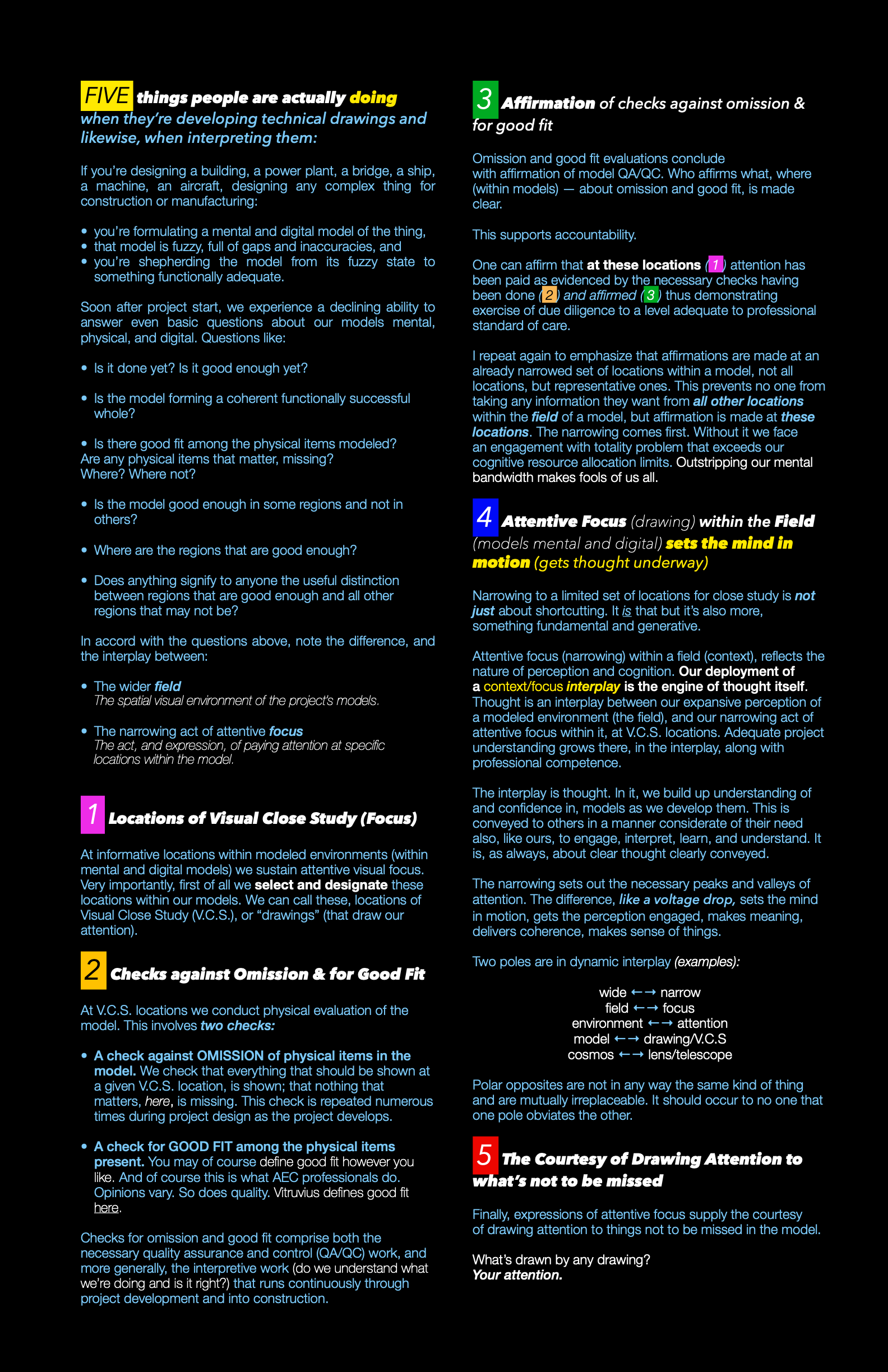
Why do Architecture and Engineering Firms invest so much in the development and use of drawings?
If you could peak in and take a look at what most of the people most of the time in most of the firms are working on …you’d see they’re working on drawings.
Even today, in 2026.
Why is that?
Do AE firms or their clients somehow need drawings?
That’s not the right question.
A more provocative question, the right question in other words that gives a productive answer is:
What do AE and C firms need, that they acquire through the development and use of drawings?
The answer is what’s written above in cyan on the black background.
What they need is that process .
Given the actual necessary and core cognitive work, the actual process, it's funny that 20+ years ago BIM evangelists claiming to "drag the industry by hook or by crook into the future" wielded the Planck Principle in support of their idea and imperative: "Abandon Drawings! ...because Models!"1.
Doubly wrong too, because the whole premise has been only a narrative.
And infinitely wrong because the narrative in no way reflects what’s actually being done:
- “BIM” that almost entirely hides the model, during model development, review, and interpretation process.
- Outcomes: models are built typically in very low quality.
- “BIM” apps are mostly used for CAD drafting (inefficiently too), while pretending otherwise.
- And what has to be done, the actual process, was and remains completely unrecognized by these evangelists.
- Neither clash detection, nor point clouds, nor “the “I” in “BIM”, nor “AI” do anything to rescue this. And they won’t. They too are narratives.
Narratives wrapping narratives wrapping narratives, all in order to continue to hide from REALITY:
THIS IS THE PROCESS .2
- The basic problem with ideas like this (total modeling) has been understood for a long time before it was relentlessly mocked by Borges in 1946 and before that by Lewis Carroll in 1893: On Exactitude in Science ↩︎
- Looking with Intent. And Showing that you did ↩︎
For a glimpse at the future of digital media supporting the actual process of design development and interpretation, see https://tangerinefocus.com:
TANGERINE FOCUS
a lens for looking with intent — at models mental, physical, and digital — and showing that you did.
It’s in the model. The focus is in the model.