The live-action/animation hybrid follows Wile E. Coyote as he hires attorney Kevin Avery, played by Will Forte, to sue ACME over the countless products that have backfired on him. Directed by Dave Green, the film also stars John Cena and Lana Condor and arrives nearly three years after Warner Bros. Discovery originally shelved it before Ketchup Entertainment acquired the rights and brought it back for a theatrical release.
Wile E. Coyote and the Road Runner are fictional characters from the Looney Tunesand Merrie Melodies series of animated cartoons, first appearing in 1949 in the theatrical short Fast and Furry-ous. In each film, the cunning, devious and constantly hungry coyote repeatedly attempts to catch and eat the roadrunner, but is humorously unsuccessful.[10]Instead of using animal instinct, the coyote deploys absurdly complex schemes and devices to try to catch his prey. They comically backfire, with the coyote invariably getting injured in slapstick fashion. Many of the items for these contrivances are mail-ordered from the Acme Corporation and other companies.
. . . Jones based the coyote on Mark Twain‘s book Roughing It,[13] in which Twain described the coyote as “a long, slim, sick and sorry-looking skeleton” that is “a living, breathing allegory of Want. He is always hungry.”
I think as a kid in the 70s watching these every Saturday morning the message was loud and clear: tech is no magic bullet and tends to backfire.
You can watch these, the original episodes and authenticity just oozes out of them. They’re not made up fantasy. This stuff is born out of experience. And I have no doubt that from 1930 to 1969 when these were produced, midway between the two wars at the start, then continuing beyond for 24 years after the second, right through the apex of machine industrialization of the 20th century.
It’s all stuff that’s been seen and done. And lessons learned. Real ones. With consequences.
There are limits to what can be done with tools. And they have to be applied, sensibly, and at the right scale. It’s a counter-dose to what otherwise had become a religion:
“All tech is good! All technology is applicable to all things! Always at ever-increasing scale and scope! More is more and more is always better!
Sounds familiar.
Which is more true:
– All tech is useful? or: – All discernment is useful?
Manifestos from tech titans such as Mark Zuckerberg, Sam Altman, Marc Andreessen, and Alex Karp are proliferating because they want more power and money, despite already having a great deal. As the sub-title says: they want “something from the rest of us. And the manifestos reveal what that is.” It is more money and power.
Traditionally, manifestos have been written by outsiders such as Gordon Moore (Moore’s Law.) He was an outsider in 1965 and only became an insider because he helped Intel and semiconductor industry become rich and useful.
“But the authors of AI manifestos are not outsiders banging on the gates. They run some of the richest and most powerful institutions in the world. They command enormous pools of capital, employ thousands of people, and have unusually direct access to governments. Manifestos are the weapons of the powerless, and these men are anything but.”
They claim that “AI is inevitable,” which if true would mean that a manifesto is not needed. For instance, “when was the last time you encountered a manifesto about the sunrise? When did you read rich men waxing lyrical about the untold promise of our local star?”
The AI these rich men are talking about is not inevitable, only some parts of it. For instance, “AI is not going back in the box. Existing capabilities, technical knowledge and commercial incentives will not simply vanish.” True, there is some “weak inevitability.”
“But strong inevitability is simply untrue—even if we do in fact end up in one of the worlds that the manifestos describe, it is not currently inevitable that we must end up there. What has already been discovered may be impossible to reverse, but the scale, pace, and success of what gets built around it remain very much open.”
In other words, “the future still—thank heavens—depends on us, on human choices. The discourse of strong inevitability attempts to obscure that fact. The interesting question is why its proponents are trying so hard.”
The reason is that their vision of the benefits from AI, which they want to claim is inevitable, is highly uncertain. While the tech titans have managed to co-opt much of the U.S. economy to build data centers, they want more money and political control to build more data centers even though the benefits are highly uncertain.
A Harvard Professor, Jill Lepore, argues that the tech bros are trying to replace the traditional nation state, including constitutional democracy, with machines that are making decisions and are owned by corporations, thus making humans unnecessary.
That may sound extreme, but it is plausible. Thus, the tech titans write manifestos to justify their hijacking of first the venture capital system and now the global financial system. They claim that everything will be just wonderful, but some of us keep wondering why our lives aren’t already partly wonderful, and those of us living closest to data centers are the most angry.
Wile E. Coyote was named sarcastically, not at all wily. When the creator handed out discernment for recognizing problems and purpose, and the wit to match them with tech products for problem solution, he missed Wile E. who got nothing. Well, I’m hoping to laugh out loud on Friday at the movie.
AEC software discourse on LinkedIn now looks like this:
I think this is the write side of the same architectural problem I have been exploring from the read side.
Before an agent can safely change a model, it needs a persistent account of what changed, which requirements apply, what evidence is authoritative and which dependencies may be affected. If every evaluation begins by reopening the authoring model and reconstructing the whole document, “continuous compliance” risks becoming faster batch QA/QC.
The CI/CD analogy becomes especially interesting around containment. In a dependency-rich parametric model, the true boundary of a change may only become visible after execution and regeneration. So perhaps the safe pattern is: propose the change, execute it in isolation, observe the actual change set, test it against an allowed-impact envelope, and only then commit or roll back.
That requires more than an intelligent agent. It needs a project catalogue, versioned requirements, deterministic execution, authority, provenance and an independently observable change history.
The AI can decide what ought to happen. The surrounding system has to prove what actually happened—and whether it was allowed to.
In the U.S. such things were well known after 1914. That’s pretty old, more so today because clearly we’re devoted now to a tech path, the use and proper operation of which will require more time and effort than just doing the work, say by hand, with pencils, machine-free. Maybe time for a new word for such machines.
A Rube Goldberg machine, named after American cartoonistRube Goldberg, is a chain reaction–type machine or contraption intentionally designed to perform a simple task in a comically overcomplicated way. First appearing in a cartoon for the New York Evening Mail, these machines consist of a series of simple unrelated devices; the action of each triggers the initiation of the next, eventually resulting in achieving a stated goal.
The term “Rube Goldberg machine“ comes from the cartoonist by the same name, Rube Goldberg, who would illustrate many of these machines.[1] The first Rube Goldberg machine was drawn by him in 1914, titled the Automatic Weight-Reducing Machine drawn for the “Inventions!” section of the New York Evening Mail. In the cartoon, the machine uses a variety of objects to get an overweight person to become trapped in a hole. The man is then starved until he is thin enough to pass through the hole and escape.[1] https://en.wikipedia.org/wiki/Rube_Goldberg_machine https://en.wikipedia.org/wiki/File:Something_for_nothing_(1940).ogv
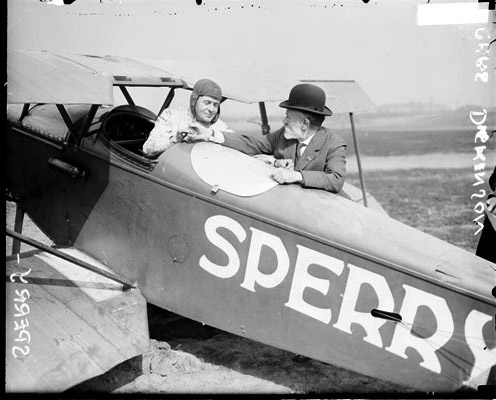
By the way, that same year, a very useful machine, the first autopilot, 1914:
The Sperry autopilot is a historic gyroscopic flight stabilization system invented by Lawrence Sperry in 1914. It used spinning gyroscopes to automatically control an airplane’s surfaces, allowing hands-off, straight-and-level flight and revolutionizing aviation safety and long-distance navigation.
Invention and Public Demonstration Lawrence Sperry famously demonstrated the device on June 18, 1914, at an aviation safety contest in Paris. By walking out onto the biplane’s wings while the aircraft continued to fly itself stably, he proved the reliability of his three-axis gyroscopic stabilizer.
Convincing! Proof! By the way, as far as I know, no one has referred to auto-pilot as “AI”.
Nice thing about it is the clear purpose, and the sensible use of tech applied for a sensible purpose, and with the problem actually resolved, directly.
You know, and absent all the grandiose promises!
But what is “sensible”? Well, it takes discernment to know that. But, you don’t need a whole lot of it, just enough. Some things really are obvious.
What is the problem in AEC?
A couple of recent posts of describe this at sensible level of generalization, sensible such that:
the problem description aligns with the general observable purpose of AEC work,
and, the problem is addressable by appropriately designed software
which if developed could be easily put to immediate practical use, applied directly to the core work of AEC professions.
Hi! My name is Rob Snyder, I’m on a mission to elevate digital models in AEC (architecture, engineering, and construction) by developing equipment for visual close study (VCS) within them, so that they supply an adequate assist to the engine of thought we all have running as we develop models during design and as we interpret them so they can be put to use in support of necessary action, during construction for example.

 TANGERINE FOCUS