Drawings belong in models. It’s where they’ve always been.
V1.0 Drawings in Mental Models
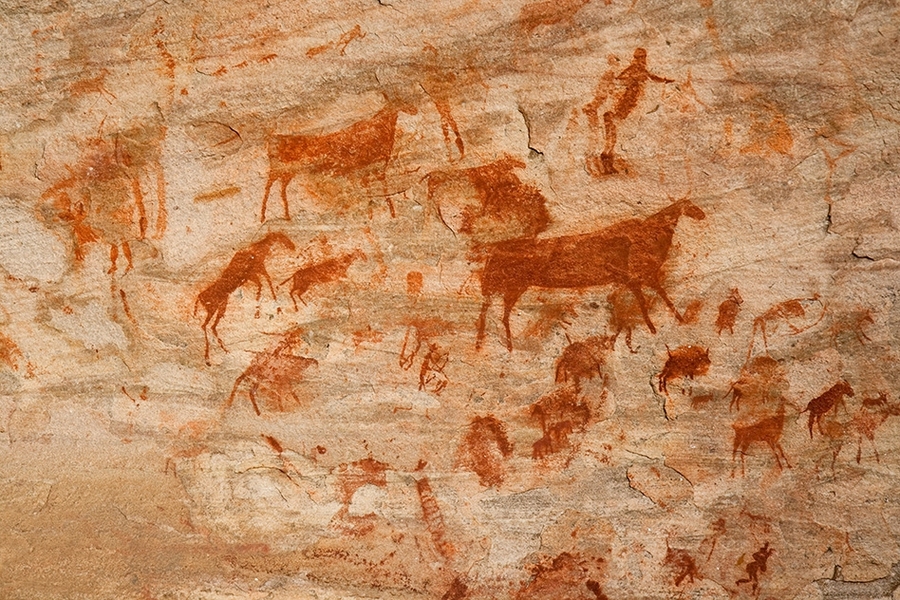
Drawings belong in models. It’s where they’ve always been. For good reason. From the first time anyone scratched out a drawing in sand, on a cave wall, on papyrus, they instantiated that graphic in-situ where it really is, in the mental model in formation in their minds. An interplay was underway.
I was paid for years to build digital models of buildings and technical drawings of those. Doing that work long enough made me see that the two things (drawing and modeling) form a loop/interplay and that without that loop running, meaning is left superficial and quality degrades across both.
It’s the same with anything I suspect, any field of study or work. There is the broad expanse of the field, and there is the close study of particular aspects of it. And there is an interplay/loop running between those, one mutually informing the other. In that flow, meaning is found, understanding grows.
This is the engine of thinking itself.
The Engine of Thought, an interplay between two poles: wide and narrow, environment and focused close study. In the interplay, thought happens and understanding grows. With either of the two poles absent or diminished, the engine shuts down, or evaporates along with thinking itself and understanding, which fails to develop.
There is more to say about this. Let’s break it into five parts: 0, 1, 2, 3, 4…
(0). Initiation:
A mental model of the project starts to form (more here). It’s fuzzy, fluid. A mist, really. Here are some of the basic questions about models that we all have as we author and use them:
is it done yet?
is it good enough yet?
is the model forming a coherent functionally successful whole?
is there good fit among the physical items modeled?
are any physical items that matter, missing? Where? Where not?
is the model good enough in some regions and not others?
where are the regions that are good enough?
does anything signify to anyone the useful distinction between regions that are good enough and all other regions that may not be?
And here are the primary functions of technical drawing as we’ve known it for centuries. Drawing IS equipment for visual close study (V.C.S.) of models. Here are the functions:
The functions of V.C.S. equipment
At significantly informative LOCATIONS within models mental, physical, and digital, we conduct sustained articulate expression, ofthe act of VISUAL CLOSE STUDY (V.C.S.).
PHYSICAL EVALUATION of models at V.C.S. locations. Evaluation is primarily A CHECK AGAINST OMISSION of physical items in the model, and A CHECK FOR GOOD FIT among the physical items present. It takes thoughtful effort through the lens of visual Close Study (V.C.S.), and time, to develop and complete these checks, particularly during model development during the design phase of a project. Models start from nothing and grow into what they become. The checks are done all along the way in a process of effort-full thinking, using the engine of thought, *see (4).
Physical evaluation at V.C.S. locations concludes in a state of AFFIRMATION of model QA/QC. Who affirms what, where, is made clear. This supports ACCOUNTABILITY.
Successful expression of Visual Close Study (V.C.S.) sets out the necessary array that is the 2-pole *ENGINE OF THOUGHT* itself, an engine formed as an INTERPLAY between the wide expanse of a modeled environment (the FIELD), and the narrowing act of our attentive focus within it at V.C.S. locations.
In this INTERPLAY, thought happens and understanding grows.
The two poles, (wide/narrow) (FIELD/focus) (model/V.C.S.), are as distinct from each other as the cosmos is from a lens for looking at it, as distinct as the universe is from a telescope, They’re not in any way the same kinds of things and one cannot replace the other.
Finally, VISUAL CLOSE STUDY supplies THE MINIMUM COURTESY OF DRAWING ATTENTION TO THINGS NOT TO BE MISSED IN THE MODEL
Let’s comment a little more on these functions.
(1) Visual Close Study (VCS) of models
Expression of visual close study (V.C.S.), sustained articulate expression of the act of narrowed attentive focus within the wider expansive environment of a project’s mental, physical, and digital models.
Any single technical drawing is an expression of the act of looking somewhere specific within a model mental, digital, or physical. A drawing is the act of visual close study (VCS), there, at that location, and the articulate expression of this close study.
(2) Physical evaluation
Physical Evaluation, of the model at V.C.S. locations, primarily a check against omission of physical items, and development of good fit among the physical items present.
There at that location, we evaluate, is everything that should be shown there actually shown there? Is anything that matters there missing?
The main idea hinted at here in step (2) has to do with evaluation, of a particular kind.
It’s not primarily about classification, or conformance with classification standards. Classification is there but it’s secondary.
The evaluation in step (2) is primarily about physicality.
It’s about the evaluation of putting things together, assembling an assemblage. It’s a check against omission, of physical things. It’s a check on how complex physical systems are fit together, and how we affirm (step 3, below) system quality in terms of whether or not any of the physical pieces that are necessary are missing, and whether or not all the pieces needed fit together well or not.
Good fit involves many sub-evaluations, like:
economy, firmness, and delight (Vitruvius)
Is it fit for purpose, including ‘doing the job’ and meeting the budget?
Is it durable, stable, reliable?
Does it stir something in us?
(3) Affirmation
Affirmation of (2. Physical Evaluation)
Finally at some point after the long work of model development and review, someone with authority (experience, knowledge) to do so, AFFIRMS the status of the questions in (2).
(4) INTERPLAY: the engine of thought
Building The Engine of Thought, an interplay between two poles: wide and narrow, environment and focused close study. In the interplay, thought happens and understanding grows. With either of the two poles diminished, the engine shuts down, or evaporates along with thinking itself and understanding, which fails to develop.
Along the way (0, 1, 2, 3…) an INTERPLAY is engaged, in our minds, between:
a set of expressions of visual close study (VCS) at various locations of narrowed attentive visual focus within a model
and
the wider expanse of the whole of the modeled project environment.
In the interplay, thought happens and understanding grows.
Fuzzy initial ideas are sorted and judged. Selected stronger concepts are thought through, clarified along the way, and ultimately, thought through all the way through so they can be carried to fruition.
0, 1, 2, 3, and 4 are the higher order work of AEC professions, done by binding up, stitching together model and drawing
That list is not complete though. There are some other functions in play. I’ll add another one here, call it item 5.
(5) The courtesy of drawing attention to things not to be missed, in the model
Item 5 is about having the courtesy (to oneself and to others) to draw attention to critical aspects of a model. You may have a model that is of excellent quality throughout, but even so, people using that model are going to appreciate it if you draw their attention to particular things that are not to be missed. I describe a case of that in a little project of my own here. Please take a look. It’s a fun story, I think:
So these are vital functions, essential, the function of technical drawing, 5 functions that is, all at once.
1, 2, 3, 4, and 5 are not to be dismissed. And not to be dismissed lightly without serious thought put into the consequences, after which, the conclusion certainly will come that dismissal was not a good idea, and that it’s the idea of the dismissal of drawing that ought to be dismissed, not drawing.
We can also dismiss the idea of keeping drawing locked permanently in the same form of expression by which we’ve known it in all the centuries before digital computing and software.
Modeling evolved, from mental to digital model. Drawing can evolve too.
First thing to notice is that as drawing has always been instantiated, by mental exercise, in the mental model. So in the digital model, drawing should be instantiated too, digitally, automatically. This is about automated drawing-model fusion.
I invented that. it’s documented on the V2.0 page. That was my earlier work. Variations of it are in 9 softwares since we did it first in 2012.
With the popularization of digital modeling by the 1990s, technical drawing continued as before in it’s usual role, while instantiation into the model continued as it always had, unaltered from V1.0, as mental exercise only. Until I invented the automated fusion of drawings in digital models in 2012.
V3.0 OPEN V.C.S. Equipment for Visual Close Study in Models (2024)
Those envisioning the future of software/tech in the AEC industry must account for the clear necessity of these functions within each AEC discipline as they develop their discipline models, and the use of drawings, and things that are functionally like drawings, throughout the design > fabricate > supply > construct > and use and maintain chain.
There is no future in which the essential functions of drawing are not expressed either in traditional form, or in new forms of expression of the same functions within digital models.
There is no future in which the functions are abandoned.
TGN (V3.0) is an evolution in FORM. The form of expression, of technical drawing, now that it resides in digital models (V2.0), should evolve. Because it can. And must.
TGN stitches together technical drawing and digital modeling. Not only a fusion, but also an evolution in form that surfaces the best of both media, in a new form of expression greater than the sum of its parts.
It is proposed to enter the market through an open source set of core features to be developed, shared, and promoted to existing and new software companies and relevant standards organizations (e.g., Open USD), with commercial opportunities for software companies for extending beyond the open core.
The V3.0 page includes a summary outline explanatory text describing the 8 core features of ‘TGN’ VCS equipment in digital models., a more comprehensive TGN VCS specification for software developers, and demonstration videos simulating TGN functionality in a visual mockup.
Development has started
We have now 3 developers volunteering on this TGN open source project so far and 2 more just now joining. We’re getting our codebase house in order, to make it easier to open the doors and invite everyone who’s interested, into the project.
We’ll announce our GitHub and Discord server later in August (2024).
How to build a model of something very complex that doesn’t exist yet
That’s design of course.
Imagining things that don’t exist.
Starting with a conception (in fog) of things that should be, then developing them into what they become. Thinking things through all the way through along the way to get there.
That’s not easy. And you need some equipment to help you.
Years ago I tried to describe it by unwinding a completed digital model of a building, turning things off, then isolating a corner of the model, then deleting pieces one at a time.
Here’s a video showing that. It’s model creation in reverse, sort of. It’s not reverse order precisely but it’s going from done to undone, backward toward the beginning when there was nothing, or close to nothing:
 OPEN VCS, a lens for looking at models