I brushed off my old modeling skills for a project at home.
Fire block and ceramic tiles are going up, behind a wood stove to the left of the chimney here:


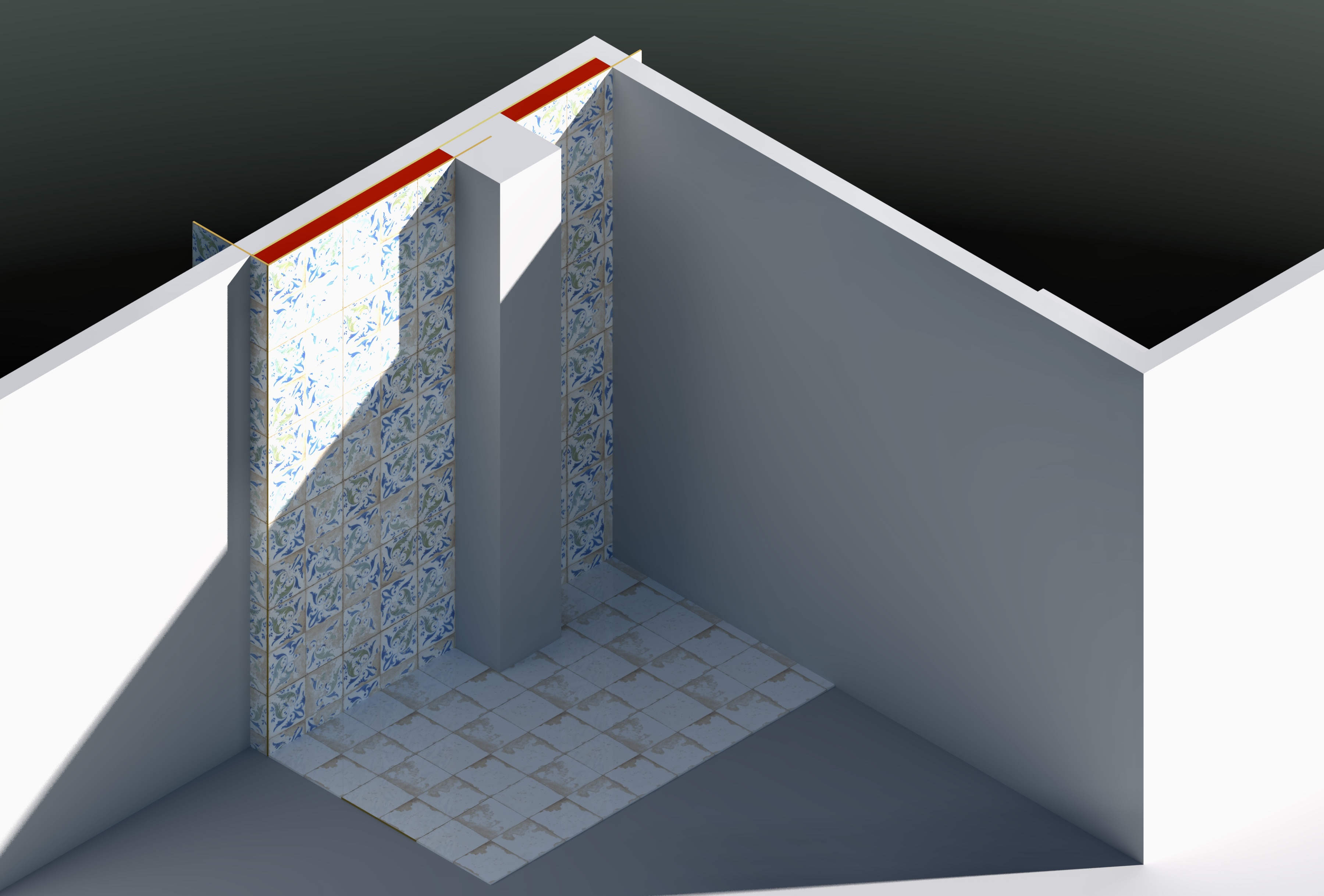
I worked this out in my head before but I’m glad I modeled it in software. My mental model was not bad but had gaps. Making the model digitally confirmed some things, and revealed others I hadn’t thought of. And the outcome is beautiful and useful.
It’s correctly dimensioned with the tile joint spacing included. I was concerned with the tile grid lines so I modeled them two different ways, first with a whole tile against the wall corner and building out from there, then aligning the tile grid at the left edge of the chimney.
As expected, the latter turned out to be much better. The graphics confirm this and emphasize it; it’s much better than predicted, to align there, and cut the tiles where they meet the wall on the right. There’s no way this is the wrong decision. The model shows this.
Likewise, a whole tile at the top of the wall, or a whole one at the bottom then building up? Clearly, a whole tile at the top is better. And the cut tile at the bottom looks like foundation, or base. So it looks right.
A happy accident, unexpected, happens to the right of the chimney with the grid aligned this way. A whole 4-square fits just very nicely between cut tiles on either side of it.
The tile is made in 4-squares, 2×2. Another unexpected revelation is that the rotations of the 4-squares when arrayed on the wall, matters, a lot.
I was able to rotate the textured 4-squares in the model very easily and see the huge impact of getting the rotations wrong, or right. I’m glad I know this before starting the tile work.
Modeling this also shows I can easily get tile counts off of this simple model too, and it’s accounting for where to cut, and tile waste too. So we know exactly how much tile to buy.
So hurray for digital modeling!
I already knew this and started my celebration of digital modeling in 1996.
Since 1998 I did architectural building design and construction documents (model-driven technical drawing), through high intensity digital modeling in firms large and small including my own.
Reminiscing…, here are a few of the projects I worked on:
I got into digital modeling before that as a student in Architecture school. So for 30 years now I’ve been a huge fan of it. So:
All Hail Emperor Digital Model!
But something’s missing…
As mentioned in the title of this post, digital modeling is like an emperor with no clothes.
Remind yourself, it’s a short story you can read in 3 minutes:
THE EMPEROR’S NEW CLOTHES
https://andersen.sdu.dk/vaerk/hersholt/TheEmperorsNewClothes_e.html
a translation of Hans Christian Andersen’s “keiserens nye klæder”
I don’t know how good Andersen’s emperor looked unclothed. Fortunately, digital models look great unclothed, like some naked Zeus God. It’s a story element not in Andersen’s original and no doubt its part of the reason nobody calls out that maybe it would be better with clothes on.
No matter the greatness of one’s ruler, covering up is beneficial. For many reasons that are obvious, not least getting civilized.
I’m calling it out.
And I made some clothes for the models to put on.
Put these on. It’s civilizing and beneficial. The model just works better:
So yeah, get some clothes on your models so people can interact with them in a sensible way and make sense of them, easily.
Read about the proposed clothes at the link below, and push the developers of your favorite modeling apps to sew these clothes into their software, and push it into Open USD through AOUSD.
Get me involved. The clothes will be finer with my help.
These are “clothes” for the model that conform with constraints inherent in visual perception and cognition.
Human understanding of digital environments, and the real world alike, is dependent on mental model formation. Formation of an adequate mental model in turn depends on human engagement of a particular form, the form subject to constraints inherent in human perception and cognition.
A LITTLE PREFACE
Martin Ciupa posted this gem:
Douglas Hofstadter’s book “I Am a Strange Loop” is an exploration of the sense of “I” and examines in depth the concept of a strange loop to explain the sense of “I”. The concept of a strange loop was originally developed in his 1979 book Gödel, Escher, Bach. In the end, we are self-perceiving, self-inventing, locked-in mirages that are little miracles of self-reference.
Hofstadter demonstrates how the properties of self-referential systems can be used to describe the unique properties of minds.
*****
From 1st linked article…
Think of your eyes as that video camera, but with a significant upgrade: a mechanism, the brain, that not only registers images but abstracts them, arranging and constantly rearranging the data into mental structures–symbols, Hofstadter calls them–that stand as proxies for the exterior world. Along with your models of things and places are symbols for each of your friends, family members and colleagues, some so rich that the people almost live in your head.
https://www.scientificamerican.com/article/a-new-journey-into-hofsta/
https://en.m.wikipedia.org/w/index.php?title=I_Am_a_Strange_Loop
To that I add some thoughts. In this post, I have a few things to add about the “mechanism, the brain, that not only registers images but abstracts them, arranging and constantly rearranging the data into mental structures”.
The abstracting and arranging and rearranging, of visual input, into mental structures (your models of things and places, proxies for the world, that live in your head) happens in two ways, the difference between which is analogous to the distinction between autonomic processes (like breathing) — that happen without our conscious effort or control over them — and somatic processes that involve voluntary actions that we are aware of.
The analogy isn’t perfect but the gist of it holds up and is useful.
For visual processing, it’s a question of degree. It happens on a gradient, from automatic (involuntary) visual processing that happens without our awareness, to voluntary visual processing requiring effort that we’re aware of and technique (including media) in support of that.
Here you can see an example of the former. This is me, engaged in autonomic visual processing of my back yard. Yes I’m moving through the garden with volition, but the visual processing happens by itself without conscious effort, like breathing:
Now it should be clear already that as digital environments these days become ever more “realistic”, they become stand-ins for the real world and thus are subject to the same fundamental constraints. That is, if we are going to immerse ourselves in them and perceive them, our perception operates according to the same gradient ranging from autonomic to somatic visual processing.
In video games, autonomic visual processing is usually adequate. But for more complex tasks, it isn’t. Where it isn’t, effort, and equipment are needed.


 OPEN VCS, a lens for looking at models