Richer ground, where crops thrive.
I’m searching for a developer partner who shares my understanding of why equipment for visual close study (VCS) — of models, in models — matters, and the industry potential of it, and wants to help build either the open source core for everyone, or a company that builds product around this core, or both.
At my website https://tangerinefocus.com, there’s a page about me https://tangerinefocus.com/about-2/, and a page about my software development proposal to evolve the form of expression of technical drawing that otherwise has remained essentially unchanged in form for hundreds of years https://tangerinefocus.com/visual-engagement-with-modeled-worlds/
I’ve contributed to the evolution of drawing already with my previous work on drawing-model fusion, which started with my proposal for the automated fusion of technical drawings in-situ within digital models, a concept that found its way into 9 different software products from 9 different companies, some of those leading their segment in AEC, the first of which hired me to lead the development team to build it and release it in commercial software first, in 2012: https://tangerinefocus.com/tgn/earlier-media-innovations/.
The new proposal, designated for now as ‘TGN’, leapfrogs past the earlier fusion work, in form, mechanism, legibility, user engagement, functional effect, clarity, openness, usefulness and utility generally: https://tangerinefocus.com/visual-engagement-with-modeled-worlds/ But it remains a proposal only as I continue searching for people who want to make it happen and want my help doing it.
I was asked today again to compare BCF and TGN. Here’s my answer:
BCF is OK but not enough. My earlier work is also OK but not enough. Here’s my earlier drawing-model fusion, https://tangerinefocus.com/tgn/earlier-media-innovations/
The new proposal is an evolution of that, a new mechanism, and carries the idea further logically. TGN is ALL that technical drawing is, PLUS more, including that it’s expressible in the model, not just externalized, and it takes advantages of things that are possible because of the model. Unlike BCF, it’s not limited to a single viewing point; it’s more than a saved view with an element filter and some comments. BCF is great, but it needs to go a bit further.
This is a question of degree.
- BCF goes part way, but the task it starts to address is bigger than what it addresses.
- Technical drawing is great, but it’s externalized only — except for those few, 9, softwares that followed my fusion work in MicroStation in 2012 https://tangerinefocus.com/tgn/earlier-media-innovations/ , but those are all siloed, and still, too limited anyway. There are flaws in that fusion concept that I’ve addressed in the new proposal, for better legibility, better engagement for users, and greater visual expression. TGN will get more people more engaged with more models.
The demonstration videos I made are partial. The outline text is pretty clear though. If you read the outline of 8 features and think about it, you can see much more of what this can be. The demos and the outline, and a specification, are here: https://tangerinefocus.com/visual-engagement-with-modeled-worlds/
Of course, any existing technical drawings and variants — BIM views, BCFs, and technical drawings made from BIM, or made manually — all can be upgraded to TGN form, even automatically. The logic is straightforward. It’s reversible too. And of course BCF issue-handling remains intact. Users could create BCF issues against TGN rigs in models.
Users need VCS to evolve further
Scroll down from near the top of this page to see the TGN feature outline, 8 features of TGN: https://tangerinefocus.com/visual-engagement-with-modeled-worlds/ Notice feature 3, a built-in camera PATH. This, what’s expressible through that path, is how our mind works anyway. Look at any technical drawing, and notice that mentally, you envision the drawing at it’s true orientation, where it really is, in the mental model, and, you wobble your viewing vantage back and forth along a path, in your mind to see the drawing from various viewpoints, contextualized and in a spatial visual temporal continuity.
Sure, a user can do that with drawing model fusion the way I built it at Bentley in 2012, but a controlled path is not built-in to those v1.0 fusions, and it’s very easy as everyone knows, for users to fly OUT OF CONTROL in the model. With a controlled path built in, engagement is better, and the author’s control of graphics along a PATH (see the 8 features of TGN and these videos) opens up new possibilities for VCS expression, no longer confined to a flat plane. You can read about that in the rest of the 8 features..
Industry Potential
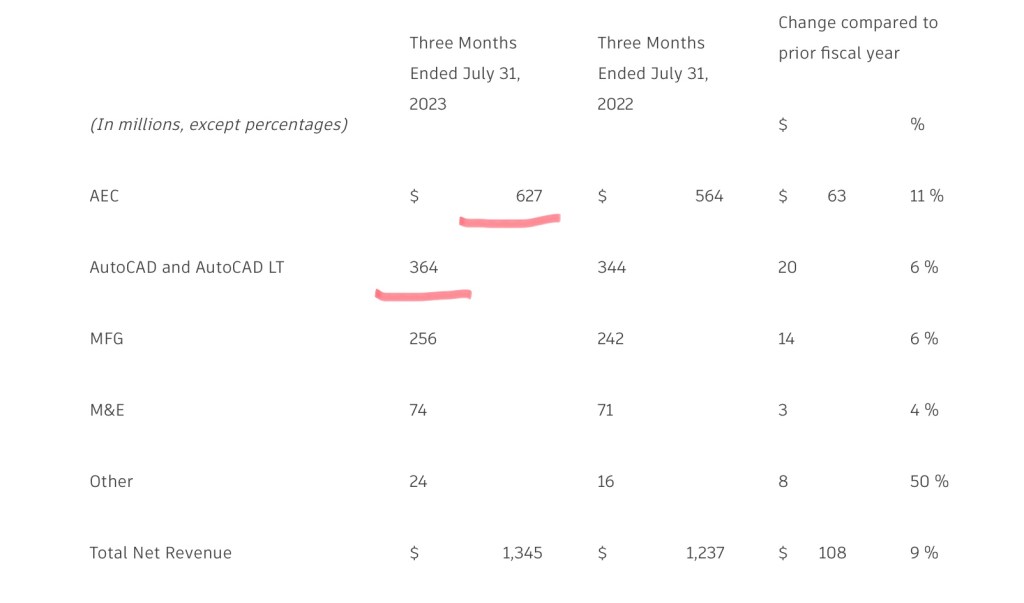
I think there is something to think about in terms of business and market size, some dots to connect. AutoCAD revenue is 60% of Autodesk AEC revenue. This, after more than 20 years of heavily marketed AEC software focused on MODELING. While AutoCAD is for TECHNICAL DRAWING.
Technical drawing IS the articulation of VISUAL CLOSE STUDY (VCS), of mental models.
TGN is VCS for digital models, just as drawing is for close study of mental models.
The market potential of software for visual close study of models, now 30+ years into the proliferation of digital models supplementing mental models, should only GROW from this point forward, not decrease.
TGN is an engine of that growth. That is, it will be, for those who recognize facts that are indeed right out in the open for anyone to see. It’s seeing, the facts, that matters. It does take a little effort. But not much, really. Just, some mental barriers have to be moved out of the way and then it is very easy, and very straightforward.
The reason TGN is going to be an engine of VCS software growth is because it’s designed with:
1. Adequate recognition of the FUNCTION of VCS against models (I write a LOT about this function on my blog and in the TGN specification), and
2. Adequate recognition of the potential for evolution in the FORM of VCS equipment given that equipment’s instantiation IN DIGITAL MODELS as opposed to VCS instantiation, for centuries, in mental models, via mental exercise only, unassisted by digital model media.
This is why I say I have a 30 year outlook. This is a big space. And underdeveloped so far.
- Is BCF is as good as VCS can be?
- Or technical drawing as-is, stuck in a form of expression essentially unchanged in form for hundreds of years, with VCS externalized from the digital model, but re-instantiated in mental models only, via mental exercise unassisted by the digital model? That’s as good as we can do?
- Or v1.0 drawing-model fusions continuing in stasis, failing to evolve drawing’s FORM of expression as proposed following drawing’s instantiation within digital models, drawing’s form evolving as it can and should in new ground? It’s compelled to evolve there. The digital model is richer ground.
V1.0 drawing-model fusion / drawings IN models (in 9 softwares since 2012) https://youtube.com/playlist?list=PLAiyamA5WoZbdfVlrOFLbrgF8AEyi2Fma&si=N2hWt-XvnHsdo3Zb
V2.0 Equipment for visual close study (VCS) of models, evolution in drawing’s FORM of expression (proposed) since their instantiation within digital models, their form evolving in new ground: (proposed since 2018) https://youtube.com/playlist?list=PLAiyamA5WoZZOMO8TGQl3UAjpTHOyKruF&si=NETa-ApcPUs2iYR2
These demos are partial but if you read the features outline on the proposal page, you can see where this can go.
Here’s a video I made in 2010 while we were developing the drawing-model fusion at Bentley. It’s demoed on a project I modeled, and the BIM drawings we made at my architecture firm before Bentley hired me. They’re really good drawings from a really good model, on a little project: https://youtu.be/q06htv-whj8?si=NBOv5aAI9IBi_bt6
Imagine those examples of drawing-model fusion upgraded to TGN format, with the upgrade automatic (see the outline of TGN features, on the proposal page: https://tangerinefocus.com/ ). Then imagine you’re an engineer or architect or builder having the TGN capability already in hand in your modeler from the beginning of the project. That way you could author these VCS (visual close study) expressions with much greater expressive and communicative potential than just seeing flat drawings stuck in-place inside models.
By the way, Augmented Reality?
In the AEC industry, VCS IS the augmentation.
Pioneer TGN: Equipment for visual close study (VCS) of models
Martin Iten
How can technology bridge the gap between different data requirements without enforcing rigid standards?
– Martin Iten on LinkedIn
It’s a great question because standards matter but so does their inevitable non-attainment (we don’t live up to them, ever). It’s one of the motivations behind the proposal for ‘TGN’ features to be implemented in all modeler software. https://tangerinefocus.com/
As you can see on the proposal page, it’s designed to accommodate any mix of standards and anyone’s unique interpretation of those, all their deviations from standard, while enabling articulate expressions of interpretive visual close study (VCS) in models anyway, and cross-modeler portability of VCS rigs.
Embracing flexibility while maintaining interpretive clarity is crucial.
Ibid. (Martin Iten)
Related:
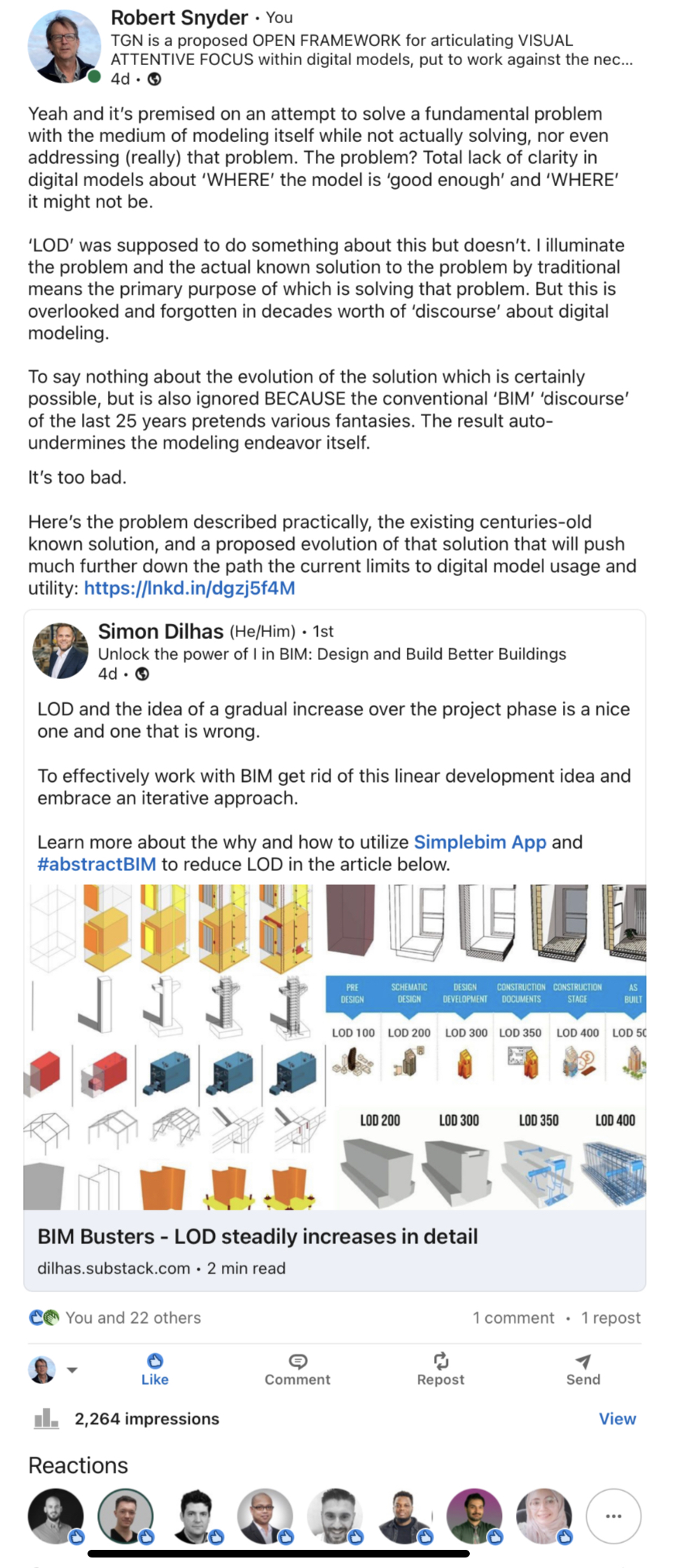
Yeah and it’s premised on an attempt to solve a fundamental problem with the medium of modeling itself while not actually solving, nor even addressing (really) that problem. The problem? Total lack of clarity in digital models about ‘WHERE’ the model is ‘good enough’ and ‘WHERE’ it might not be.
‘LOD’ was supposed to do something about this but doesn’t. I illuminate the problem and the actual known solution to the problem by traditional means the primary purpose of which is solving that problem. But this is overlooked and forgotten in decades worth of ‘discourse’ about digital modeling.
To say nothing about the evolution of the solution which is certainly possible, but is also ignored BECAUSE the conventional ‘BIM’ ‘discourse’ of the last 25 years pretends various fantasies. The result auto-undermines the modeling endeavor itself.
It’s too bad.
Here’s the problem described practically, the existing centuries-old known solution, and a proposed evolution of that solution that will push much further down the path the current limits to digital model usage and utility:


 OPEN VCS, a lens for looking at models