OK, in general…
Any plan for the expression of these (5) functions within modeled environments?
- FACILITATE VISUAL CLOSE STUDY (V.C.S.): articulate expression of the act of attentive focus within the environment of a project’s mental, physical, and digital models
- ENABLE PHYSICAL EVALUATION of the model at V.C.S. locations, primarily a check against omission of physical items, and development of good fit among the physical items present.
- DESIGNATE AFFIRMATION of (2) Physical Evaluation. MAKE CLEAR WHAT (2) IS AFFIRMED, by who, when.
- ENGAGE THE ENGINE OF THOUGHT, set up and engage the interplay between two poles: between wide and narrow perception, between environment and focus (VCS).
In the interplay, thought happens and understanding grows. With either of the two poles diminished, the engine shuts down or evaporates along with thinking itself and understanding, which fails to develop. - DRAW ATTENTION TO THINGS NOT TO BE MISSED in the model (a minimum courtesy).
These are the functions of technical drawing. 5 functions, that is, all at once.
The functions have a past (V1.0), present (V2.0), and a future (V3.0).
More here:
But you said:
Drawings are just dumb lines and arcs.
No. They are what they DO.
Just as words and letters are not lines and arcs.
Letters and words (and sentences, paragraphs, chapters, books…) are what they DO, and what they mean.
Drawings are the 5 functions above.
They facilitate visual close study. They enable physical evaluation. They designate affirmation. They engage the engine of thought. And they supply the courtesy of drawing attention to things not to be missed in models mental, physical, and digital.

This is the nature of 3D in general:
Models, on their own, don’t do what drawings do. So they are not what drawings are.
Drawings and models are different kinds of things, different categories. One not replaceable by the other.
Models are environments. Modeled environments are excellent hosts for specialized equipment within them that embody or carry out the 5 functions of drawing. But that equipment has to BE THERE.
Software developers in AEC (architecture, engineering, and construction) still largely omit that equipment or otherwise put insufficient energy and imagination into envisioning and developing it.
That insufficiency is unrecognized. Developers are convinced everything is fine mostly because they believe:
1) drawings are dumb lines and arcs, and
2) they’re developing an ordained substitute (models).
So:
…
1) They’re not.
2) They’re not.
People can be, just, completely wrong. En masse. For decades.
It’s happened many times before. And we’re not immune to these things today.
I’m doing what I can to change it.
From my website:
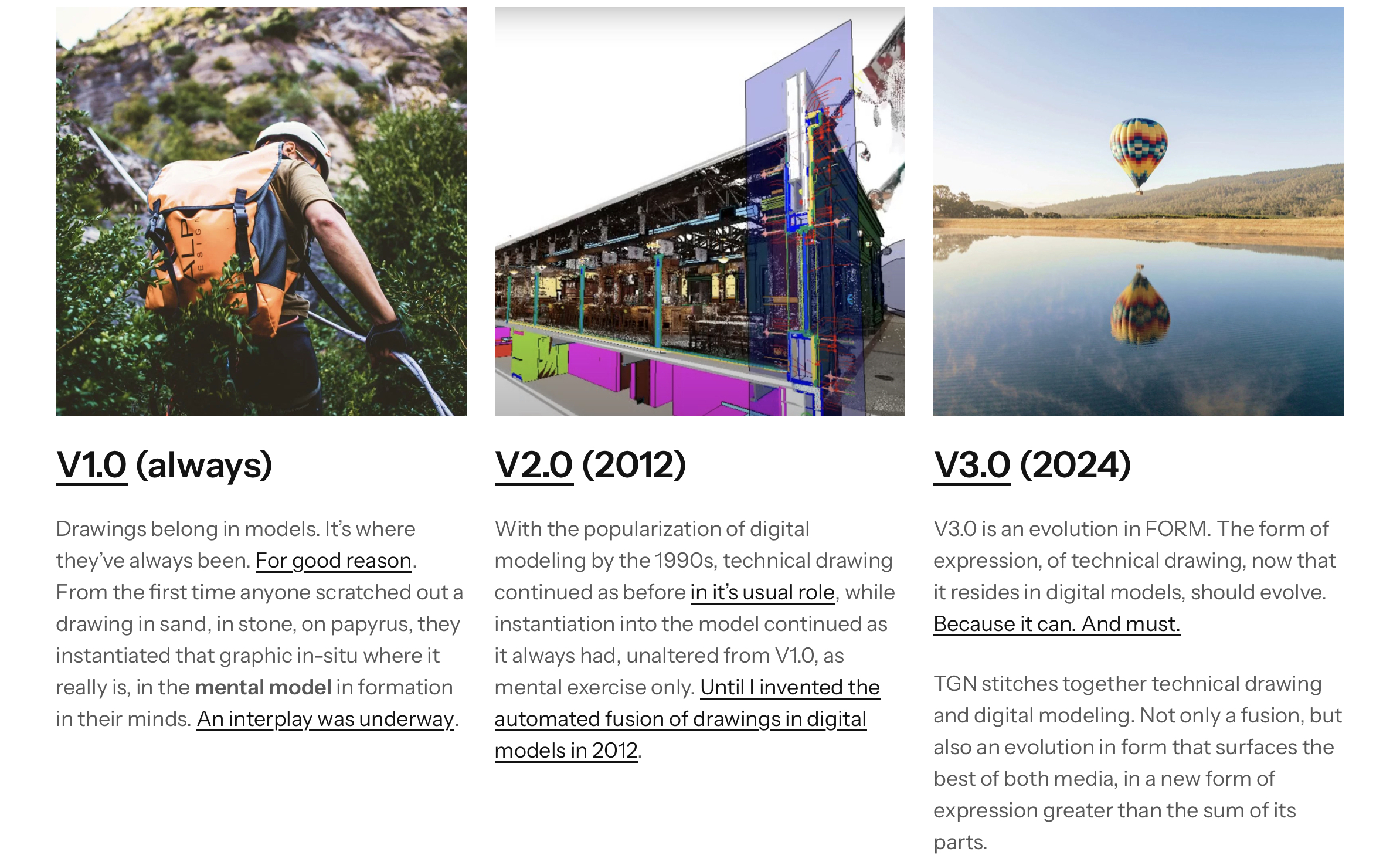
The past (V1.0), present (V2.0), and future (V3.0) of technical drawing.
V2.0 is my earlier work. It literally just took the two things (drawings and models) as they are and stuck them together, a direct fusion. It was automatic. And it spread to 9 different softwares that I know of (but siloed in each).
V3.0 is more mature thinking. It leapfrogs the earlier fusion and puts adequate energy into imagining what vehicle could embody the functions of technical drawing if technical drawing were invented today in the midst of pervasive digital modeling rather than many centuries ago when models were mental and physical only and engagement with them (with models) had to be externalized into some other medium.
So what does that vehicle look like?
Well you can imagine it yourself. Or, if you want a head start, read this page:
And please note:
We intend for this vehicle to operate in any, and all, modeling and model-handling softwares.
And to be portable, from any modeler to any other.
And, there is a gateway built into the vehicle design for input from traditional drafting/drawing/illustration/graphics softwares.
And in fact, it’s about a two way street connecting modeling and external graphics apps (and pencils too, by the way).
And more than a street, it’s actually a network.
Yeah, it’s about network and network effect.
Please have a look. And think about it.

 OPEN VCS, a lens for looking at models