I’ll just start at a random spot here.
That common belief, that a clash-free model is a good quality model, is a belief sitting way out past the frontier deep in a terrain called absurdity. The idea that checking that 2 or more things don’t occupy the same or near space, somehow equates to eval of model quality is a fixation on the mote/speck while ignoring the beam in the eye. Fixation on “data’ drifts toward that same category.
It’s tech that did this to us. Decades of software use occupying more and more mental bandwidth absorbing more and more finite resource (intellectual labor hours, equipment budget…), we’re fixated on things that drift more and more toward maintenance of the demands of software for software’s sake than toward anything contributing to the project. The drift goes so far for so long that many of us don’t remember or never knew what the latter (the project) actually is. I try to recall it here.
I’ve mentioned the following on this blog many times before and it is worth repeating so I do. After that I’ll add new commentary.
Getting models1 modeled right, and adequately interpreted, requires persistent model review through a lens that enables coherent, sustained, articulate visual engagement with stability in where to look at the model over long periods of time, to conduct review and document it.

Most people who do this work, the core work of AEC professions, know why it matters and just do it without verbalizing what it is and why it matters. But if you wonder how to formulate the origin, purpose, and value of technical drawing in AEC, this is my attempt to do that.
Others lament the persistence of “documents” while advocating greater use of “data” and analysis of “data”. These lamentations are off target and fired from the wrong angle of approach. The core work of AEC professions (described in this post; read on) is not document-centric; AEC professionals are neither “document-fixated” nor stuck by habit developing drawings instead of moving forward into data and analytics (aside: they are also into data and analytics).
Rather:
Simply so, documents (including drawings), rather, are an adequate (and well tuned indeed) expression of the most mission critical work tasks and functions (listed in this post, below) of AEC professionals, while models, and “data”, and insights extractable through data analytics, are not.
Technical drawing is an expression of the acts, behaviors, and functions that are the core work of AEC professions. Drawing is an expression of this and at the same time a vehicle for it. Read on for explanation of why that is, and what the actions, behaviors, and functions are.
The first time I heard people arguing for getting rid of equipment for attentive focus in models, that is, arguing for the elimination of technical drawing (construction drawings), was over 20 years ago, around 2004 or so. I’ll come back to that so hold that thought (20 years) while I take a comic diversion.
Having worked some years by then (2004) as a digital modeler and construction drawings attendant (drafter) automating drawings from digital models, the idea of discarding drawings “because models” just right away brought to mind Wile E. Coyote‘s anvil cliff diving and relentless misadventures with dynamite:
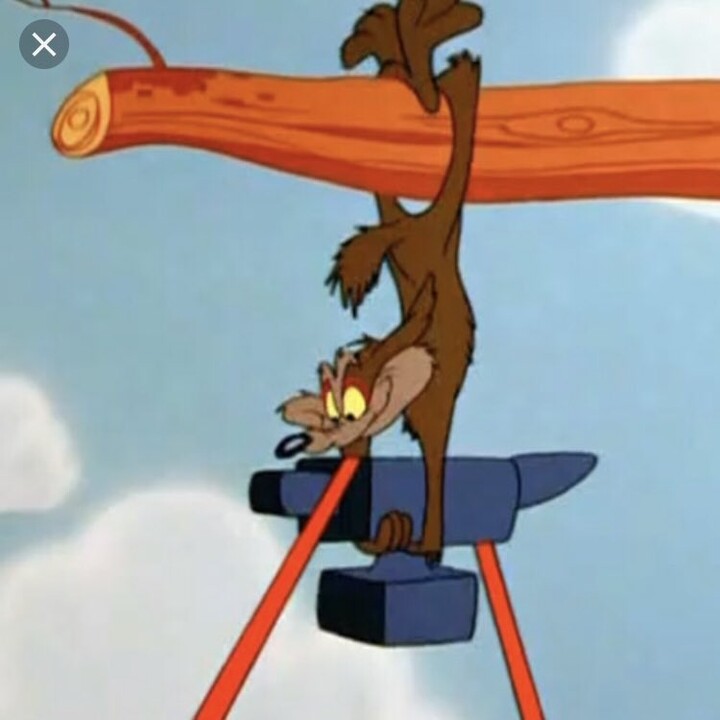
Yes, the Road Runner carelessly blazing though Looney Tunes’ best of the best background art, pursued and never caught by the “wily” engine of relentless self defeat: Wile E. Coyote, Esquire, a wily producer of really bad ideas from which no good will come.
Ever.
And if these cartoons didn’t make it into the current era, or for whatever reason you’ve never seen them, I can only recommend taking a look. These ran from 1930 or so up until 1970. I watched them as a little kid and watching them again now I’m still laughing out loud, the laughter of sad realization, tragedy the basis of all comedy. Clearly, these are strong commentary on the pitfalls of getting drawn into technology, and anyone these days deeply drawn into the use of CAD/BIM tools is going to recognize these cartoons sardonically. Take a look and see!
Anyway, 20 years later, the idea of eliminating drawings persists and some are still framing “eliminating drawings” as a forward looking goal.
They should watch Looney Tunes. They’re unaware of:
- what attentive focus in AEC modeling and how it’s expressed (described below), and
- that equipment for focus can, should, and must evolve, and
- that the evolution’s already begun
Eliminating drawings undermines thought itself.
Refer to the Yann LeCun post above:
(“Manipulating mental models… is what we call thinking.”)
Why that is is pretty obvious; you’re just cutting (all) the legs off the perception stool. Scroll down to recall what you’re perceiving and how you’re perceiving it (“it” being an adequate understanding of things very complex)
Maybe be less Wily and more like Road Runner. Stop and ask, has anyone promoting the idea of eliminating drawings over the last 20+ years put any thought into what drawings are before devoting themselves to their elimination?
Eliminating drawings undermines thought itself.
What are AEC technical drawings?
What are they for? What is their purpose? What do they do? In other words, what are they?
They’re a lens for looking at models, in a systematic way that stimulates thought, amplifies interpretive power, and applies thought and interpretive power, i.e., understanding, to the necessary model review functions listed on this page below.
Project development and delivery, in architecture, engineering, and construction, is about building models (mental and digital, and physical models) and QA/QC’ing those models by developing and issuing a set of construction drawings. The drawings are a continuous QA/QC process.
That lens for model review, our means and method of visual engagement with models mental, physical, and digital, need not be left (only); it is neglectful to leave that lens stuck (only) in an ancient form of expression, flattened, and externalized from the digital model, only to be visualized where it is in-situ within the mental model, by mental exercise alone entirely unassisted by the digital model.
Likewise it is neglectful to leave digital models insufficiently equipped (undressed, unadorned), or to put it more accurately, in an abject state of dis-equipment vis-à-vis the necessary model review functions listed on this page below.
What QA/QC means in project development and delivery:
If you’re designing a building, a ship, a machine, or an aircraft, designing any complex thing for construction or manufacturing, what’s really happening is that:
- you’re formulating a mental and digital model of the thing,
- that model is fuzzy, and full of gaps and inaccuracies, and
- you’re shepherding the model from its inadequate state to something functionally adequate.
Basic Questions
Very soon after project start, an AEC digital model quickly exceeds our cognitive grasp. It’s just too much to hold in mind. We experience a declining ability to answer even basic questions about it, like:
- is it done yet?
- is it good enough yet?
- is the model forming a coherent functionally successful whole?
- is there good fit among the physical items modeled?
- are any physical items that matter, missing? Where? Where not?
- is the model good enough in some regions and not others?
- where are the regions that are good enough?
- does anything signify to anyone the useful distinction between regions that are good enough and all other regions that may not be?
Focus is needed.
First of all, recognize the difference:
- The broader field
- The narrowing focus
The interplay between those is the mind in motion. Or perhaps more precisely, sets the mind in motion.
As it is for all fields, so it is in AEC design and construction.
Drawings are the expression of and vehicle for, five primary actions, behaviors, and functions of AEC professionals revolving around model review:
Model Review: technical drawings are checks, against omission, and for good fit. And, they’re one stroke in a 2-stroke engine of thought, or one pole in a two-pole INTERPLAY that IS thinking.
(1) Attentive Focus or Visual Close Study (VCS)
At informative locations within modeled environments (within models mental, physical, and digital) we develop and express our act of attentive clarifying focus. Let’s call these locations, locations of visual close study (V.C.S.).
(2) Checks against Omission and for Good Fit
At V.C.S. locations in models we conduct physical evaluation of the model. Physical evaluation consists mainly of two checks:
- A check AGAINST OMISSION of physical items in the model (checking that everything that should be shown here at this V.C.S. location, is shown here; nothing that matters, here, is missing), and
- A check FOR GOOD FIT among the physical items present (define good fit however you like; Vitruvius defines good fit here).
Checks for omission and good fit are the QA/QC and interpretive work carried on through project design and development, and continuing during construction.
(3) Affirmation of (2)
Omission and good fit evaluations conclude with AFFIRMATION of model QA/QC. Who affirms what, where, within models mental, physical, and digital, about omission and good fit, is made clear. This supports accountability.
But preceding accountability, these checks and affirmations are supporting something more fundamental and more generative: coherent thought itself, thought applied to the process of making our models clear, building up our own understanding of and confidence in our own models, and then conveying that to others in a way that’s receivable. Clear thinking clearly conveyed… One can affirm, or assert, that at these locations, the primary checks have been made, that professional standard of care, is met.
(4) Drawings in models (mental and digital) set the mind in motion
Checks and affirmations are made at an already, first of all, narrowed set of locations within a model, not ALL locations, but representative ones. Everyone is free to take whatever they can, and want, from all other locations within the FIELD of a model, but at these locations affirmation is made. The narrowing comes first. Otherwise one creates an engagement with infinity problem that makes fools of us all.
The narrowing sets out the necessary peaks and valleys of attention. The difference, like a voltage drop, sets the mind in motion, gets the perception engaged, makes meaning, delivers coherence, makes sense of things.
Visual close study within models, our narrowing focus within a FIELD, is our deployment of a context / focus interplay that is the engine of thought itself. Thought is an interplay between our expansive perception of a modeled environment (the FIELD), and our narrowing act of attentive focus within it, at V.C.S. locations.
From this engine comes adequate project understanding and functional competence. In the interplay, thought happens and understanding grows.
There are two poles in dynamic interplay (which is thought):
(WIDE ←→ narrow)
or
(FIELD ←→ focus)
or
(MODEL ←→ VCS)
The two poles are as different from each other as the COSMOS and a ←→ lens for looking at it, as mutually distinct as the UNIVERSE and a ←→ telescope. These things are not in any way the same kinds of things, and are mutually irreplaceable.
It should occur to no one, that one obviates the other.
(5) The Courtesy of Drawing Attention to what is not to be missed
Finally, expressions of attentive focus through visual close study supply the courtesy of drawing attention to things not to be missed in the model.
What’s drawn by any drawing?
Your attention.
AEC software development may, and likely will, continue to choose to be completely disinterested in the 5 primary cognitive functions above that architects, engineers, and builders are engaged in, vis-à-vis models, for the vast majority of their time.
As mentioned elsewhere in this blog, it apparently never occurs to software development organizations to think about this at all.
Thought in software companies in AEC rarely moves out of the starting gate. It’s just stuck in a gate that never opens.
A thought-terminating slogan keeps the horses standing in place forever:
“Drawings are just dumb. lines and arcs” (to be automated then eliminated).
Meanwhile, architects, engineers, and builders continue doing the thinking anyway. They’re running the race and don’t have time to talk about it. They’re too busy doing it.
They’re focusing their attention, developing their memory, and putting in play the cognitive dynamic that as far as we can discern or say, is thought itself2, by engaging the equipment for setting that dynamic in motion.
It’s worth noting that perceptual equipment operates in a particular way that always involves intermittent attention, and a set of dynamics related to intermittent attention.
https://tangerinefocus.com/2023/07/28/real-and-modeled-reality-mental-models-views-tweeners-memory-wobble-and-my-kitchen-sink/
Technical drawing – in its centuries old form – is the form of that equipment (for looking at models).
That form will evolve. The evolution already started. See here:
(you really should ^^^ see there)
- It’s true whether models are mental, physical, or digital models, and by the way, it’s always mental and digital; a digital model never stands alone without a mental model in tandem, because a digital model has never meant anything to anyone without an adequate mental model in formation. More on this here: REAL AND MODELED REALITY, MENTAL MODELS, VIEWS, TWEENERS, MEMORY, WOBBLE, AND MY KITCHEN SINK) ↩︎
- to the extent that we can attempt to describe what thinking is. At least we can say there is an observable dynamic in play when thinking happens. ↩︎

 TANGERINE FOCUS