I start with a really brief review of 40 years of software industry rhetoric about technical drawings:
First, drawing was about placing and trimming lines and arcs. Then by 1995 it was about automating drawings from 3D models. By 2003 it was common already to hear calls for abandoning drawing altogether, “because models”.
Stop here in awe, of an idea as brilliant as feeling compelled to abandon telescopes… “because, we’re in the universe”,
…or dreaming of ditching cameras… “because we’re in the world.”
Stomping right on the heels of those howlers, then all the rage was “moving beyond geometry; it’s the “I” in BIM,”
Not even false, these ideas don’t rise to that level. They’re really just nonsense.
Missing the point entirely, none of these even hint at awareness of what drawings are, how they function, what they do, their purpose, how they’re perceived, their relation to models…
They’re a lens for looking at models, in a systematic way that stimulates thought, amplifies interpretive power, and applies them, thought and interpretive power, i.e., understanding, to the necessary model review functions listed on this page below.
Yes, the thought premises driving development of the primary AEC software products of the last 40 years, are basically just not thoughtful (nonsense?)1.
More and more model automation and, for example, placing your digital project model into a total earth simulation, hasn’t changed that and won’t.
Too bad.
What drawings are, for those interested:
- What are AEC technical drawings?
- Drawings are the expression of and vehicle for, five primary actions, behaviors, and functions of AEC professionals revolving around model review:
- INTELLIGENCE
- AEC INTELLIGENCE
- APPLIED INTELLIGENCE OF AEC PROFESSIONALS
- THE FORM OF EXPRESSION OF TECHNICAL DRAWING WILL EVOLVE
- SOFTWARE’S AVOIDANCE OF SUPPORT FOR THE CORE WORK OF AEC
- Commentary
What are AEC technical drawings?
What are they for? What is their purpose? What do they do? In other words, what are they?
They’re a lens for looking at models, in a systematic way that stimulates thought, amplifies interpretive power, and applies thought and interpretive power, i.e., understanding, to the necessary model review functions listed on this page below.
Project development and delivery, in architecture, engineering, and construction, is about building models (mental and digital, and physical models) and QA/QC’ing those models by developing and issuing a set of construction drawings. The drawings are a continuous QA/QC process.
That lens for model review, our means and method of visual engagement with models mental, physical, and digital, need not be left (only); it is neglectful to leave that lens stuck (only) in an ancient form of expression, flattened, and externalized from the digital model, only to be visualized where it is in-situ within the mental model, by mental exercise alone entirely unassisted by the digital model.
Likewise it is neglectful to leave digital models insufficiently equipped (undressed, unadorned), or to put it more accurately, in an abject state of dis-equipment vis-à-vis the necessary model review functions listed on this page below.
Getting models2 modeled right, and adequately interpreted, requires persistent model review through a lens that enables coherent, sustained, articulate visual engagement with stability in where to look at the model over long periods of time, to conduct review and document it.
What QA/QC (model review) means in project development and delivery:
If you’re designing a building, a ship, a machine, or an aircraft, designing any complex thing for construction or manufacturing, what’s really happening is that:
- you’re formulating a mental and digital model of the thing,
- that model is fuzzy, and full of gaps and inaccuracies, and
- you’re shepherding the model from its inadequate state to something functionally adequate.
Basic Questions
Very soon after project start, an AEC digital model quickly exceeds our cognitive grasp. It’s just too much to hold in mind. We experience a declining ability to answer even basic questions about it, like:
- is it done yet?
- is it good enough yet?
- is the model forming a coherent functionally successful whole?
- is there good fit among the physical items modeled?
- are any physical items that matter, missing? Where? Where not?
- is the model good enough in some regions and not others?
- where are the regions that are good enough?
- does anything signify to anyone the useful distinction between regions that are good enough and all other regions that may not be?
Focus is needed.
First of all, recognize the difference:
- The broader field
- The narrowing focus
The interplay between those sets the mind in motion.
As it is for all fields, so it is in AEC design and construction.
Drawings are the expression of and vehicle for, five primary actions, behaviors, and functions of AEC professionals revolving around model review:
Model Review: technical drawings are checks, against omission, and for good fit. And, they’re one stroke in a 2-stroke engine of thought, or one pole in a two-pole INTERPLAY that IS thinking.
(1) Attentive Focus or Visual Close Study (VCS)
At informative locations within modeled environments (within models mental, physical, and digital) we develop and express our act of attentive clarifying focus. Let’s call these locations, locations of visual close study (V.C.S.).
(2) Checks against Omission and for Good Fit
At V.C.S. locations in models we conduct physical evaluation of the model. Physical evaluation consists mainly of two checks:
- A check AGAINST OMISSION of physical items in the model (checking that everything that should be shown here at this V.C.S. location, is shown here; nothing that matters, here, is missing), and
- A check FOR GOOD FIT among the physical items present (define good fit however you like; Vitruvius defines good fit here).
Checks for omission and good fit are the QA/QC and interpretive work carried on through project design and development, and continuing during construction.
(3) Affirmation of (2)
Omission and good fit evaluations conclude with AFFIRMATION of model QA/QC. Who affirms what, where, within models mental, physical, and digital, about omission and good fit, is made clear. This supports accountability.
But preceding accountability, these checks and affirmations are supporting something more fundamental and more generative: coherent thought itself, thought applied to the process of making our models clear, building up our own understanding of and confidence in our own models, and then conveying that to others in a way that’s receivable. Clear thinking clearly conveyed… One can affirm, or assert, that at these locations, the primary checks have been made, that professional standard of care, is met.
(4) Drawings in models (mental and digital) set the mind in motion
Checks and affirmations are made at an already, first of all, narrowed set of locations within a model, not ALL locations, but representative ones. Everyone is free to take whatever they can, and want, from all other locations within the FIELD of a model, but at these locations affirmation is made. The narrowing comes first. Otherwise one creates an engagement with infinity problem that makes fools of us all.
The narrowing sets out the necessary peaks and valleys of attention. The difference, like a voltage drop, sets the mind in motion, gets the perception engaged, makes meaning, delivers coherence, makes sense of things.
Visual close study within models, our narrowing focus within a FIELD, is our deployment of a context / focus interplay that is the engine of thought itself. Thought is an interplay between our expansive perception of a modeled environment (the FIELD), and our narrowing act of attentive focus within it, at V.C.S. locations.
From this engine comes adequate project understanding and functional competence. In the interplay, thought happens and understanding grows.
There are two poles in dynamic interplay (which is thought):
(WIDE ←→ narrow)
or
(FIELD ←→ focus)
or
(MODEL ←→ VCS)
The two poles are as different from each other as the COSMOS and a ←→ lens for looking at it, as mutually distinct as the UNIVERSE and a ←→ telescope. These things are not in any way the same kinds of things, and are mutually irreplaceable.
It should occur to no one, that one obviates the other.
(5) The Courtesy of Drawing Attention to what is not to be missed
Finally, expressions of attentive focus through visual close study supply the courtesy of drawing attention to things not to be missed in the model.
What’s drawn by any drawing?
Your attention.
The applied thought functions, the 5 described above, fairly well represent the core cognitive workload of AEC professions. Have a look at the digital model and drawings automated from the model, below, for demonstration of these 5 primary cognitive actions, behaviors, and functions of AEC professionals.
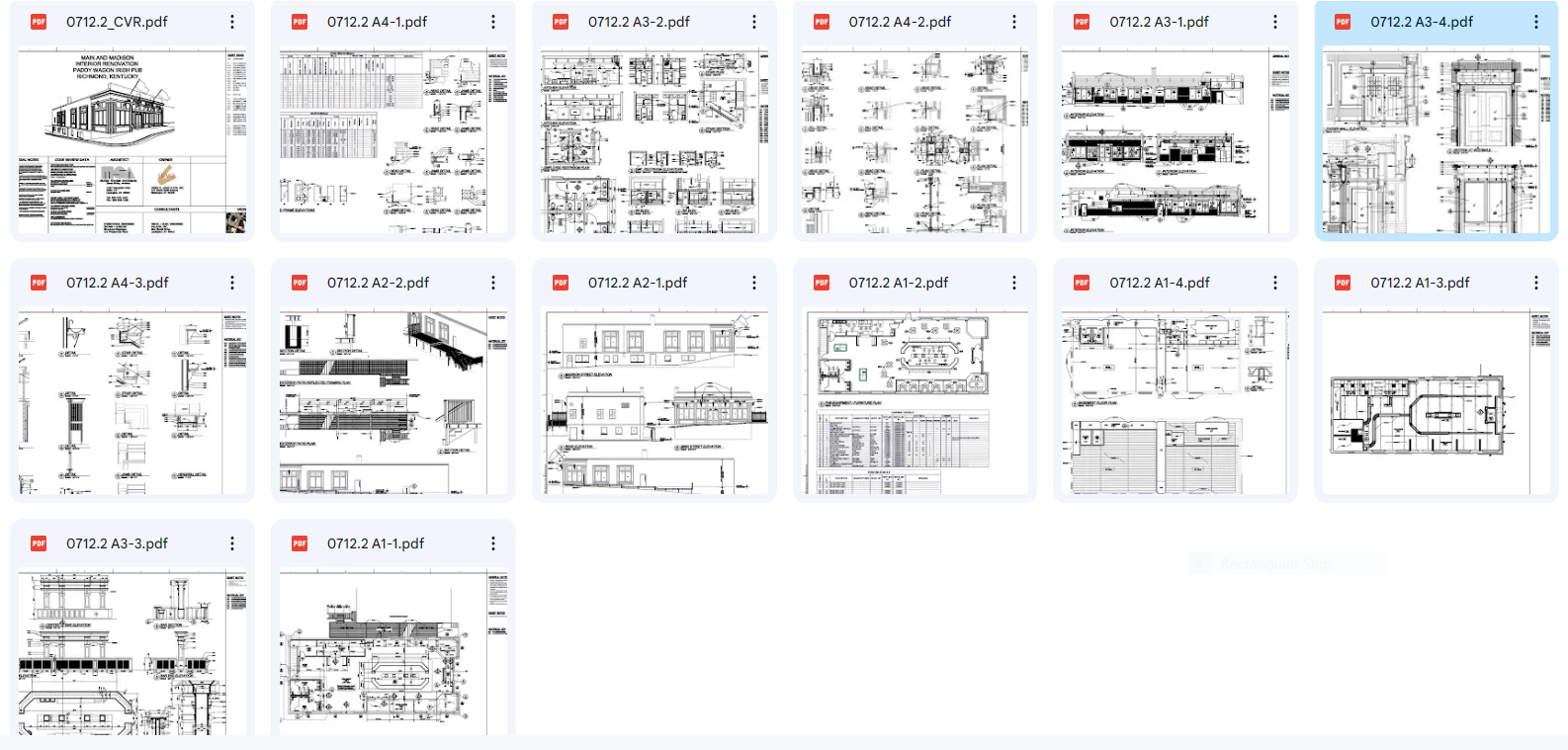
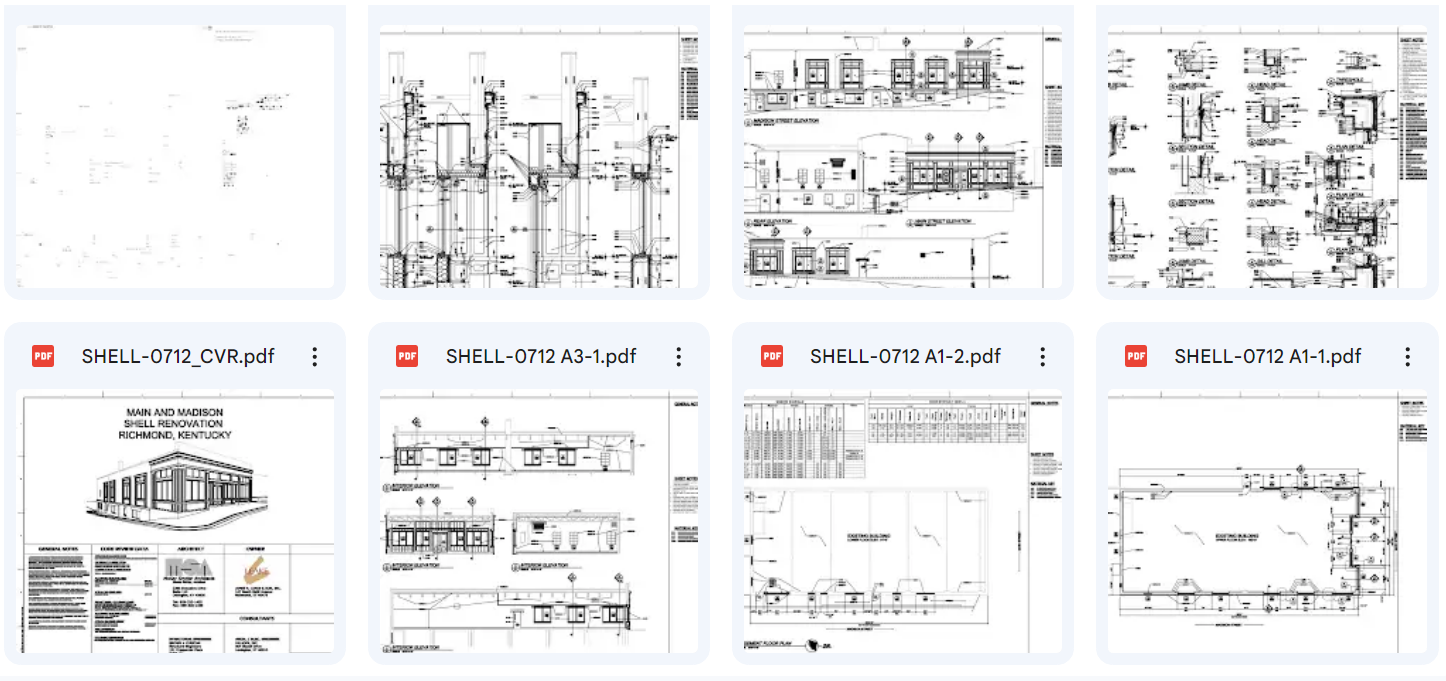
In the video is a model I built in 2007 and the drawings that were derived complete from that model. You can click on the caption under the drawing images and view each automated drawing close up (you can download the PDFs of each sheet). I did projects this way since 1999. That’s a lot of modeling. But that’s not really the real story that matters. What matters is how essential the drawings were (are). That is, LOOKING AT THEM is essential for successfully completing the development of the model. And for successfully conveying the model’s adequacy, and meaning, more than superficially, to others.
There is a story there, the story of looking closely at models mental and digital, in order to adequately answer the questions listed above, here: https://tangerinefocus.com/2025/07/07/forget-artificial-what-is-intelligence-and-to-what-is-intelligence-applied-in-the-architecture-engineering-and-construction-professions/#aec-technical-drawings-are-checks-against-omission-and-for-good-fit. That story must continue; it can and should evolve, with new equipment for looking, built into the models, which I propose here https://tangerinefocus.com (earlier V2.0 development is shown in the video).
That model was adequate, high enough quality to automate all (very nearly 100%) of the non-annotation graphics on all the construction drawing sheets. This was in 2007 and I’d done the same before that on other projects already in 1999:
By the way, this V3.0 lens in models is going to be very useful no matter whether users like highly simplified schematic or sketch models, or prefer elaborated “total modeling”, or, any degree of model completion in-between.
The lens also includes within it, the traditional form of drawing’s expression, both in fusion within the V3.0 lens infused within the digital model, and externalized from the digital model.
A few thoughts about definitions:
INTELLIGENCE
Intelligence steers effective application of relevant thought to important tasks.
You see the real puzzle in this: …knowing what is effective, and what is relevant and important. That puzzle defies summarization and is beyond the scope of both this post and all software and is generally not expressible in words.
There is a language for it though in AEC (it’s called technical drawing) and there is an observable dynamic in play when it happens, and an observable set of primary tasks. These last two I’ve attempted to describe in this post.
AEC INTELLIGENCE
AEC intelligence is putting your finger on the most important tasks in AEC and applying relevant thought to them.
APPLIED INTELLIGENCE OF AEC PROFESSIONALS
The core work of AEC professions is the figuring out of complex physical things. Mainly figuring out what they are to become.
THE FORM OF EXPRESSION OF TECHNICAL DRAWING WILL EVOLVE
It will evolve in-situ within digital models. The evolution has already begun. See here: https://tangerinefocus.com The beginning is only a baby’s first steps. World class athleticism comes later.
SOFTWARE’S AVOIDANCE OF SUPPORT FOR THE CORE WORK OF AEC
One could easily argue that 1985’s line extend and trim tool supplied more direct support to the core work of AEC professions than decades worth of digital fixations that have flowed like lava out of software houses since then.
Evaluation and reprioritization is long overdue.
In general we should start with thought about core and ancillary tasks, and how these are supportable by software, or could be.
There are:
Core Tasks of AEC professions
These are described in this post.
Ancillary tasks of AEC professions
These are secondary tasks that supply meaningful support to core tasks.
Sub-ancillary tasks
Sub ancillary tasks are neither core tasks nor supportive of core tasks (ancillary3). Over the last 40 years of software proliferation into AEC we’ve all seen the drift away from support for the core and ancillary work, diverting instead to what we’re now inundated with: work serving the demands of software itself (sub-ancillary) that offers little, or even no support at all, to core or ancillary tasks.
Commentary
Notes:
- “I wouldn’t dismiss it as “nonsense,” but I do agree the trajectory has been inverted. For decades the dominant AEC tools have shaped the way we design, often pulling us into workflows that serve the software rather than the project.
Design intelligence grows out of intent, focus and iteration. Technology should follow and amplify that process, not dictate it. Approaches like VCS remind us that tools are valuable only when they extend, rather than constrain, the way designers actually think and work.” – Dr. Utku Başyazıcı in a comment ↩︎ - It’s true whether models are mental, physical, or digital models, and by the way, it’s always mental and digital; a digital model never stands alone without a mental model in tandem, because a digital model has never meant anything to anyone without an adequate mental model in formation. More on this here: REAL AND MODELED REALITY, MENTAL MODELS, VIEWS, TWEENERS, MEMORY, WOBBLE, AND MY KITCHEN SINK) ↩︎
- Ancillary: providing necessary support to the primary activities or operation of an organization, institution, industry, or system. ↩︎