Everyone knows it’s all old now.
Very old.
While I’m apt to ask “who cares?” knowing few do, I’ll tell anyway about my experience with AEC software since 1993 and since ’98 modeling whole projects in complete detail digitally.
I found a long lost Compact Disc of mine in a box returned a few weeks ago by a dear friend who’d stored some of my things in between moves long ago. Thought lost, the box was re-discovered!
The CD case:
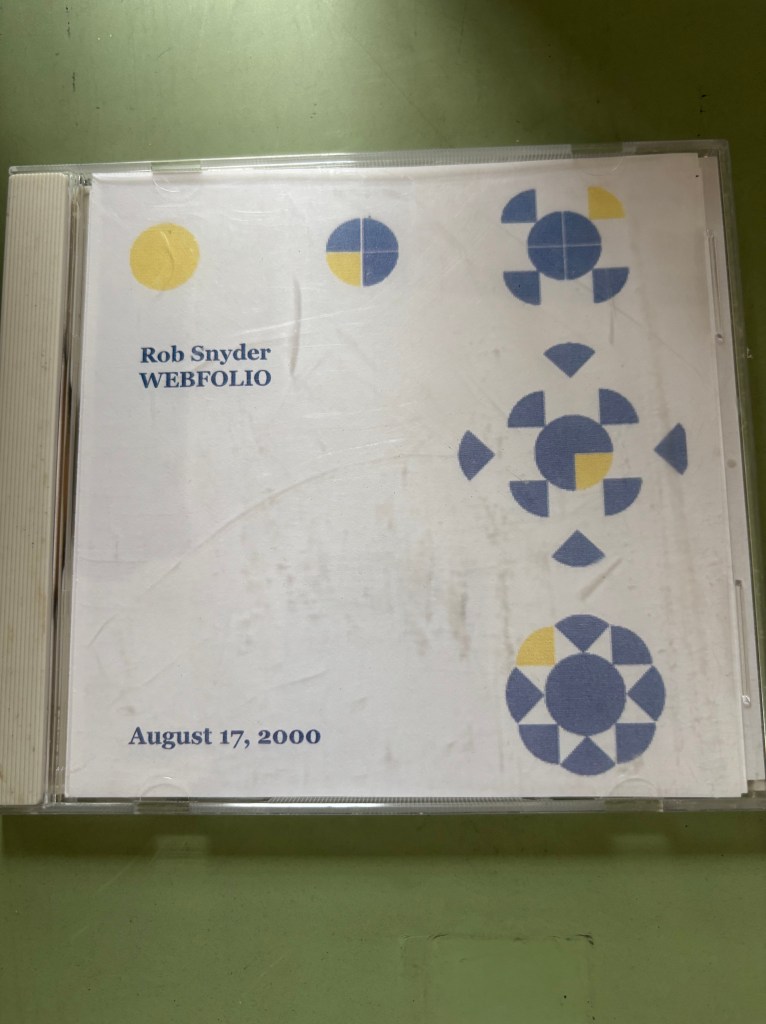
By the way, among many oddities here, I can read and edit these digital model files from the ’90s in the current (even the free) version of the software that was used to create them, without upgrading.
This is not Revit.
Why does any of this matter?
It matters (I’m not alone in this) for a couple of reasons:
- Model development work was carried out in the 3D graphics area of the software. We were always engaged directly with the model. In pure 3D digital space we immersed ourselves in the project visually, and manipulatively. We continuously studied, reflected on, and manipulated the model directly, in “3D”. This required some knowledge of how to control the UI but once you had that you were a digital sculptor, not a painter, not a drafter.
We were manic model builders. We could and did routinely produce very high quality very thoroughly developed digital models (you see this still today commonly in Rhino, among “design architects”).
I thought all along that this was kind of the point of modeling software. I only discovered very late, because of my work history (either using or making Bentley software from 1996 through 2015) that this is not the case for most people in AEC, 95% of whom use a BIM software that is not oriented in this way.
I’ll add some screenshots later of those models from the 90s on my lost and found CD (and maybe links to the models).
In the meantime you can see later examples of projects I modeled, or was involved with on the software development side later, in this playlist:
drawing-model fusion since 2012 (like fusion of sound in film)
I got into viz too (same software):
https://tangerinefocus.com/projects/ - The other reason this matters goes hand in hand, or hand in glove with the first reason:
The drawings were automated from the model but the only real, sound, and lasting reason that matters has to do with what we used the drawings for. It’s what everyone uses drawings for whether they realize it or not. So what is that? What are drawings for? What do we use them for? Or to put it another way:
Why do Architecture and Engineering Firms invest so much in the development and use of drawings?
If you could peak in and take a look at what they’re working on–most of the people in most of the firms most of the time–you’d see they’re working on drawings.
Even today, in 2026.
Why is that?
Do AE firms or their clients somehow need drawings?
That’s not the right question.
A more provocative question, the right question in other words that gives a productive answer is:
What do AE and C firms need, that they acquire through the development and use of drawings?
I’ve had, or taken, the luxury of thinking about that for a long time.
I wrote the answer here;
don’t skip what’s written here in cyan on the black background:
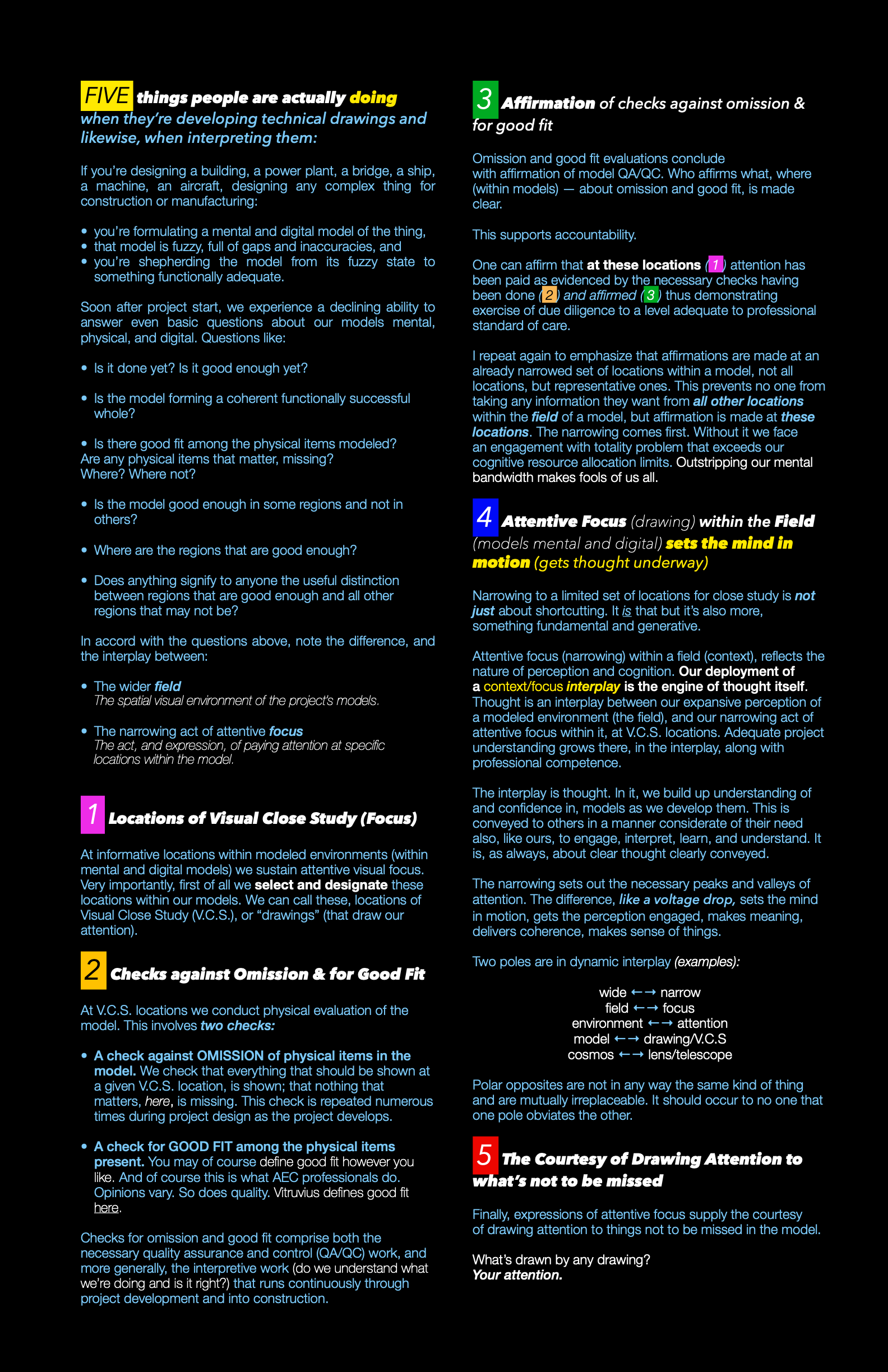
Note the loop in what’s written above in cyan on the black background:
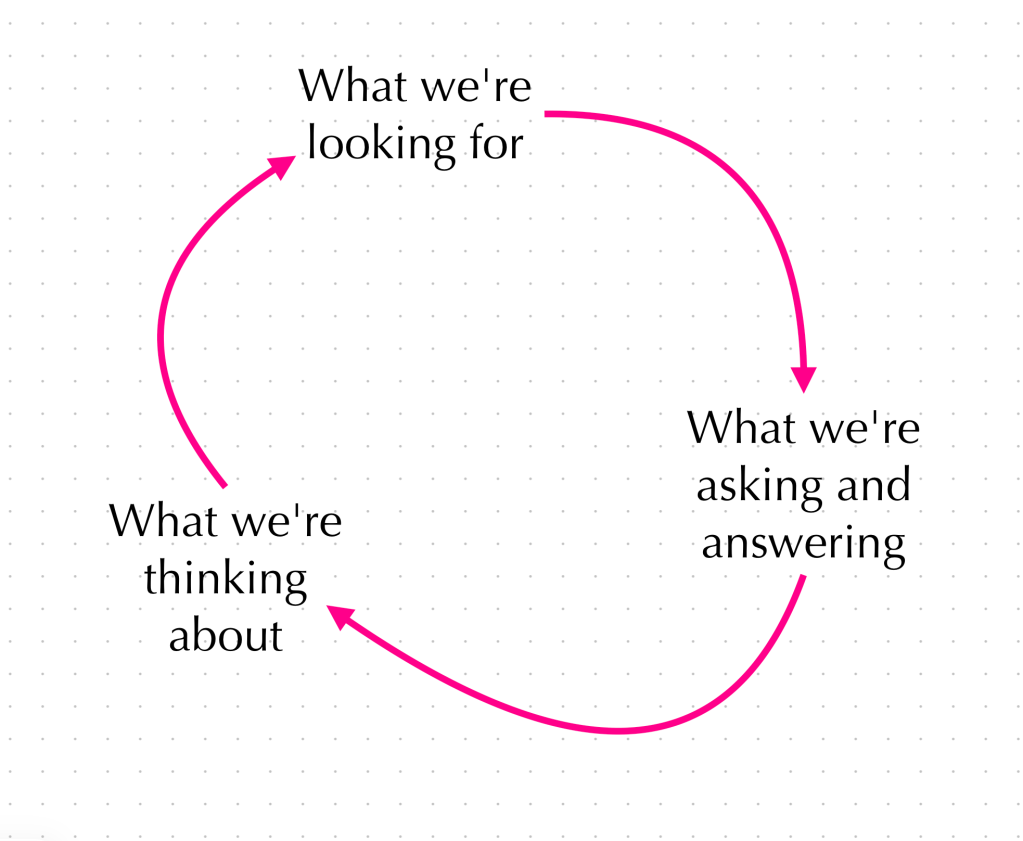
The intent of drawing, really, is about getting ourselves into this loop.
- What we see and look at informs what we think about.
- What we think about informs what we see and look at.
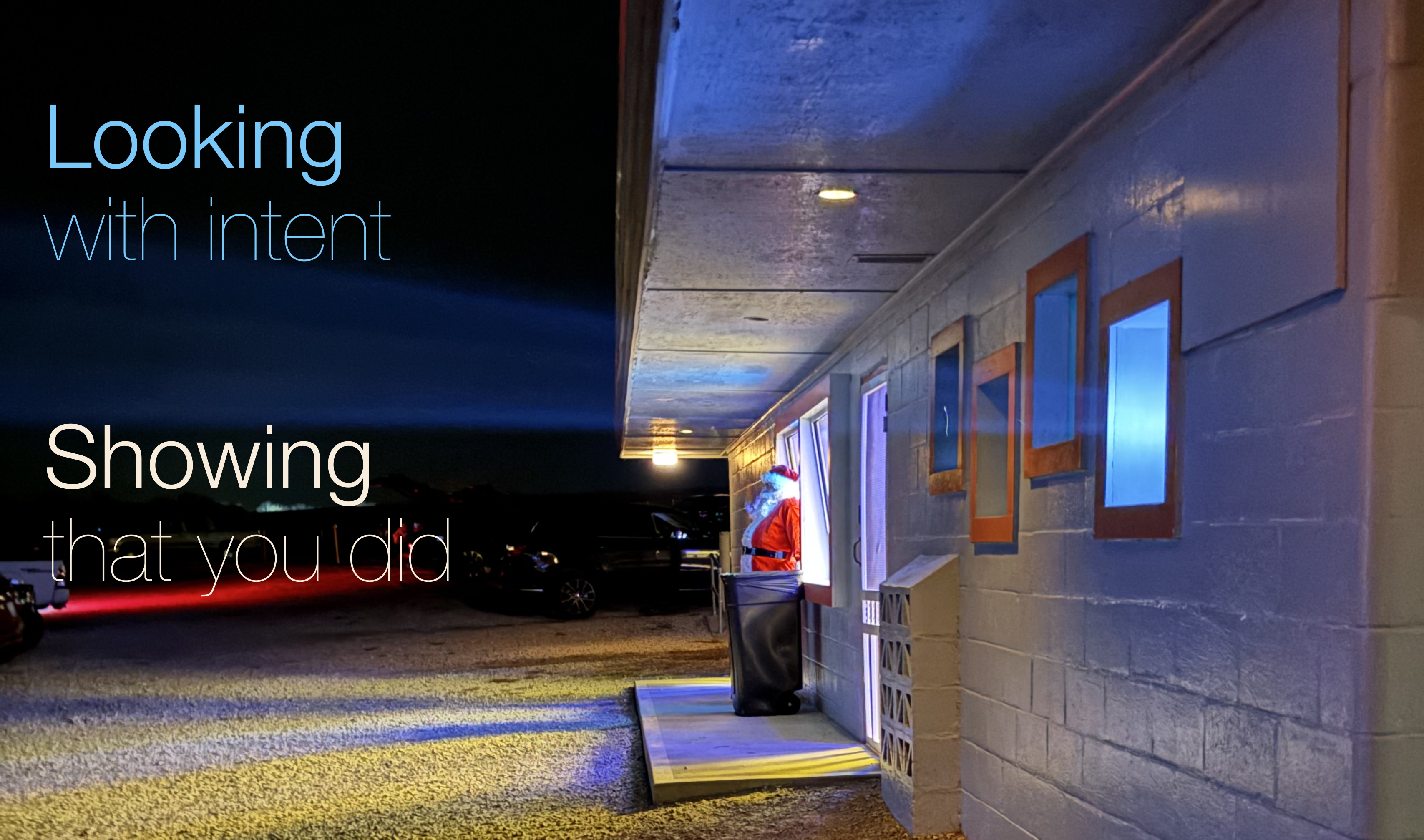
The set of drawings is the expression of this loop, both the active experience of it, and a tangible record of it.
The AEC software industry has not arrived at the end of the road of development that amplifies this loop.
No. Hardly. Not at all in fact.
They’ve only barely begun even to be aware that there is a road, that the loop is even a thing, let alone that it will develop.
Before computing, people used to understand this loop very well indeed. We’ve been Rip Van Winkle‘d for 30 years into some kind of intoxicant-induced decades long slumber, dazed and confused by hardware and software products.
Clap Clap. Wake up.
Break the spell and get back to real thought and project engagement.
I have more to say on this here:


