Well the dismal science is more dismal than you might have guessed from the self-deprecating humor of economists naming their discipline this way.
(expand the detail arrow below):
“The dismal science” is a well-known nickname for the academic discipline of economics.
“The dismal science” is a well-known nickname for the academic discipline of economics.
Today, people use the phrase as a joke or a critique because economics often focuses on depressing topics like scarcity, recessions, inflation, and hard financial choices. However, the real history behind the phrase is quite different and darker. Investopedia
The True Origin of the Term
- The Creator: Scottish writer and essayist Thomas Carlyle first used the phrase in 1849. Wikipedia
- The Essay: He wrote it in an essay called “Occasional Discourse on the Negro Question”. Investopedia
- The Real Reason: Carlyle did not mean it was gloomy about money. Instead, he was angry at economists who believed in human equality and opposed slavery. Economists argued that freedom and equal rights should apply to everyone, but Carlyle supported slavery and a strict racial hierarchy.
Investopedia 2
- The Contrast: Carlyle compared economics to “the gay science,” which was an old-fashioned term for poetry and art. Because economics taught that people were equal and deserved liberty, he labeled it “dismal”.
The Library of Economics and Liberty +3
To be consistent, we’d nickname AI in accord with the way it’s described by those responsible for it, Doomsday Science, or: “The Doomsday Device”.
Diverting momentarily to a more constructive, or uplifting, outlook (with regards to life, not “AI”), the photo below of Jimmy Buffet jumping into Biscayne Bay during his August 16, 1985 show at the Miami Marine Stadium, ended the preceding post on this blog:

The photo ended the post but there’s more to say.
Let’s jump in and all go for a swim.
The point of the previous post was just to state the obvious:
if AI is going to do actual AEC thought, then maybe we oughta think for 2 seconds about what AEC thought is.
Here’s what AEC thought is:
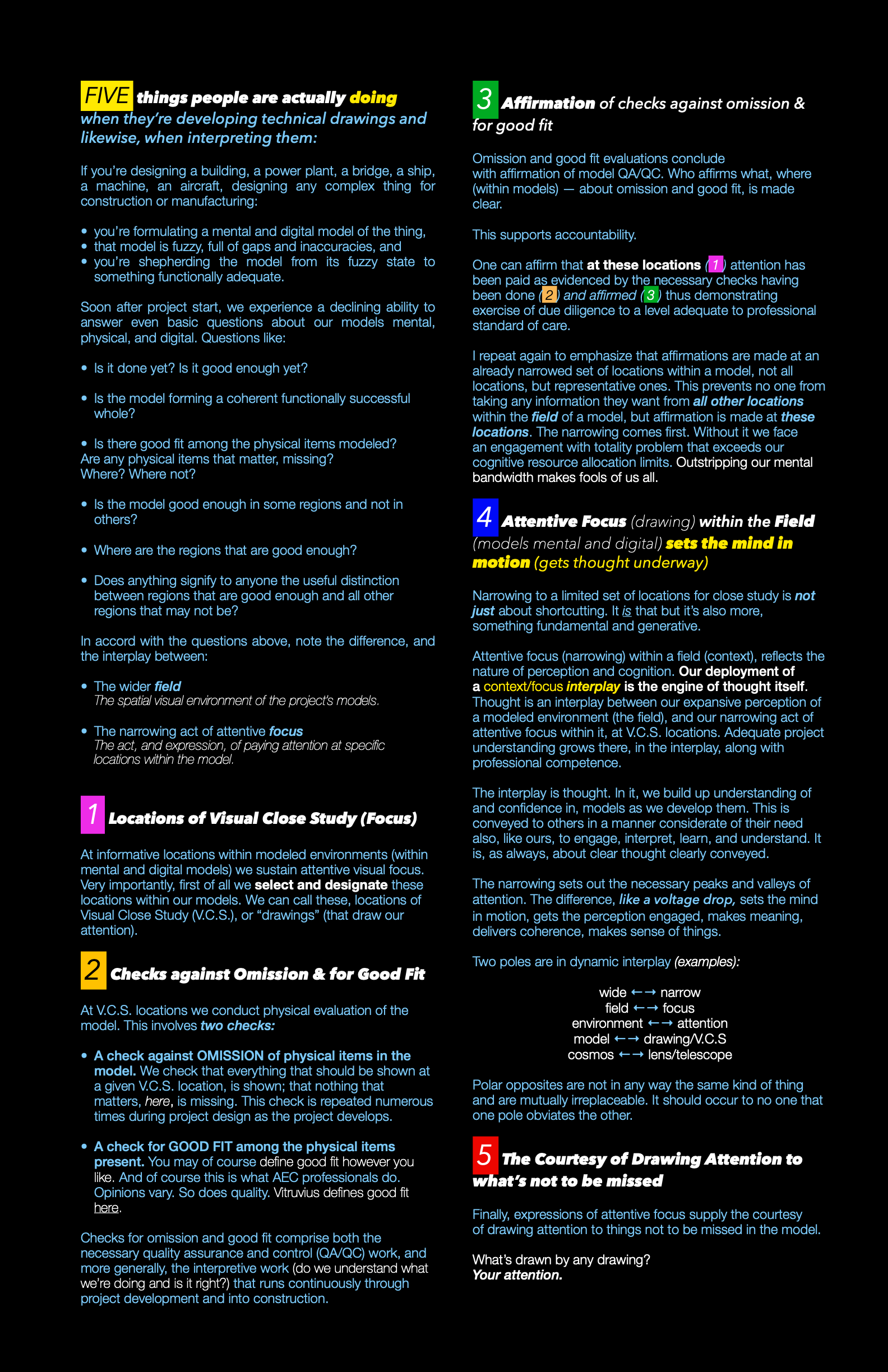
Note the mental model put into formation and sharpened by this exercise, the wide-narrow (environment-focus) interplay in the cyan text on black background above.
Also observe for yourself: no digital model (nor physical reality itself) has ever meant anything to anyone, without an adequate mental model in formation.
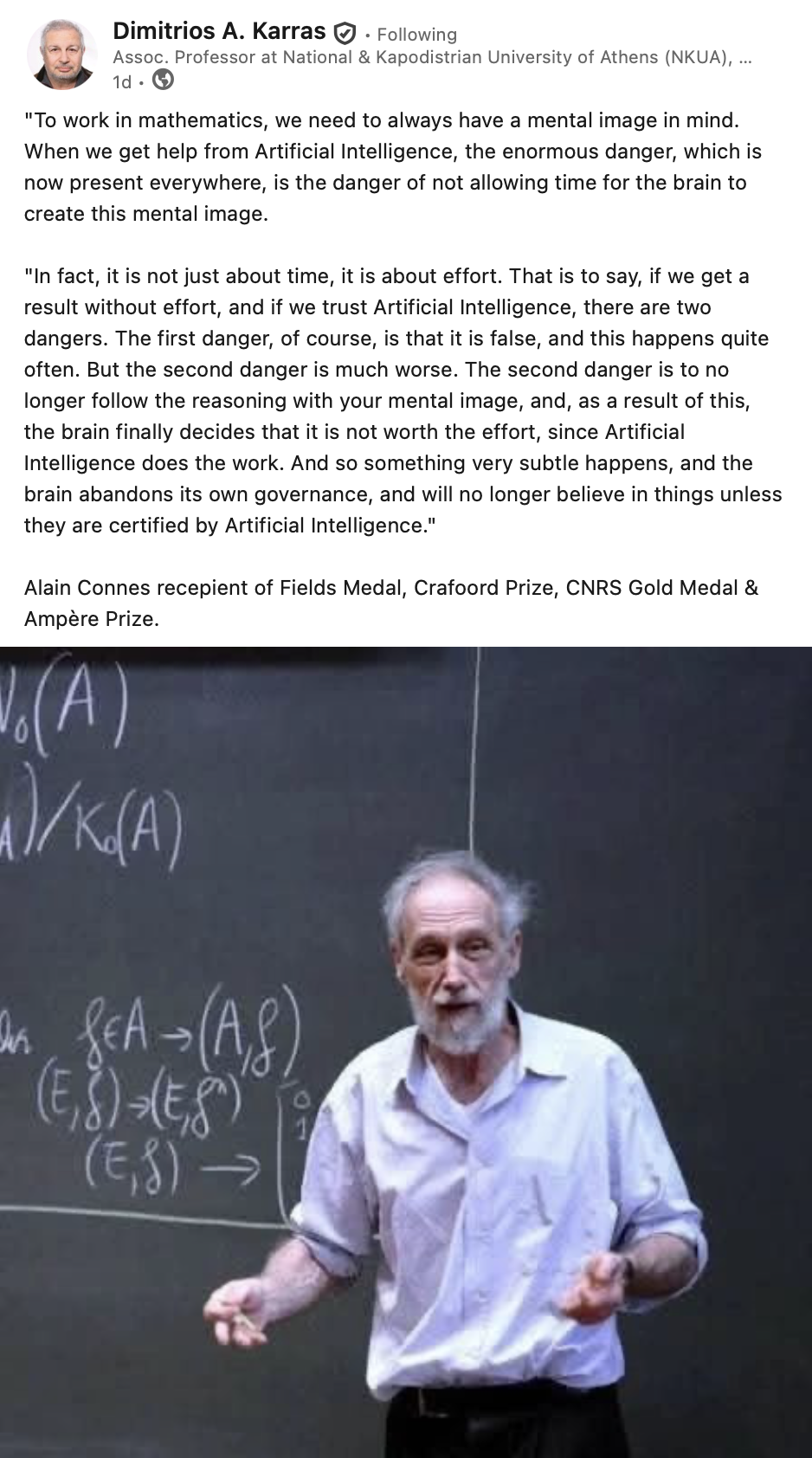
Almost all AEC software omits the digital model from this exercise entirely, leaving the interplay to be carried out as mental exercise alone with no assist whatsoever from the digital model. That points at what digital media is and what it can become as it evolves.
I’ll come back to that. It overlaps with AI. Let’s continue with AI for a minute:
If AI (Doomsday Science) is gonna take over and do that, actual AEC thought…
…the first question is, why would anyone want that?
Why would anyone who does anything interesting in life, be interested in that?
Would Jimmy Buffet be interested?
Would you?
Are you a misanthrope?
There’s a guy, Jimmy Buffet, who writes and performs music based on his LIFE,
That’s why you love it.
It resonates with you, as a human being.
Part of this is that you are inspired, by the observations, reflections, and musical skill, of another human being, who lives and learns from living, and has something to say and express.
AI can “generate” music (“music”).
Read that sentence again..
What are you even talking about?
AI can generate music.
Why would you listen to it?
It’s dismal, disembodied.
There’s nothing to care about.
Who cares about it?
I guess that’s exactly what’s meant by Doomsday Device:
Everything is turned to excrement (or apparition) masquerading as vitality and nobody gives 2 capital F’s about it.
Sure, it’ll crank out architectural “product” endlessly. There will be no Jimmy Buffet making music with his leg broken 3 times in a year. No Louis Kahn or anyone else with a life unfolding. No one doing things of their own accord, building a life that matters, to them and influences, motivates or inspires us.
There will be only a corporation, and a machine with swarms of “agents” churning out neon shadowplay generation until there’s no tomorrow, which is the day after no one cares.
None of this is new. It’s just a question of degree, approaching totality.
The ACME Corporation:
Wile E. Coyote and the Road Runner are fictional characters from the Looney Tunesand Merrie Melodies series of animated cartoons, first appearing in 1949 in the theatrical short Fast and Furry-ous. In each film, the cunning, devious and constantly hungry coyote repeatedly attempts to catch and eat the roadrunner, but is humorously unsuccessful.[10] Instead of using animal instinct, the coyote deploys absurdly complex schemes and devices to try to catch his prey. They comically backfire, with the coyote invariably getting injured in slapstick fashion. Many of the items for these contrivances are mail-ordered from the Acme Corporation and other companies.
. . . Jones based the coyote on Mark Twain‘s book Roughing It,[13] in which Twain described the coyote as “a long, slim, sick and sorry-looking skeleton” that is “a living, breathing allegory of Want. He is always hungry.”
Rube Goldberg Machines:
The concept dates back at least to 1914:
A Rube Goldberg machine, named after American cartoonist Rube Goldberg, is a chain reaction–type machine or contraption intentionally designed to perform a simple task in a comically overcomplicated way. First appearing in a cartoon for the New York Evening Mail, these machines consist of a series of simple unrelated devices; the action of each triggers the initiation of the next, eventually resulting in achieving a stated goal.
The term “Rube Goldberg machine“ comes from the cartoonist by the same name, Rube Goldberg, who would illustrate many of these machines.[1] The first Rube Goldberg machine was drawn by him in 1914, titled the Automatic Weight-Reducing Machine drawn for the “Inventions!” section of the New York Evening Mail. In the cartoon, the machine uses a variety of objects to get an overweight person to become trapped in a hole. The man is then starved until he is thin enough to pass through the hole and escape.[1]
https://en.wikipedia.org/wiki/Rube_Goldberg_machine
https://en.wikipedia.org/wiki/File:Something_for_nothing_(1940).ogv
Not all tech is like that (see below). But yeah, we always choose either to counterproductively overcomplicate, or to put tech on target.
Imagine improving a Rube Goldberg machine by encompassing it within a vastly more complex much larger Rube Goldberg machine to drive it.
Now THAT’s advanced thinking!
Wow!
By the way, that same year, a very useful machine, the first autopilot, 1914:
The Sperry autopilot is a historic gyroscopic flight stabilization system invented by Lawrence Sperry in 1914. It used spinning gyroscopes to automatically control an airplane’s surfaces, allowing hands-off, straight-and-level flight and revolutionizing aviation safety and long-distance navigation.
Invention and Public Demonstration
Lawrence Sperry famously demonstrated the device on June 18, 1914, at an aviation safety contest in Paris. By walking out onto the biplane’s wings while the aircraft continued to fly itself stably, he proved the reliability of his three-axis gyroscopic stabilizer.
Convincing!
Proof!
Nice thing about it is the clear purpose, and the sensible use of tech targeting a core problem and with the problem actually resolved, directly, and absent all the grandiose promises.
By the way, as far as I know, no one referred to auto-pilot as “AI”, neither in 1914 nor since.
Is this the future we’re promised?
A dismal doomsday future where everything is crap and nobody cares. Where everything we otherwise would have done or used to do is replaced by ACME corporation generations.
A future where the lessons learned from Rube Goldberg are not learned so not applied to putting tech on target solving real problems.
But rather to make tech a leviathan, that flattens everything by inserting itself everywhere not just as an overcomplicated system but as a Rube Goldberg machine taken exponentially to the power of Rube squared at least, or even greater exponential powers.
Take a Rube Goldberg machine and “improve” it by building a vastly larger and much more overcomplicated Rube Goldberg machine, to encapsulate and drive all previous Rube Goldberg machines.
Exaggeration? Click the detail arrow for a slice of today’s AEC software discourse
Before an agent can safely change a model, it needs a persistent account of what changed, which requirements apply, what evidence is authoritative and which dependencies may be affected. If every evaluation begins by reopening the authoring model and reconstructing the whole document, “continuous compliance” risks becoming faster batch QA/QC.
The CI/CD analogy becomes especially interesting around containment. In a dependency-rich parametric model, the true boundary of a change may only become visible after execution and regeneration. So perhaps the safe pattern is: propose the change, execute it in isolation, observe the actual change set, test it against an allowed-impact envelope, and only then commit or roll back.
That requires more than an intelligent agent. It needs a project catalogue, versioned requirements, deterministic execution, authority, provenance and an independently observable change history.
The AI can decide what ought to happen. The surrounding system has to prove what actually happened—and whether it was allowed to.
Taking this back to AEC:
Nobody wants that. Nobody wants an RGmachine. Nobody wants an RGmachine2 (Rube Goldberg squared). It’s not on target with what’s actually needed to get the job done. It’s off in its own universe serving its own interests and mining ours for fuel.
- The AEC task is straightforward: Looking with Intent and Showing that you did
- 40+ years of AEC software is demonstrably, already and has long been, deeply anchored in Rube Goldberg machine territory.
- Adding “AI” around this is RGmachine squared (RGmachine2)
- Some AEC firms will throw in the towel and return to pencils on paper.
- Their efficiency and productivity may increase relative to RGmachine and RGmachine2.
- This should be tested, scientifically.
- Their efficiency and productivity may increase relative to RGmachine and RGmachine2.
- Tech could aim digital modeling directly at the core non-optional work of AEC professions: Looking with Intent and Showing that you did
- https://tangerinefocus.com << This could be done with or without AI involvement (there is a role for AI there; if it demonstrates its value then it can assist, if the cost is sensible)
- rolling all the way back to pencils and paper appears to be an increasingly viable option.
- The longer digital modeling drifts without this, the further RGmachine drifts toward RGmachine2 which effectively might as well be (∞). And the longer digital models will remain stuck as they are: woefully underutilized as if software had missed the point and the opportunity entirely, for 30 years (while blaming users!).
- https://tangerinefocus.com << This could be done with or without AI involvement (there is a role for AI there; if it demonstrates its value then it can assist, if the cost is sensible)