So are models though.

The original vanilla flavored variant of the “get rid of drawings” argument is over 20 years old already and seemed to originate (back then around 2004) as a counter to the observation that digital model development front loads project workload, with payoff later.
As argument back and forth about this ran up the escalation ladder, “getting rid of drawings” presented an off-ramp:
If we’re gonna front load projects with model development, and we still have to do all of the drawing development anyway (albeit partially automated), then what are we even doing? Why not jettison drawings; why not abandon them? Just develop the model and be done.
The idea still surfaces regularly. A variant is that, well, drawings are just… old.
There is substance in the latter argument (not the former; see the cyan text on black background in 2 columns on 1 page below ).
Digital modeling is a transformation of previous forms of modeling (mental modeling, physical modeling, reality itself and the mental model of it).
So, modeling (as a thing) progressed.
So it certainly is correct to imagine that drawing (as a thing, as a medium) ought to progress too.
I hasten to add however that:
no digital model ever meant anything to anyone without an adequate mental model in formation.
You can prove this to yourself in 2 seconds with the simplest thought exercise:
- Wake up in the morning and walk to wherever the coffee apparatus is in your house without an adequate mental model of your environment in place and accessible. You won’t make it to the coffee.
And to put a fine point on it, modeling did not progress from mental modeling to digital modeling.
Rather, modeling progressed from mental and physical modeling (and reality itself and our mental model of it) to mental and physical modeling plus the digital model and our mental model of it.
So, back to the “drawing is old” argument.
So yes, drawing is old, but the issue isn’t drawing’s age but rather that:
Drawing also earns its due. Drawing deserves its own progression.
Yes:
Drawings are 4000 years old.
Models are 4000 years old too.
Or, models, and drawings, both are much older than that.
And between the two, models are likely the elder:
Mental models very likely were held in mind long _before_ drawings were made to interpret and clarify them.
Models are always in formation.
Even in rare edge cases of digital model “perfection”, the mental model remains full of gaps, inaccuracies, and incompletions.
Drawing sharpens and develops the model (in every medium: mental and digital), acting both as the vehicle for the act of looking intentfully at models to evaluate their quality (fitness and adequacy), and as the tangible expression and record of this act:
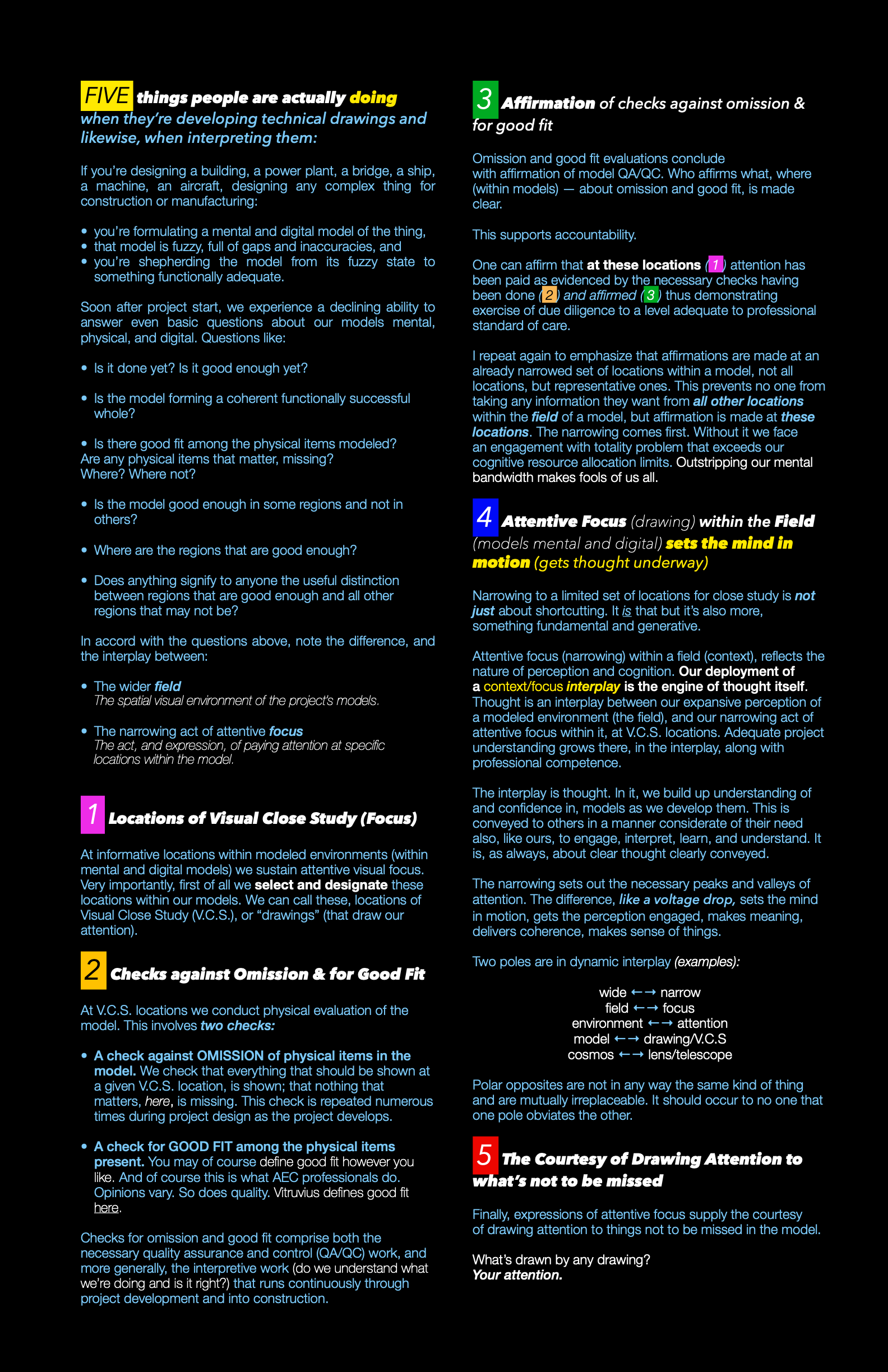
Drawing and modeling, as shown above on the black background, are connected in interplay. The interplay is the observable dynamic of thought. Understanding grows there, in the play.
Astronomical analogy
Telescopes are an astronomer’s lens for looking at the cosmos.
No astronomer has argued that the cosmos presents the imperative for abandoning telescopes.
The cosmos is precisely the reason _for_ telescopes.
And it is the interplay between what is seen through that lens, and the whole of the cosmos itself and our mental model of it, where thought happens and understanding grows.
No astronomer wants to lop off half the engine of thought.
On the contrary, astronomers always seek an ever improving lens, always better telescopes.
AEC should do the same:
https://tangerinefocus.com


