“The tool is not the problem.”
For 20 years the AEC software industry says the tool is not the problem.
Through its narratives, conferences, expert voices, special interest groups, blogs, advertising, white papers, to name a few of its communication channels, software lays blame elsewhere.
For 20 years now it’s:
- adversarial business relationships in AEC and
- an insufficient spirit of collaboration.
This heavily promoted narrative line ends up protesting:
- the basic nature of contract law itself.
What’s needed is a reimagining of contract law.
Contract law is the problem, not the tool.
No specifics are given.
The umbrella over this line, is cursory observation about AEC multi-party fragmentation.
And that’s it.
No further thought is developed. No steps for re-imagining contract law are given. Because, really, they can’t be; we can’t fundamentally alter the nature of contract law and a thousand years of precedent, because of “BIM”.
These narratives freely wander into the absurd without shame because they’re not serious in any way. They don’t even pretend to be serious. They’re just narratives doing a job, which is to obfuscate, divert, distract, and create starry-eyed dreams of another kind of industry in another kind of world governed by another kind of law populated by another kind of people operating in another kind of time.
And in that framing it’s perfectly clear; the tool is not the problem.
Interesting.
Other variants of the narrative for 20 years now, narrow down to the individual.
The individual is the problem. People are obstinate, stubborn, stuck in their ways, resistant to change; they lack the open mind able to envision a time and place where the tool is not the problem.
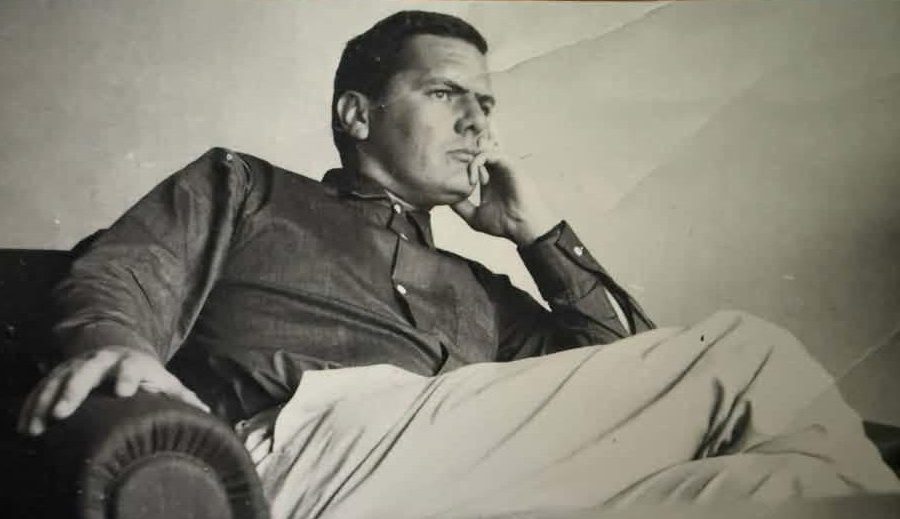
People who’ve worked in the industry doing AEC work for too long are stuck in their ways. Apparently nothing can convince them so we’ll just have to wait until they all retire. And then we’ll get on with building a future where the tool is not the problem.
We’re all the audience of these narratives.
I remember them already in 2004, 22 years now of AEC software as Queen Gertrude insisting she’s not the problem:
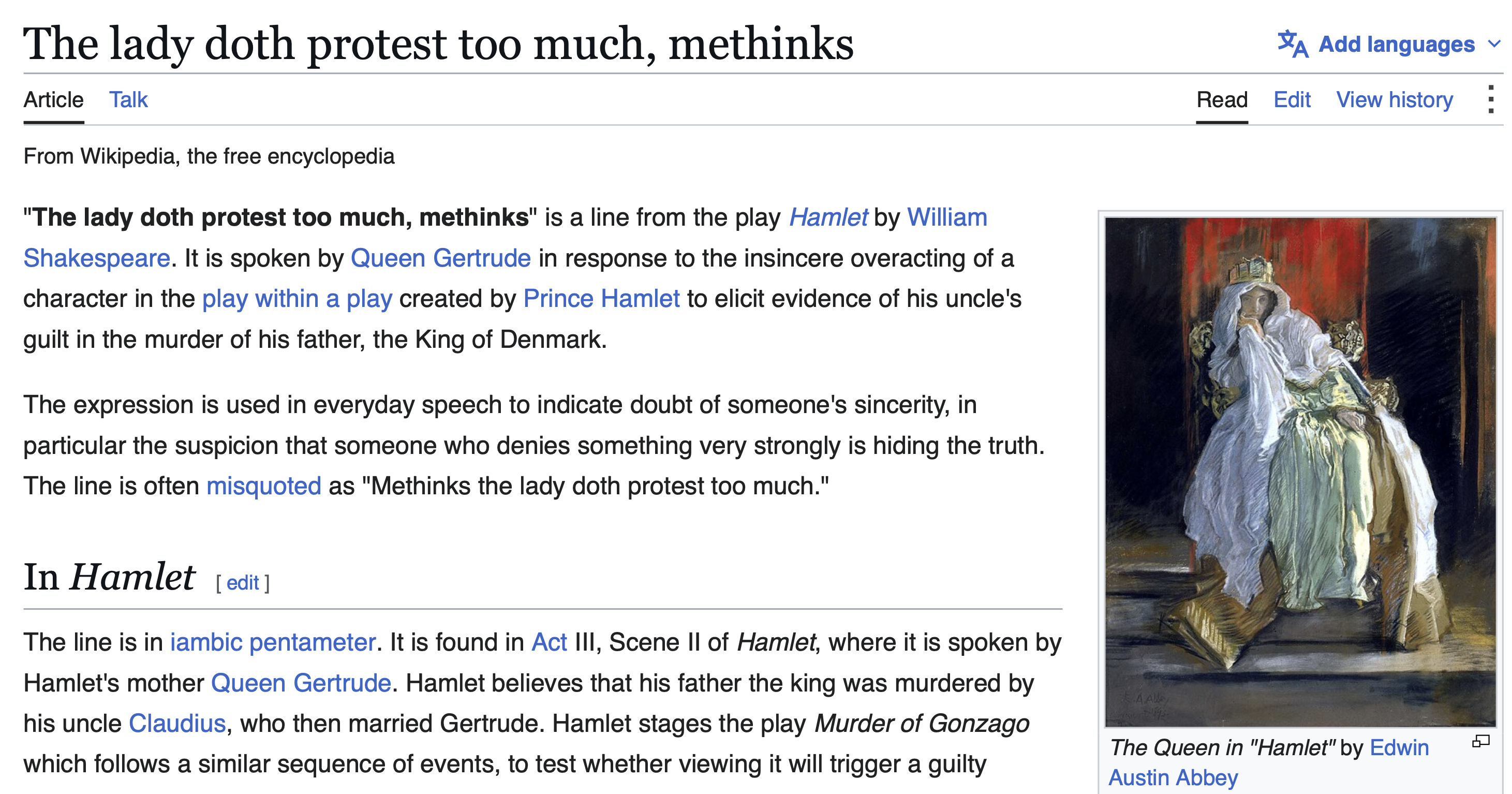
Can we carve out some space in this narrative domination for some counterargument?
The tool isn’t the problem?
Yes it is.
The tool is the problem.
the reason we’re still using drawings is that the current crop of BIM tools are totally inadequate at communicating information.
– Dominic Seah
If they were better than drawings we would use them.
The tool is an invasive obstacle to thought and understanding, an enormous distraction and brain drain from getting the job done. It comes with an ideology that supports doing everything imaginable other than the core non-optional essential work of AEC without interference, and without tools that won’t shut up and instead make everything about tools at the expense of the real and necessary work.
The job, the real and necessary work, what is that?
It’s described below on 1 page in two columns of cyan text on black background (scroll down).
But first let me say, there is core work, or primary, the primary work.
There is also secondary, and even tertiary work. All necessary. To simplify a bit, let’s focus on the primary work of AEC and call it the non-optional work.
Adjacent to and against non-optional core work, is ancillary work:
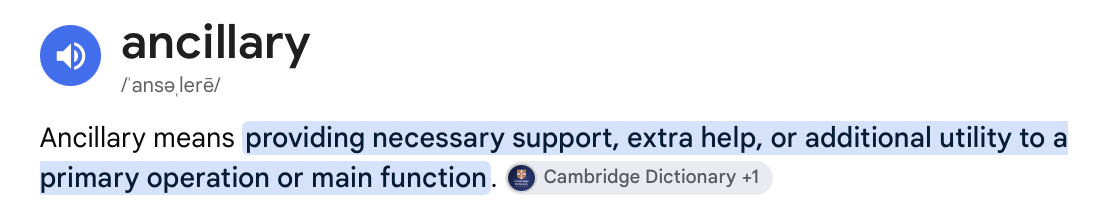
Would it be reasonable to expect that AEC software in development for 20, 30, 40 years, would claim for itself a role in service to core non-optional AEC work, at best? And if not, at least a role assisting ancillary work in support of core work?
This is what we all assume software does.
But apparently there’s a problem.
Maybe it doesn’t.
Doubts abound but are suppressed.
The suppression itself is cause for doubt. The software industry has spent more than 2 decades insisting it isn’t the problem, loosing arrows targeting you (us) as the problem, or law as the problem, or the basic observable dynamic of human perception and thought…
Yes, AEC software narratives target the mind as the problem.
“The tool is not the problem.”
This arrow loosed on us, in fact is a vector pointing back at AEC software.
Here is the core work of AEC, and yes, the vehicle of that work is the mind, the mental model, and a medium the purpose of which is sharpening of the mental model:
the medium of technical drawing:
This is what people are actually DOING when they develop and issue drawings, and what others are actually doing when they receive and interpret them:
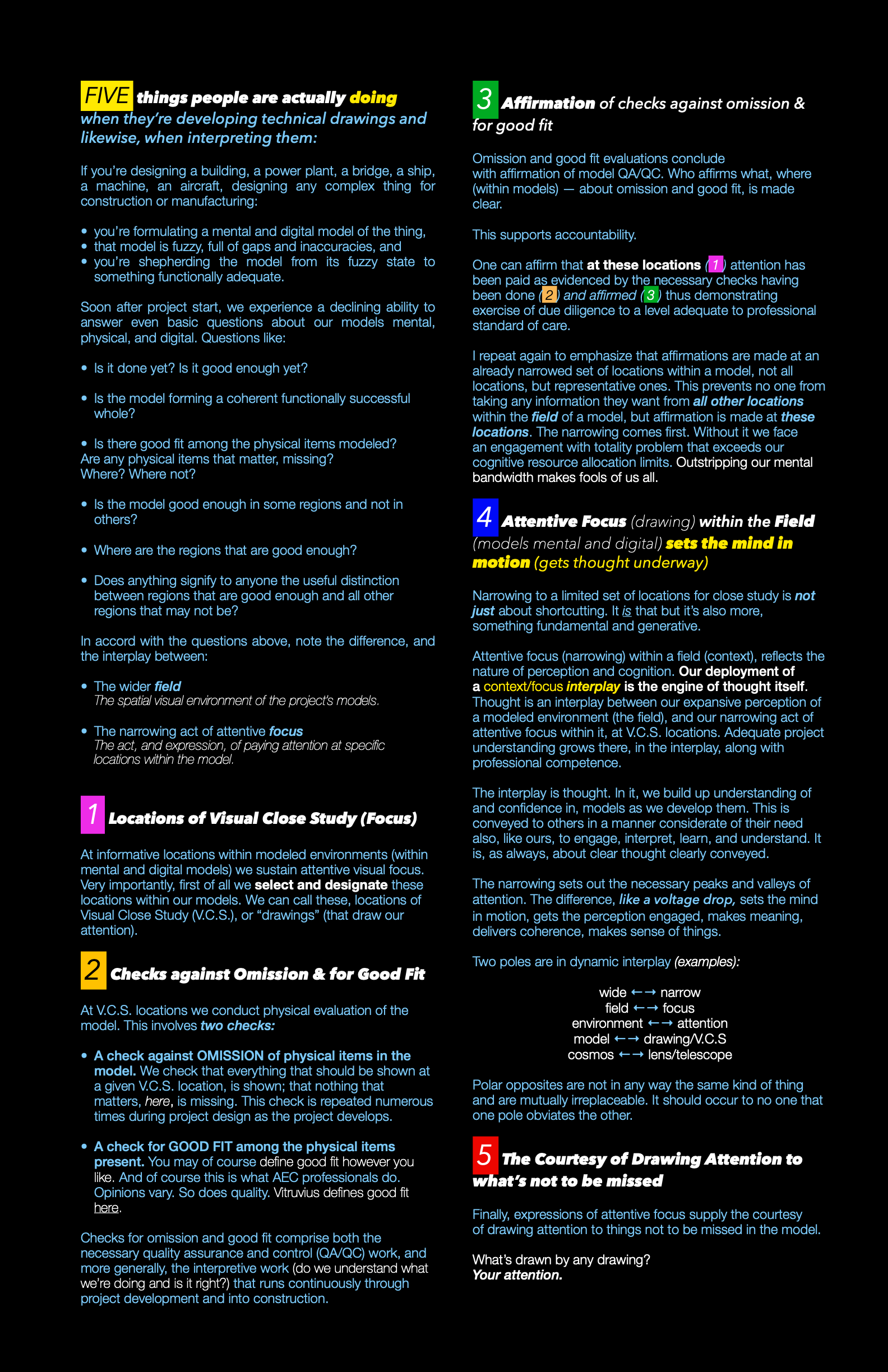
The cyan text above, on black background on 1 page in 2 columns, is a viable candidate description of the core non-optional work of AEC.
Let’s challenge that premise:
This (the cyan text on black background above) is what people are actually DOING when they develop and issue drawings, and what others are actually doing when they receive and interpret them.
That’s the premise. What’s described above (don’t skip reading it) is the core non-optional work of A, E, and to some extent, C, professions (builders have to think and understand before building).
This work is actualized through the medium of drawing. Importantly, drawing is always in interplay with models mental, physical, and digital.
There is apt analogy:
Astronomers’ telescopes are in interplay with the cosmos, and the latter cannot substitute for the former; the cosmos is no substitute for the lens for looking at it.
Notice from the 1 pager above, the analogy isn’t the whole story.
The lens for looking/evaluating overlaps Astronomy and AEC (Architecture, Engineering and Construction). Each field is distinct, its lens characteristically different, serving industry-unique purposes but in the same conceptual frame: a lens for looking at large complex things narrowly, but always within the context of a wider whole (as is true for basically everything).
Looking closely while “remaining within the context of a wider whole” is the operative concept.
The context is this: a model too vast to comprehend whole has to be perceived through a lens focused on representative locations.
At locations of visual close study (VCS), checks are performed against omission, and for coherence. These are high level cognitive functions that are consequential; buildings can’t fall down, can’t be ugly unintentionally, must be watertight, must not bleed excessive heat, foster mold, etc.
Checks against omission and for coherence are not only performed, they’re also affirmed, and conveyed, at VCS locations, by the drawing medium. The affirmations are location specific and representative (their validity is inferred at similar locations).
VCS evaluations are not conducted in the abstract. They are always envisioned within the context of the wider whole, of the environment of an AEC project’s model. This is true whether the project’s models are mental models only, or mental and physical, or mental and digital.
The interplay between what’s shown at locations of visual close study (VCS) and the wider whole of the environment of the model (mental and digital) is “the mind in motion”, as it is in EVERY field of study.
One never studies an entire field in totality.
One surveys the field (in overview, which is always a bit fuzzy) and deep dives into areas of interest.
The wide or whole (model) and the narrow or focus (drawing) inform each other. The interplay is thought itself. Understanding grows there in the play.
Lastly, the medium of drawing simply provides the courtesy of drawing attention to what is not to be missed. What’s drawn by every drawing? Your attention.
Now if these checks, affirmations, courtesies and thought in motion would be focused not at VCS locations but instead “focused everywhere” —an oxymoron; focus everywhere is the opposite of focus; it’s the lack of focus— but for the sake of argument let’s suppose it, then AEC cognitive work is an exercise in modeling totality, modeling everything everywhere.
I did this myself in the 90s. It is counterproductive. It increases the workload by factors of 10. It also interferes with the observable dynamic of thought and understanding
which is tuned to a certain frequency of visual close study at significant locations within a model mental and digital, in interplay with the mental model of the whole that is always in formation, sharpened by the act of VCS at an optimal pace.
If we increase the frequency and pace to the point of intention to model total detail everywhere, then the first thing we find is we’re in a swamp pulling us down into never ending modeling. There we also find we quickly lose our bearings on what to focus on, we lose track of what’s good enough where and what isn’t. Our thought process degrades, understanding and confidence decline, and if we allow it, self deception and delusion mask the inadequacy. Quality sharply declines while work load increases.
But then let’s say generative AI takes over and builds models in totality, perfectly, in seconds.
Then how do we inspect, verify, understand, sign off on, and act according to (build) such models?
Well the answer is: the same way we always have, the only way we can: via visual close study (VCS) at significant representative locations through which, in interplay with a formative mental model, the latter is sharpened and coherent enough that understanding and confidence reach the necessary threshold.
There’s only one way to get that:
By looking at it, inspecting it, reviewing it, thinking about and understanding it.
So, we need the same tool as always, the vehicle and medium for the act and expression of looking carefully, intentfully, systematically, and showing that we did.
OK, but then someone says:
“but what if robots build it, and 3D printers?”
The answer is the same again. If robots and 3D printers will build it, then as always we have to be confident that the model is right and good enough. And we will resort again to the same method of VCS in interplay with our mental model in formation.
No digital model ever meant anything to anyone without an adequate mental model in formation.
And it’s put into formation via systematic visual close study. And then, of course for the robots the g-code has to be written to explain to the robots what to do.
G-code is drawing for robots.
Drawings are for humans.
Like telescopes are for (human) astronomers.
The Role of AI:
AI can automate the location of VCS rigs in models, some or all of the modeled components that are visible at VCS rigs, some or all of the embellishing graphics. It can even to some extent evaluate what’s there. But there’s a big difference between automating drawings (or models) and evaluating them. The actual looking, and thinking are the purpose of drawings. Their creation, “printing,” and sharing are not their purpose. The purpose is on the 1 pager.
Who talks about this?
Nobody.
Tech-oriented people in AEC tend to forget this or never learned it.
Project-focused people just do the work and usually don’t metacognate about it:
I said this is a counter narrative or counterargument.
It applies to this variant question too:
Why are we still stuck with 5000 year old drawing?
To answer a question like that requires first asking, and answering, a different kind of question:
What is drawing?
I mean, right?
If you really do, want to know why you’re still stuck with something after 5000 years, the first step in thought is to begin with asking what that thing IS, that I’m stuck with.
Now you have the answer.
That answer only tells you the function, the purpose, of the thing we’re stuck with, and why.
It says nothing though, and neither implies anything, about the form of expression of the medium of drawing.
Nothing, in fact, suggests that drawing’s form of expression must remain static for thousands of years, nor that its form will, or even ought to, remain unaltered, even as modeling transformed over the last 40 years from mental modeling only, to mental and digital modeling.
About evolution in drawing’s form of expression, see: https://tangerinefocus.com


