What if AEC software companies have no idea what they’re dealing with?
Imagine that.
We don’t imagine that leaders of things (of companies for example) don’t know what they’re doing. It doesn’t occur to us that this could be the case. It’s not that we reject that it’s the case, or could be. The situation in our mind precedes that. We remain unaware of the question or possibility. So we never ask. The question is off our radar. We don’t interrogate it at all.
Concomitantly we automatically believe anything AEC software companies tell us. The reason for this is we assume (it’s not even assumption; it’s before assumption), we believe, without realizing we hold a belief, that they must understand what they’re talking about; they must be good if not great, at figuring out what to develop, and it must be so, that the applications they produce must demonstrate not only the state of the art as it is, but the best of all states, of the art, that could have been, or even could possibly be.
The apps we have, that do the things they do, are as good as having and doing could possibly be.
– so it is said
The belief isn’t universally held of course, otherwise we’d not have the plethora of complementary apps appearing all the time as we do, filling one gap or another, or extending things one small increment at a time very slowly.
But, the belief underlies the state of things that makes the state of things the state of things.
I put a laughing emoji here
🤣
…because maybe it’s OK, right? Maybe no harm is done by looking back over 30 years and asserting (maybe, right)?:
…maybe ideas embraced decades ago, ideas that shaped things into what they are today, maybe those ideas were not really ideas; maybe they were just a slogan or two accepted without examination or interrogation of any kind at all.
The state of things today is the consequence of precisely that.
What if that were true?
Maybe the state of things would be very different today if slogans had been examined long ago.
Or will be different in the future if examined today. And why not?
Go back to an earlier time. The 1980s were not that long ago. And computers and software were not on every desk. Architects and engineers still drew by hand with pencil on paper (and modeled via mental exercise).
What do we remember about the pencil companies though?
They made fine pencils. They advertised. They stayed in their lane and did a good job making a good product at a good price. You could select a good set, and have your preference.
What they didn’t do was:
make self-glorifying claims about pencils revolutionizing everything.
they’d have been laughed at, rightly so and thought insane.
suggest that pencil companies harbor deep insight into the nature of AEC architecture and engineering and are qualified to opine on the alteration of AEC’s core workflows.
prescribe structural change in AEC workflow.
claim to be qualified to impinge on AEC work and workflow.
while doing all of the above, demonstrate for decades:
the absence of any actual insight into AEC business (not AEC pencil business, AEC business itself)
absence of any apparent interest in actually understanding AEC, despite claims that of course understanding customers is their intention and operational philosophy
volumes could be written about why these intentions, “philosophies”, and practices inevitably (or relentlessly) achieve only reinforcement of the software company’s interests and continued blindness to what tool users actually do (other than “use the tool”!).
absence of qualitative or quantitative improvement in AEC business attributable to following these prescriptions
charge an excessive and ever-increasing share of AEC firm revenue for pencils, and “free” advice about AEC business from pencil companies.
make a product that’s counterproductive if used as directed.
I’ve asserted, and have been working in software companies to address, since 2007that AEC software companies do not know what drawings are. (It only just occurred to me the other day that they don’t know what models are either.)
Give or take a few years, AEC software companies did and said::
1983: software apps, for drawing lines, arcs, shapes, text…
1998: new features include the 4th iteration of a line trimming tool
2002: “drawings are just dumb lines and arcs“; it’s Building Information Modeling (BIM) now!
2010: It’s time for “Moving Beyond Geometry”; It’s the “I” in BIM (data, “information”)
2026: “It’s the AI show now. Not the I, theAI“
After 20 years pointing at this blindspot and ways to move our vision back into this blind area, it just occurred to me the other day finally that the blindspot is twice as large as I’d thought it was.
We’re dealing with total blindness. It’s all dark. The entire field is blacked out:
AEC software companies do not know what drawings are.
AEC software companies do not know what models are.
The state of the art that gives us the best of all possible states that can be, is given to us by software companies that have no idea…, neither what drawings are, nor what models are.
Nor do they have any interest whatsoever in asking what they are, let alone:
thinking about or proposing answers
to test against reality
in order to get better answers
in order to form substantive ideas, real ideas
about what models are and drawings are
in order to drive software development…
There are some in the margins that do this, yes. But they are not representative. This is not what the AEC software industry does in general.
And there is a very good argument to be made that the AEC software industry has the worst product-market fit among all other software sectors. Take web development for example. It’s a pretty good fit. The tools are, adequate.
AEC tech generally fits pretty poorly with what the industry does and needs. And, actually it’s pretty easy to figure out why:
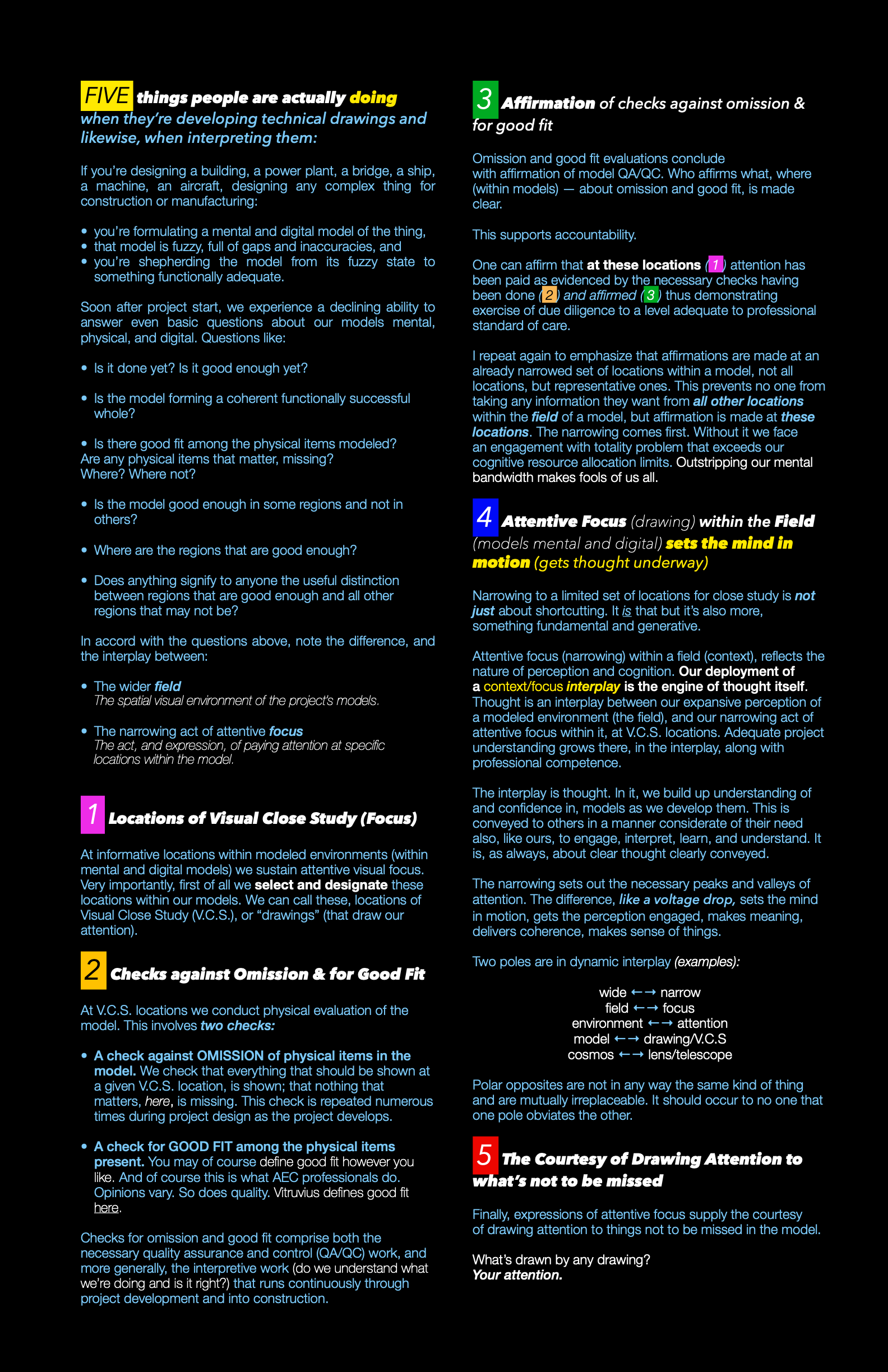
The AEC problem space involves extreme complexity that overwhelms the ordinary capacity of our perceptual equipment.
To deal with extreme complexity, AEC relies on specialized equipment that assists specifically and directly with both perception and cognitive load and processing. I have written about this here and here.
Now software enters the scene… From stage left, or out of left field so to speak (out of nowhere, arriving from nowhere relevant).
The infinite monkey theorem states that a monkey hitting keys independently and at random on a typewriter keyboard for an infinite amount of time will almost surely type any given text, including the complete works of William Shakespeare.[a] More precisely, under the assumption of independence and randomness of each keystroke, the monkey would almost surely type every possible finite text an infinite number of times. The theorem can be generalized to state that any infinite sequence of independent events whose probabilities are uniformly bounded below by a positive number will almost surely have infinitely many occurrences.
In this context, “almost surely” is a mathematical term meaning the event happens with probability 1, and the “monkey” is not an actual monkey, but a metaphor for an abstract device that produces an endless random sequence of letters and symbols. Variants of the theorem include multiple and even infinitely many independent typists, and the target text varies between an entire library and a single sentence.
Alright, so they just haven’t had infinite time yet…
If you take offense at that… ahem, careful now… And it’s not so bad; see here. But if you’re willing to self criticize, consider the definitions of drawing and model below, and then account for what the industry gave us so far:
1983: software apps for drawing lines, arcs, shapes, text…
1998: new features include the 4th iteration of a line trimming tool
2002: “drawings are just dumb lines and arcs“; it’s Building Information Modeling (BIM) now!
2010: It’s time for “Moving Beyond Geometry”; It’s the “I” in BIM (data, “information”)
Underutilization of models must be solved by software that increases model utility.
Software must re-orient itself to support use of models for what they’re best suited:
being the environment within which architects, engineers, and builders visualize.
Specifically, the model must be the place where AEC professionals activate and express that particular kind of lookingthatnot only just happens to bethe AEC industry’s most heavily invested form ofVISUALIZATION(though it is usually not thought of as such): the set of drawings embodying the act of looking with specific intent at models.
And, by the way, the form of this equipment for lookingwill evolve, when that happens.
By the way, at no time past or present has anyone advocated or achieved mental model perfection.
Notice that mental model perfection is not obtainable, not with the perceptual equipment and brains that we have, and more importantly, not necessary. And having it, if it could be had, would contribute nothing to effective project development and completion.
Likewise, it would very likely be counterproductive as the congnitive resource consumption would be very high and would divert cognition away from the essential activity that is the basic observable dynamic of thought as it actually works, doing what it actually does, as outlined here.
The same of course is demonstrably true of digital model perfection.
The hardness scale of graphite leads (HB, H, F) was introduced in around 1790 in Germany.
Pentel introduced a mechanical plastic lead in the early 1960s but it really didn’t become the standard until really around 1980 with a lot of marketing.
So it took almost 200 years for pencils to change.
CAD was really introduced to the masses in the late ’80s and I can argue into the early ’90s.
Pencil drafting was still around until about 1997. 1998 with sketching still going on but CAD took over as the primary in about 10 years
Intelligent modeling has been around for a long time but really didn’t take hold and till probably the 2010s.
But they’re still all going for the same thing… A drawing.
That’s a great segue to clarity:
Pencils as they evolved a bit, never aimed at changing fundamental underlying conditions of perception and thought.
Neither did CAD.
It’s the digital modeling discourse that threw a monkey wrench into everything with its extraordinary claims made thoughtlessly and without evidence (since they never really thought about it, they never devised any experiments, conveniently because those would have failed and undermined their narrative).
We have the perceptual and cognitive equipment that we have (eyes and other senses, our minds, memory, the processes of thought itself…). I describe it here: Looking with Intent and Showing that you Did
Maybe in a hundred million years this will change in some meaningful way but probably not.
We need software now, not software for a likely-not-to-happen hypothetical future in a hundred million years when humans are something else fundamentally different than we are now.
Both pencil and CAD drawing are premised on “looking at” mental models.
Digital modeling discourse pretends that:
there was no model before the digital model (mental model is never mentioned1).
and the lens for looking at the digital model should either be abandoned altogether (get rid of drawings “because models”) or (this is never thought about at all): left in precisely the same form of expression it embodied when models were mental and physical only (before digital).
Digital modeling discourse also pretends that it isn’t obviously true that no digital model ever meant anything to anyone without an adequate mental model in formation, and how that is achieved (via study through an adequate lens for looking at it).
this really is the root source of the error and its consequences. This is category error: the digital modeling discourse puts the digital model in comparison against drawing (as if model = drawing 2.0). That’s a fundamental mismatch. The digital model needs to be put into comparison against other models (mental model, physical model).
Hi! My name is Rob Snyder, I’m on a mission to elevate digital models in AEC (architecture, engineering, and construction) by developing equipment for visual close study (VCS) within them, so that they supply an adequate assist to the engine of thought we all have running as we develop models during design and as we interpret them so they can be put to use in support of necessary action, during construction for example.



 TANGERINE FOCUS